Every Bali term in the guides, in plain English — so you never have to feel lost. On the guides these words are underlined; tap one for a quick definition without leaving the page.
- Acintya
- 'The Unthinkable' — the supreme formless absolute of Balinese Hinduism, represented only by an empty throne. Acintya, is a theological and symbolic concept in Indonesian Hinduism that expresses the ineffable nature a supreme divine principle in Indonesian Hindu theology. Acintya is conceptual and iconographic representation of the ultimate reality that lies beyond thought, form, and direct worship. Read more on Wikipedia ↗
- Agama Hindu Dharma
- The formal name of Balinese Hinduism — a distinct island religion braiding Shaivite Hindu, Buddhist and indigenous strands, state-recognised in the 1960s. Balinese Hinduism is a distinct form of Hinduism practised primarily on the island of Bali, Indonesia. It developed through a long process of religious syncretism, combining indigenous Balinese beliefs with Hindu traditions that spread through the Indonesian archipelago from the early centuries CE. Rather than representing a direct continuation of Indian Hinduism, Balinese Hinduism constitutes a locally evolved religious system shaped by ritual practice, communal organisation, and sacred geography. Read more on Wikipedia ↗
- Aksara Bali
- The traditional Balinese script, a Brahmic abugida in which each consonant carries a built-in vowel modified by marks. Still seen on signs and inscriptions; everyday writing now mostly uses Latin letters. The Balinese script, also known as hanacaraka, is an abugida used in the island of Bali, Indonesia, commonly for writing the Austronesian Balinese language, Old Javanese, Malay and the liturgical language Sanskrit. With some modifications, the script is also used to write the Sasak language, used in the neighboring island of Lombok. In the present day it is also sometimes used to write the national language Indonesian. Read more on Wikipedia ↗
- Andaman Sea
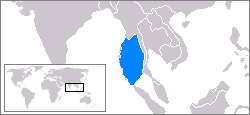
- The arm of the Indian Ocean on Langkawi's west side — warmer, calmer sunsets than the name suggests, and the reason the beaches face west into the light. The Andaman Sea is a marginal sea of the northeastern Indian Ocean bounded by the coastlines of Myanmar and Thailand along the Gulf of Martaban and the west side of the Malay Peninsula, and separated from the Bay of Bengal to its west by the Andaman Islands and the Nicobar Islands. Its southern end is at Breueh Island just north of Sumatra, with the Strait of Malacca further southeast. Read more on Wikipedia ↗
- arak
- Balinese rice/palm liquor. Legitimate arak is a local staple, but illegally methanol-adulterated batches have poisoned tourists — only drink it from reputable bars, never unlabelled bottles. Arrack is a distilled alcoholic drink typically produced in India, Sri Lanka, and Southeast Asia, made from the fermented sap of coconut flowers or sugarcane, and also with grain or fruit depending upon the country of origin. It is sometimes spelled arak, or simply referred to as 'rack or 'rak. In many parts of India, arrack is colloquially known as "desi daru". Read more on Wikipedia ↗
- babi guling
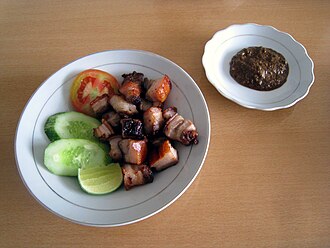
- Balinese spit-roast suckling pig, rubbed with the base genep spice paste — the island's most famous feast dish, served with crackling, blood sausage and rice. Babi panggang refers to various Indonesian grilled pork dishes, 'babi' meaning pig or pork, and 'panggang' meaning grilled or roasted in the Indonesian language. Read more on Wikipedia ↗
- Bahasa Indonesia
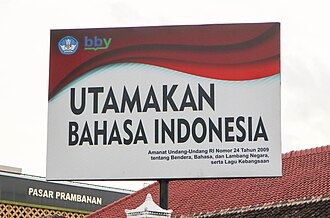
- Indonesian: the national language, a standardised form of Malay adopted as a neutral common tongue so no single ethnic group's language would dominate. The language of school, government and media across the country. Indonesian is the official and national language of Indonesia. It is a standardized variety of Malay, an Austronesian language that has been used as a lingua franca in the multilingual Indonesian archipelago for centuries. With over 280 million inhabitants, Indonesia ranks as the fourth-most populous nation globally. According to the 2020 census, over 97% of Indonesians are fluent in Indonesian, making it the largest language by number of speakers in Southeast Asia and one of the most widely spoken languages in the world. Read more on Wikipedia ↗
- banjar
- The tight-knit neighbourhood association every Balinese belongs to — a community council that runs ceremonies, mutual aid and local life, and holds real social authority.
- baris
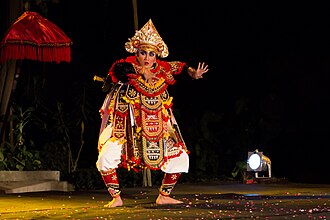
- A traditional Balinese warrior dance, originally a temple offering, showing a young soldier's courage and shifting emotions through sharp, martial movements. Baris dance is a family of traditional war dances in Bali, Indonesia, accompanied by gamelan, in which dancers depict the feelings of a young warrior prior to battle, glorify the manhood of the triumphant Balinese warrior, and display the sublimity of his commanding presence. Baris derives its name from the word bebarisan, which literally means "line" or "file formation", referring to the soldiers who served the ancient rajas of Bali. Read more on Wikipedia ↗
- Barong
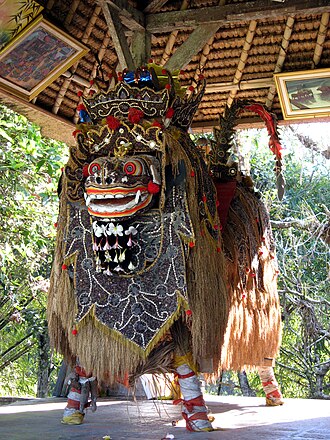
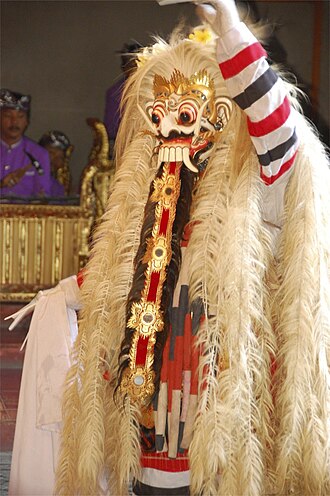
- The benevolent lion-like guardian creature of Balinese myth. In the Barong dance he battles the witch Rangda — an eternal, unresolved duel of order and chaos. Barong is a panther-like creature and character in the Balinese culture of Bali, Indonesia. He is the king of the spirits, leader of the hosts of good, and enemy of Rangda, the demon queen and mother of all spirit guarders in the mythological traditions of Bali. The battle between Barong and Rangda is featured in the Barong dance to represent the eternal battle between good and evil. Read more on Wikipedia ↗
- Basa Bali
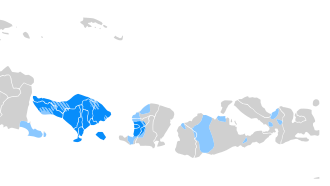
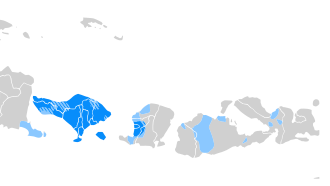
- The Balinese language: the native Austronesian mother tongue of the Balinese, spoken at home, in the village and at the temple. A separate language from Indonesian, not a dialect of it. Balinese is an Austronesian language spoken primarily by the Balinese people on the Indonesian island of Bali, as well as Nusa Penida, Western Lombok, and Eastern Java, and also spread to Southern Sumatra, and Sulawesi. Most Balinese speakers also use Indonesian. The 2000 national census recorded 3.3 million people speakers of Balinese with only 1 million people still using the Balinese language in their daily lives according to the Bali Cultural Agency estimated in 2011. Read more on Wikipedia ↗
- base genep
- The 'complete spice' paste at the heart of Balinese cooking — a pounded blend of shallots, garlic, chilli, turmeric, ginger, galangal, candlenut and more.
- betutu
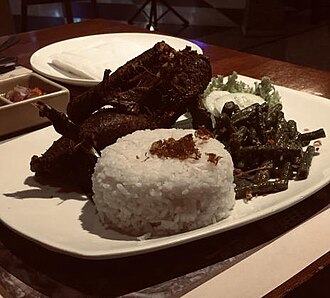
- Duck or chicken (bebek/ayam betutu) rubbed in spice paste, wrapped in leaves and slow-cooked for hours until falling apart — a Balinese ceremonial specialty. Betutu is a Balinese dish of steamed or roasted chicken or duck in rich bumbu betutu. This highly seasoned and spiced dish is a popular dish in Bali and Lombok, Indonesia. An even spicier version is available using extra-spicy sauce made from uncooked (raw) onion slices mixed with red chili peppers and coconut oil. Read more on Wikipedia ↗
- Bhoma
- The grotesque carved face set above a Balinese temple gate. Not a demon — a protective earth-spirit that filters out ill intent and admits pure intentions.
- biawak
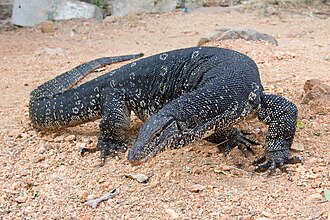
- Malay for the water monitor lizard — a metre-plus reptile that swims the Kilim mangrove channels and basks on the banks. Harmless if left alone, and a highlight of any boat tour. The Asian water monitor is a large varanid lizard native to South and Southeast Asia. It is widely considered to be the second-largest lizard species, after the Komodo dragon. It is distributed from eastern and northeastern India and Bangladesh, the Andaman and Nicobar Islands, Sri Lanka, through southern China and Hainan Island in the east to Mainland Southeast Asia and the islands of Sumatra, Borneo, Java, Lombok, the Riau Archipelago, and Sulawesi. It is one of the most widespread monitor lizards. Read more on Wikipedia ↗
- canang sari
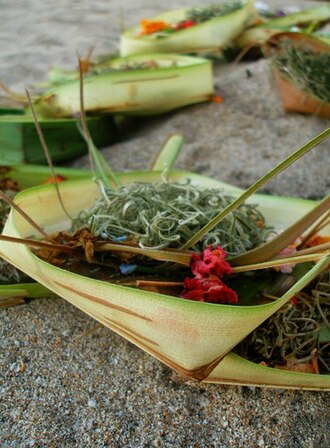
- The small daily offering you'll see everywhere in Bali: a woven palm-leaf tray of flowers, rice and incense, placed each morning as a gesture of gratitude. Canang sari is one of the daily offerings made by Balinese to thank the nine guardian deities - Dewata Nawa Sanga - in praise and prayer. Canang sari will be seen in the Balinese temples (pura), on small shrines in houses, and on the ground or as a part of a larger offering. Read more on Wikipedia ↗
- candi bentar
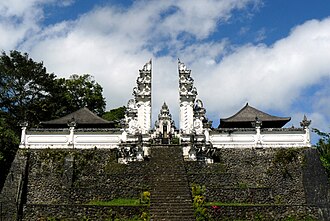
- A 'split gate' — a stone temple gateway cleanly divided into two mirror-image halves, marking the threshold into sacred ground. Candi bentar, or split gateway, is a classical Javanese and Balinese gateway entrance commonly found at the entrance of religious compounds, palaces, or cemeteries in Indonesia. It is a candi-like structure split perfectly in two to create a passage in the center for people to walk through. In contrast to the very ornate shape and decoration of the main faces, the sides of the passage are left completely plain. The passage is usually elevated with a flight of stairs to reach it. A candi bentar is commonly found in Java, Bali, and Lombok. Read more on Wikipedia ↗
- cuntaka
- Ritual impurity in Balinese Hinduism — triggered equally by blood, birth and death. It's why menstruating women, the recently bereaved, and people with open wounds stay out of temple inner areas.
- Dang Hyang Nirartha
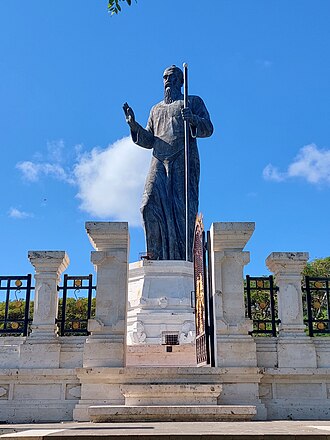
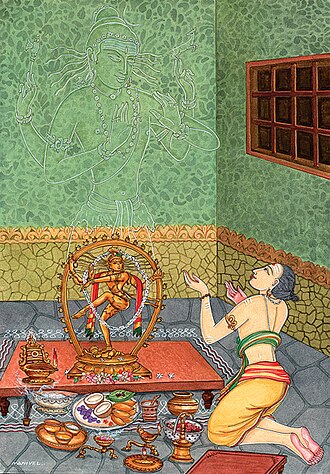
- A hugely influential travelling priest of the 1530s, credited by tradition with shaping Balinese Hinduism and founding several of its sea temples. Dang Hyang Nirartha, also known by various names such as Ida Pedanda Sakti Wawu Rauh, Mpu Nirartha, and Dang Hyang Dwijendra, was known as Prince Sangupati in Lombok and Tuan Guru Semeru in Sumbawa. He was a Hindu priest of the Shaiva sect who was born in Java during the final period of the Majapahit Kingdom and spent most of his life, until his death, in Bali. In Bali, he was appointed as Bagawanta or royal priest in the Gelgel Kingdom. In the manuscript Paniti Gama Tirta Pawitra, he is also depicted as Sang Atungga Dharma or a wandering sage who spread the teachings of dharma. Read more on Wikipedia ↗
- Dewi Danu
- The goddess of the crater lakes and irrigation water, worshipped at the lake temple Ulun Danu Beratan — the divine source that feeds the subak system.
- Dewi Sri
- The Balinese-Javanese rice goddess of fertility and prosperity — honoured with small shrines and offerings in the paddies at every stage of the growing cycle. Dewi Sri or Shridevi is the Javanese, Sundanese, and Balinese Hindu Goddess of rice and fertility, still widely worshiped on the islands of Java, Bali and Lombok, Indonesia. She is often associated or equated with the Hindu goddess Lakshmi, the shakti (consort) of Vishnu. Read more on Wikipedia ↗
- ETS
- Electric Train Service — the fast intercity trains run by KTMB down the peninsula's west coast (Padang Besar–Butterworth–KL–Gemas and on), the comfortable land alternative to flying or the bus. The KTM ETS, commercially known as ETS, is an inter-city higher-speed rail service in Malaysia operated by Keretapi Tanah Melayu (KTM). It was introduced as the operator's second electrified train service after KTM Komuter, and represents Malaysia's second inter-city rail system after KTM Intercity. Read more on Wikipedia ↗
- Galungan
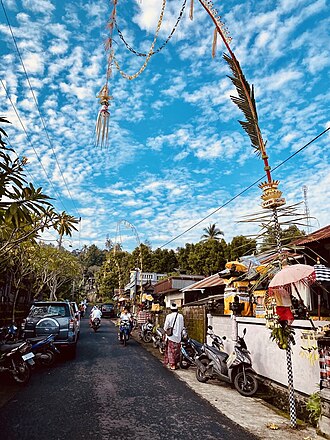
- The Balinese festival marking the victory of dharma (order) over adharma (chaos), when ancestral spirits return; the island fills with tall, curved penjor poles. Galungan is a Balinese Hindu holiday celebrating the victory of dharma over adharma. It marks the time when the ancestral spirits visit the Earth. The last day of the celebration is Kuningan, when they return. The date is calculated according to the 210-day Balinese Pawukon calendar. Read more on Wikipedia ↗
- gamelan
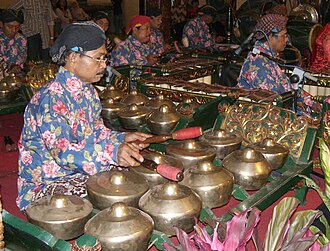
- The percussion orchestra of Bali and Java — bronze gongs, metallophones and drums, tuned in interlocking pairs so two players share one melody. Gamelan is the traditional ensemble music of the Javanese, Sundanese, and Balinese peoples of Indonesia, made up predominantly of percussive instruments. The most common instruments used are metallophones and a set of hand-drums called kendang, which keep the beat. The kemanak, a banana-shaped idiophone, and the gangsa, another metallophone, are also commonly used gamelan instruments on Bali. Other notable instruments include xylophones, bamboo flutes, a bowed string instrument called a rebab, and a zither-like instrument called a siter, used in Javanese gamelan. Read more on Wikipedia ↗
- geopark
- A landscape with rock formations of global geological importance, protected and interpreted for visitors. Langkawi was the first place in Southeast Asia to get UNESCO Global Geopark status, in 2007. UNESCO Global Geoparks (UGGp) are geoparks certified by the UNESCO Global Geoparks Council as meeting all the requirements for belonging to the Global Geoparks Network (GGN). The GGN is both a network of geoparks and the agency of the United Nations Educational, Scientific and Cultural Organization (UNESCO) that administers the network. Read more on Wikipedia ↗
- gorgonian
- A sea fan — a large, tree-like soft coral that grows in fans and whips on current-swept reef walls. The big ones are a highlight of Bali's best dive sites. Alcyonacea, in English soft corals or alcyonacians, is a former order of Octocorallia. Since a 2022 revision of Octocorallia, the content of Alcyonacea has been included in the order Malacalcyonacea and, to a lesser extent, in the order Scleralcyonacea, these two new orders now making up the order Octocorallia. Read more on Wikipedia ↗
- Grab
- Southeast Asia's dominant ride-hailing (and food-delivery) app — the everyday way to get a metered, cash-or-card car in Malaysian cities. Coverage thins out in rural areas and on the islands. Grab Holdings Inc. is a Singaporean multinational technology company headquartered in one-north, Singapore. It is the developer of a super-app for ride-hailing, food delivery, and digital payment services on mobile devices. It operates in Singapore, Malaysia, Cambodia, Indonesia, Myanmar, the Philippines, Thailand, and Vietnam. Read more on Wikipedia ↗
- halal
- Food permitted under Islamic law — no pork, no alcohol, and meat slaughtered to ritual. Most eateries in Muslim-majority Malaysia are halal; Chinese and some other restaurants are not, and usually say so. Halal is an Arabic word that translates to 'permissible' in English. Although the term halal is often associated with Islamic dietary laws, particularly meat that is slaughtered according to Islamic guidelines, it also governs ethical practices in business, finance, and daily living. It encompasses broader ethical considerations, including fairness, social justice, and the treatment of animals. The concept of halal is central to Islamic practices and is derived from the Quran and the Sunnah. Read more on Wikipedia ↗
- Hari Raya
- Hari Raya Aidilfitri — the two-day festival ending Ramadan, and Malaysia's biggest holiday. Cities empty as people travel home (balik kampung), and many shops and small eateries close for a week or more. Eid al-Fitr is the first of the two main festivals in Islam, the other being Eid al-Adha. The holiday falls on the first day of Shawwal, the tenth month of the Islamic calendar. One of the most important Islamic celebrations, Eid al-Fitr is celebrated by Muslims worldwide as it marks the end of the month-long, dawn-to-dusk fasting (sawm) during Ramadan. The holiday is known under various other names in different languages and countries around the world. Read more on Wikipedia ↗
- haze
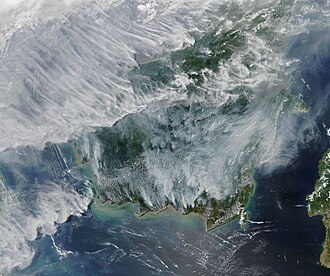
- The transboundary smoke haze that can settle over much of Peninsular Malaysia and Borneo in the dry months (roughly July–October) when regional land-clearing fires burn. Some years it's barely there; some years it grounds flights. The Southeast Asian haze is a fire-related recurrent transboundary air pollution issue. Haze events, where air quality reaches hazardous levels due to high concentrations of airborne particulate matter from burning biomass, have caused adverse health, environmental and economic impacts in several countries in Southeast Asia. Caused primarily by slash-and-burn land clearing, the problem flares up every dry season to varying degrees and generally is worst between July and October and during El Niño events. Read more on Wikipedia ↗
- helang
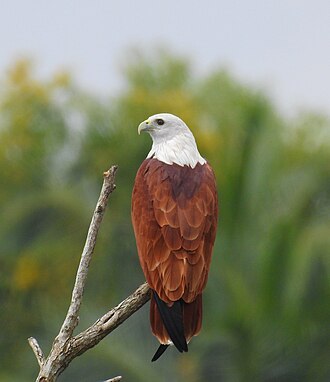
- Malay for 'eagle'. Langkawi's name is usually read as helang + kawi ('reddish-brown eagle') — the brahminy kite, the rust-red raptor with a white head you see over the mangroves. The brahminy kite, also known as the red-backed sea-eagle in India, is a medium-sized bird of prey in the family Accipitridae, which also includes many other diurnal raptors, such as eagles, buzzards, and harriers, found in the Indian subcontinent, Southeast Asia, and Australia. The brahminy kite is found mainly on the coast and in inland wetlands, where it feeds on dead fish and other prey. Adults have a reddish-brown body plumage contrasting with their white head and breast which make them easy to distinguish from other birds of prey. Read more on Wikipedia ↗
- Jalak Bali
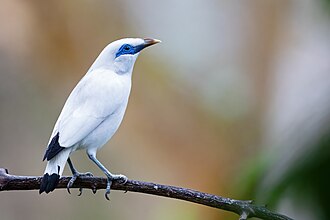
- The Bali starling (Leucopsar rothschildi) — a striking white bird with a blue eye-mask, the island's only endemic bird and one of the world's rarest, clinging on in West Bali National Park. The Bali myna, also known as Rothschild's mynah, Bali starling, or Bali mynah, locally known as jalak Bali, is a medium-sized, stocky myna native to northeast Bali in Indonesia. It is almost wholly white with a long, drooping crest, and black tips on the wings and tail. The bird has blue bare skin around the eyes, greyish legs and a brown and yellow bill. Both sexes are similar. It is critically endangered and in 2020, fewer than 50 adults were assumed to exist in the wild. Read more on Wikipedia ↗
- jukung
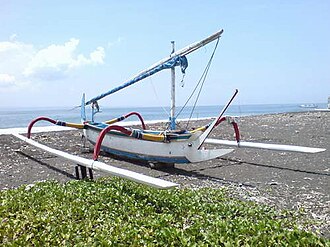
- A slender traditional Balinese outrigger canoe, often brightly painted, used for fishing and, on the east and north coasts, for taking snorkellers and dolphin-watchers out at dawn. A jukung or kano, also known as cadik is a small wooden Indonesian outrigger canoe. It is a traditional fishing boat, but newer uses include "Jukung Dives", using the boat as a vehicle for small groups of SCUBA divers. Read more on Wikipedia ↗
- kabupaten
- An Indonesian regency — the administrative district below the province. Bali is one province split into eight regencies plus the city of Denpasar, and they differ enormously in wealth: the tourist south is a world away from the farming east and north. A regency, sometimes incorrectly referred to as a district and previously known as second-level region, is an administrative division of Indonesia, directly under a province and on the same level with city (kota). Regencies are divided into districts. The average area of Indonesian regencies is about 4,578.29 km2 (1,767.69 sq mi), with an average population of 670,958 people. Most regencies on the island of Java has their regency capitals as the titular name of their regency. Read more on Wikipedia ↗
- kaja / kelod
- Bali's sacred axis: kaja points toward the mountains (pure, divine) and kelod toward the sea (powerful, dangerous). It orients temples and villages alike.
- kampung
- A Malay village or the traditional wooden-house rural settlement. Away from the beach strip, most of Langkawi is still kampung. A kampong is a type of village in Southeast Asia, particularly in Malaysia, Brunei, Indonesia, Philippines and Singapore. It is also used to refer to a 'dock' in Cambodia. The term applies to traditional villages, especially of the indigenous peoples living in this region. Read more on Wikipedia ↗
- karst
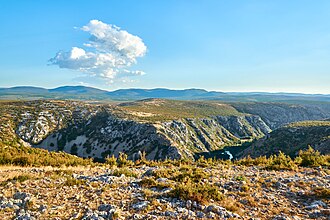
- The jagged limestone scenery — sheer grey cliffs, caves and sinkholes — dissolved out of ancient seabed over millions of years. It's what makes the Kilim mangroves and Dayang Bunting so dramatic. Karst is a topography formed from the dissolution of soluble carbonate rocks such as limestone and dolomite. It is characterized by features like poljes above and drainage systems with sinkholes and caves underground. There is some evidence that karst may occur in more weathering-resistant rocks such as quartzite given the right conditions. Read more on Wikipedia ↗
- Kedah dialect
- The strong northern Malay accent (loghat Kedah) spoken on Langkawi — clipped vowels, an '-aq' ending, and 'hang' for 'you'. Distinctive enough that other Malaysians tease it.
- kedai kopi
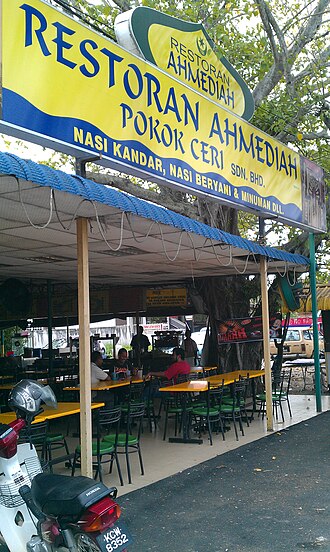
- A traditional coffee shop — an open-fronted, tiled café where several hawker stalls share the tables. Where locals eat breakfast and lunch cheaply; the backbone of a budget month on the island.
- kopi luwak
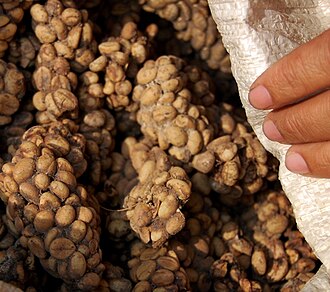
- Coffee made from beans eaten and excreted by the Asian palm civet, then cleaned and roasted. Marketed as a luxury, but most of what you're offered comes from caged, force-fed animals — a welfare problem, and by taste an overpriced novelty. Kopi luwak, also known as civet coffee, is a coffee that consists of partially digested coffee cherries, which have been eaten and defecated by the Asian palm civet. The cherries are fermented as they pass through a civet's intestines, and after being defecated with other fecal matter, they are collected. Read more on Wikipedia ↗
- kos
- A rented room — Indonesia's version of a bedsit or boarding-house room (often 'kos-kosan'). Rented by the month with fan or basic AC, it's the long-stay option locals and budget travellers use, far cheaper than a nightly hotel. A boarding house is a house in which lodgers rent one or more rooms on a nightly basis and sometimes for extended periods of weeks, months, or years. The common parts of the house are maintained, and some services, such as laundry and cleaning, may be supplied. It normally provides "room and board", with some meals as well as accommodation. Read more on Wikipedia ↗
- Kuah
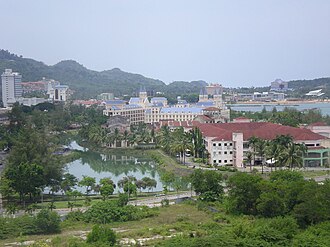
- Langkawi's main town and ferry gateway on the southeast coast — where the duty-free shops, the giant eagle statue and everyday island life are. Kuah is a resort town, mukim and district capital of Langkawi, Kedah, Malaysia. It is the entry point for those coming by ferry from either the mainland or Penang Island. The town is centered on its jetty, which is a point of arrival for tourists from the mainland. With a population of more than 30,000, Kuah has become a major town due to the growth of visitors after Langkawi developed into a tourist centre since 1986. Read more on Wikipedia ↗
- Kuningan
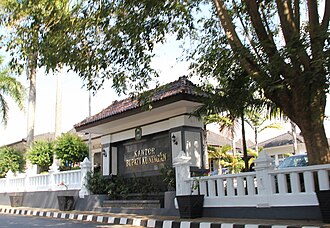
- The day, ten days after Galungan, when the visiting ancestral spirits return to heaven — marked with yellow-rice offerings. Kuningan is a town (kelurahan) and an administrative district (kecamatan) located in eastern West Java, Indonesia, between Cirebon and Tasikmalaya, about 200 km east of Jakarta. It is the administrative center of Kuningan Regency. The district is located east of Mount Cereme/Ciremai, the highest mountain in West Java. The eastern part of the district is a valley. The district's landmark is a statue of a horse, called Kuda Kuningan and its motto is Kuningan Aman (Safe) Sehat (Healthy) Rindang (Leafy) Indah (Beautiful), abbreviated as Kuningan ASRI. Read more on Wikipedia ↗
- lawar
- A Balinese mix of finely chopped vegetables, grated coconut, minced meat and rich spices; the ceremonial 'red lawar' is traditionally bound with a little fresh blood. Lawar is a town and a nagar panchayat in Meerut district in the Indian state of Uttar Pradesh. Read more on Wikipedia ↗
- legong
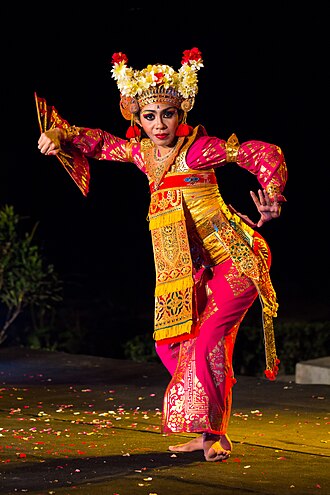
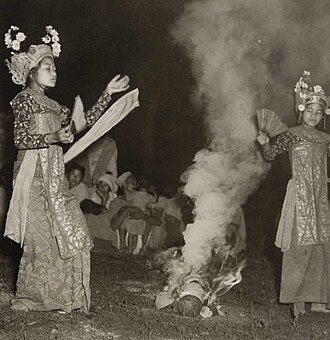
- A refined classical Balinese dance of intricate finger, foot and eye movements, traditionally performed by young girls; one of the most beautiful stage dances to see in Ubud. Legong is a form of Balinese dance. It is a refined dance form characterized by intricate finger movements, complicated footwork, and expressive gestures and facial expressions. Read more on Wikipedia ↗
- lontar
- A manuscript made of dried, treated palm leaves, its text incised with a blade and darkened with soot. The traditional medium for Balinese ritual, medical and literary knowledge.
- macaques
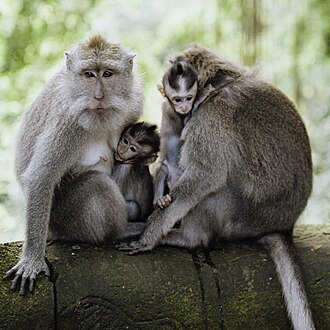
- The bold grey long-tailed monkeys around the cable car, Seven Wells and picnic spots. Clever and quick to raid an open bag — don't feed them (they can carry rabies) and keep bags zipped. Macaca fascicularis, variously known by common names such as crab-eating macaque, long-tailed macaque, or cynomolgus monkey, is a macaque species native to Southeast Asia. As a synanthropic species, the crab-eating macaque thrives near human settlements and in secondary forests. The crab-eating macaque has developed a variety of cultural perceptions, from being smart and adaptive, to being sacred, to even being pests in some cases. Read more on Wikipedia ↗
- Mahayana
- The 'Great Vehicle' — the branch of Buddhism widespread across East and Southeast Asia. Mahāyāna is the largest branch of Buddhism, followed by Theravada. It is a broad group of Buddhist traditions, texts, philosophies, and practices that developed in various regions and Buddhist communities of ancient India. Mahāyāna Buddhism accepts the main scriptures and teachings of early Buddhism but also recognizes various scriptures that are not accepted by Theravāda Buddhism as canonical. Mahāyāna scriptures like the Lotus Sutra and the Vajra-cutter Sutra emphasize the ideal of the bodhisattva, spiritual heroes who vow to attain buddhahood for the sake of saving all living beings. Read more on Wikipedia ↗
- Mahsuri
- The legendary maiden wrongly executed for adultery who, dying, cursed Langkawi with seven generations of bad luck. Her tomb near Ulu Melaka is a cultural site; the tale is woven into the island's identity. Mahsuri binti Pandak Mayah was a young woman who lived in Pulau Langkawi, an island in northwestern Kedah, Malaysia, during the late 18th century. According to folklore, she was accused of adultery and executed by stabbing. Her tomb, Makam Mahsuri, has become a tourist attraction on the island. Read more on Wikipedia ↗
- Majapahit
- The 13th–16th-century Javanese empire whose Hindu-Buddhist culture spread across the archipelago and deeply shaped Bali. Majapahit, also known as Wilwatikta, was a Javanese Hindu-Buddhist thalassocratic empire in Southeast Asia based on the island of Java. At its greatest extent, following significant military expansions, the territory of the empire and its tributary states covered almost the entire Nusantara archipelago, spanning both Asia and Oceania. After a civil war that weakened control over the vassal states, the empire slowly declined before collapsing in 1527 due to an invasion by the Sultanate of Demak. The fall of Majapahit saw the rise of Islamic kingdoms in Java. Read more on Wikipedia ↗
- mamak
- An Indian-Muslim eatery, usually open late or around the clock — cheap roti canai, teh tarik and a table to sit at for hours. A Malaysian social institution as much as a place to eat. Mamak stalls are indoor and open-air food establishments found in Southeast Asia, especially in Malaysia and Singapore, that typically serve food derived from Tamil Muslim cuisine, often combined with culinary elements unique to maritime Southeast Asia. Read more on Wikipedia ↗
- mangroves
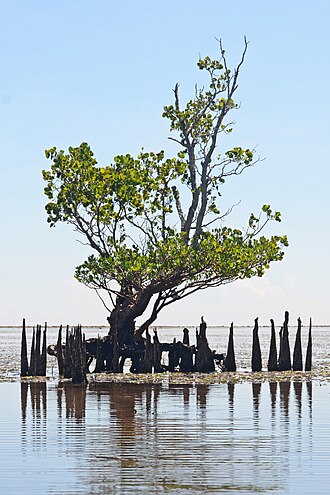
- Salt-tolerant trees that grow with their roots in tidal water, forming the flooded forest you cruise through at Kilim. A nursery for fish, crabs and the sea eagles that hunt them. A mangrove is a shrub or tree that grows mainly in coastal saline or brackish water. Mangroves grow in an equatorial climate, typically along coastlines and tidal rivers. They have particular adaptations to take in extra oxygen and remove salt, allowing them to tolerate conditions that kill most plants. The term is also used for tropical coastal vegetation consisting of such species. Mangroves are taxonomically diverse due to convergent evolution in several plant families. Read more on Wikipedia ↗
- MDAC
- The Malaysia Digital Arrival Card — a free online form most visitors must submit within three days before arriving. Do it on the official immigration site; the many look-alike sites that charge a 'fee' are not official. The Malaysia Digital Arrival Card (MDAC) is an official electronic form required of most foreign travellers to Malaysia. Administered by the Immigration Department of Malaysia, MDAC became mandatory from 1 January 2024 to streamline border processing, reduce wait times, and enhance security. Read more on Wikipedia ↗
- melukat
- A Balinese purification ritual performed at holy springs; visitors can often take part respectfully with guidance.
- meru
- A tiered, black-thatched pagoda shrine. The number of roofs is always odd and encodes rank — eleven for the supreme gods, three for a deified ancestor.
- moksha
- In the Indian religions, liberation (spiritual release) from the cycle of death and rebirth. Moksha, also called vimoksha, vimukti, and mukti, is a term in Jainism, Buddhism, Hinduism, and Sikhism for various forms of emancipation, liberation, nirvana, or release. In its soteriological and eschatological senses, it refers to freedom from saṃsāra, the cycle of death and rebirth. In its epistemological and psychological senses, moksha requires self-realization, self-actualization, and self-knowledge. Read more on Wikipedia ↗
- nasi campur
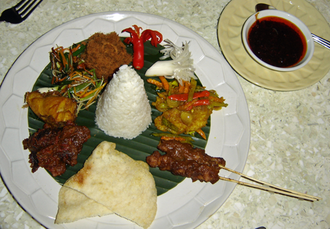
- 'Mixed rice' — you point at pre-cooked dishes behind a glass counter and pay by what you take. The default cheap lunch across Malaysia and Indonesia; a full plate is a couple of ringgit. Nasi campur, also known as nasi rames or sega campur in Java, refers to an Indonesian and Malay dish of a scoop of nasi putih accompanied by small portions of several other dishes, including meats, vegetables, peanuts, eggs, and fried-shrimp krupuk. Read more on Wikipedia ↗
- nasi lemak
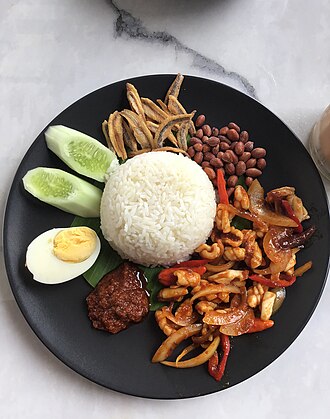
- Rice cooked in coconut milk with sambal, fried anchovies, peanuts and egg — Malaysia's unofficial national dish and the cheapest good breakfast on Langkawi, often wrapped in banana leaf. Nasi lemak is a dish originating in Malay cuisine that consists of rice cooked in coconut milk and pandan leaf. It is commonly found in Malaysia, where it is considered the national dish. As it is common throughout the Malay world, it is also a native dish in neighbouring areas with significant ethnic Malay populations, such as Singapore and Southern Thailand. In Indonesia, it can be found in parts of Sumatra, especially the Malay regions of Riau, Riau Islands, and Medan. Read more on Wikipedia ↗
- ngaben
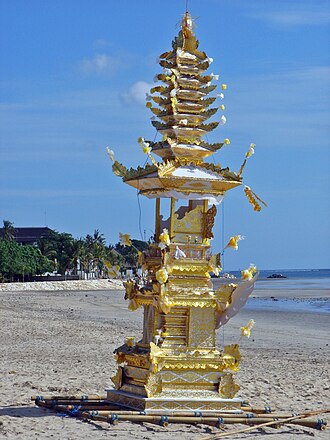
- The Balinese Hindu cremation ceremony that frees the soul from the body — often a huge, joyful, expensive communal event with towering cremation towers. Ngaben, also known as Pitra Yadnya, Pelebon or cremation ceremony, is the Hindu funeral ritual of Bali, Indonesia. A Ngaben is performed to release the soul of a dead person so that it can enter the upper realm where it can wait for it to be reborn or become liberated from the cycles of rebirths. The Balinese Hindu theology holds that there is a competition between evil residents of the lower realm to capture this soul, and a proper cremation enhances the chance that it may reach the upper realm. Read more on Wikipedia ↗
- Nyepi
- Bali's Day of Silence and new year, when the whole island stops — no travel, lights, work or noise, and even the airport closes. Nyepi, also known as Day of Silence, is a Balinese holiday held every Isakawarsa according to the Balinese calendar, and it can be traced as far back as 78 A.D. Read more on Wikipedia ↗
- odalan
- A temple's 'birthday' anniversary festival, held every 210-day Balinese year, when a quiet temple bursts into days of offerings, music and dance.
- ogoh-ogoh
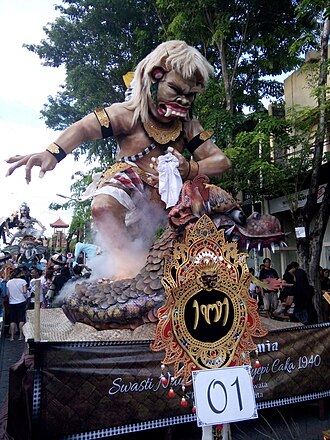
- Giant, grotesque papier-mâché monster effigies built by each community and paraded (then often burned) on the eve of Nyepi to drive off evil spirits. Ogoh-ogoh is a sculpture art form in Balinese culture that is typically paraded during Pangrupukan, a Hindu Balinese tradition held to welcome Nyepi. This tradition is part of the Tawur Kesanga procession, a Hindu Balinese ritual aimed at neutralizing negative forces in the surrounding environment and "appeasing" beings from the lower realms before the turn of the Saka Year. During the Pangrupukan parade, ogoh-ogoh symbolizes the evils of human nature or negativity in the universe. Therefore, after the parade ends, ogoh-ogoh is eventually burned as a representation of eliminating those negative traits. Read more on Wikipedia ↗
- Om Swastiastu
- The Balinese-Hindu greeting, from Sanskrit — roughly 'may all be well.' You'll hear it opening ceremonies and speeches, and see it welcome you at temple gates. Answered with the same words. The Balinese are an Austronesian ethnic group native to the Indonesian island of Bali and the surrounding islands. The Balinese population of 4.2 million live mostly on the island of Bali, making up 85% of the island's population. The Balinese are distinctive amongst the ethnic groups of Indonesia for their adherence to Balinese Hinduism rather than Abrahamic religions such as Islam or Christianity. Read more on Wikipedia ↗
- padmasana
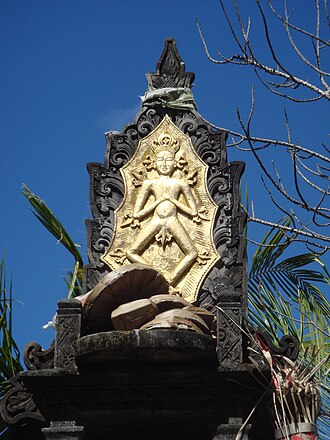
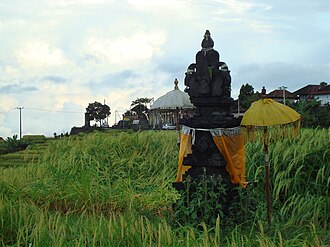
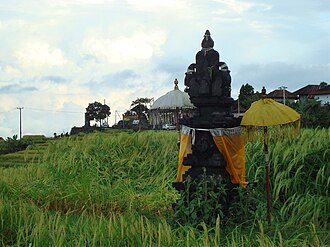
- A tall stone 'lotus throne' left deliberately empty — the seat of the supreme, formless reality, which has no image.
- pantai
- Malay for 'beach' — you'll see it on every sign: Pantai Cenang, Pantai Tengah, Pantai Kok.
- pasar malam
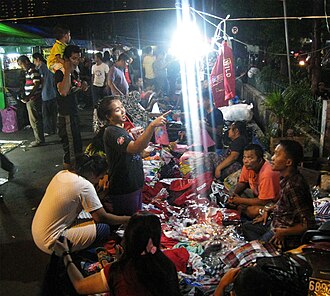
- A night market — stalls of hot food, fruit and cheap goods that rotate to a different part of the island each evening of the week. The traveller's best-value dinner. Pasar malam is a Malay word that literally means "night market". A pasar malam is a street market in Indonesia, Malaysia, Brunei and Singapore that opens in the evening, usually in residential neighbourhoods. Pasar malams are culturally very similar to night markets in Asian countries such as China, Thailand, Taiwan, Vietnam, South Korea and India. Read more on Wikipedia ↗
- pawang
- A local handler at Uluwatu who coaxes stolen items back from the macaques — usually by trading them a piece of fruit.
- penjor
- A tall, gracefully arching bamboo pole hung with palm-leaf decorations and offerings, raised outside homes for Galungan to honour the gods and the mountain.
- pulau
- Malay for 'island'. Langkawi's full name is Pulau Langkawi, and the 98 others around it all start the same way.
- pura
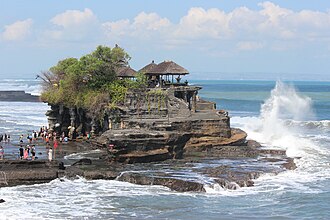
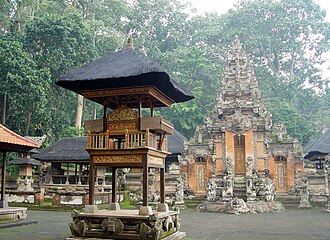
- A Balinese Hindu temple — an open-air walled complex of shrines and split gates, not a roofed building. Bali has tens of thousands, from tiny village temples to the great directional sanctuaries. A Balinese temple, known as a pura, is a place of worship for adherents of Balinese Hinduism in Indonesia. Puras are designed according to principles of Balinese sacred architecture, incorporating prescribed spatial orientation, ritual functions, and ceremonial regulations. They serve as focal points for communal worship rather than congregational prayer, with participation organised through families, villages, and ritual associations. Read more on Wikipedia ↗
- pura segara
- A 'sea temple' — one of the Balinese sanctuaries that guard the island's coastline against the powerful forces of the ocean.
- Ramayana
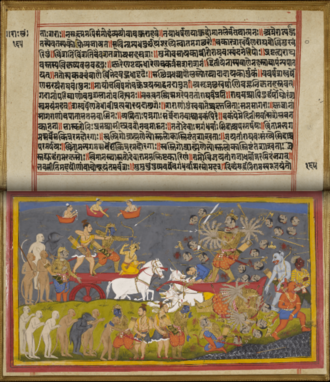
- An ancient Sanskrit epic of Prince Rama's quest to rescue his wife Sita from the demon king Ravana — the story the Kecak stages. The Ramayana, also known as the Valmiki Ramayana, as traditionally attributed to Valmiki, is a Hindu smriti epic poem from ancient India. It is one of the two important epics of Hinduism known as the Itihasas, the other being the Mahabharata, narratives of past events, interspersed with teachings on the goals of human life. It is one of the largest ancient epics in world literature and consists of nearly 24,000 shlokas (verses), divided into seven kāṇḍa (chapters). Each shloka is a couplet. Read more on Wikipedia ↗
- Rangda
- The fanged witch-queen of Balinese myth, embodiment of chaos and the demonic — the eternal adversary of the Barong. Rangda is the demon queen of the Leyaks in Bali, according to traditional Balinese mythology. Terrifying to behold, the child-eating Rangda leads an army of evil witches against the leader of the forces of good — Barong. The battle between Barong and Rangda is featured in a Barong dance which represents the eternal battle between good and evil. Read more on Wikipedia ↗
- ringgit
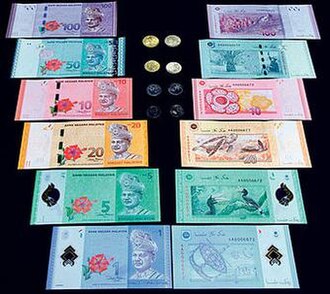
- Malaysia's currency (RM; code MYR). One ringgit divides into 100 sen. Cards work in cities and malls; you'll want cash for hawker stalls, markets, and small towns. The Malaysian ringgit is the currency of Malaysia. Issued by the Central Bank of Malaysia, it is divided into 100 cents. Read more on Wikipedia ↗
- roti canai
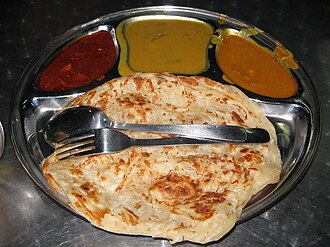
- A flaky, griddled flatbread served with a bowl of dhal or curry to dip — the classic Malaysian breakfast, cooked to order at any kedai kopi for small change. Roti canai, or roti prata, also known as roti chanai and roti cane, is an unleavened flatbread of Indian origin found in the cuisines of Southeast Asia, especially those of Brunei, Indonesia, Malaysia, Singapore, and Thailand. It is typically accompanied by dal or various forms of curry, although it can also be prepared in an array of sweet or savoury adaptations utilising diverse components like meat, eggs, or cheese and dipped in condensed milk as well as paired with mee goreng. Read more on Wikipedia ↗
- Sad Kahyangan
- Bali's set of great 'directional' sanctuary temples that guard the island. Which temples make the list varies from source to source.
- Sang Hyang Widhi
- The single supreme God of modern Balinese Hinduism, foregrounded in the 20th century to meet Indonesia's requirement that recognised religions be monotheistic. Sang Hyang Widhi Wasa is the supreme divine principle in Balinese Hinduism and in Indonesian Hindu theology more broadly. The name is translated as “The Divine Order” or “The One Supreme God.” Sang Hyang Widhi Wasa is not a personal god, but an absolute, ineffable source from which all divine manifestations arise. Read more on Wikipedia ↗
- sanghyang
- Sacred Balinese trance rituals in which performers become vessels for spirits. The Kecak's hypnotic chorus grew out of the 'voice gamelan' that accompanied them. Sanghyang is a traditional sacred Balinese dance originated from the Indonesian island of Bali. It is based on the premise that an unseen force enters the body of an entranced performer. The force, identified as hyang, is an important type of spiritual entity in ancient Indonesian mythology. Read more on Wikipedia ↗
- sarong
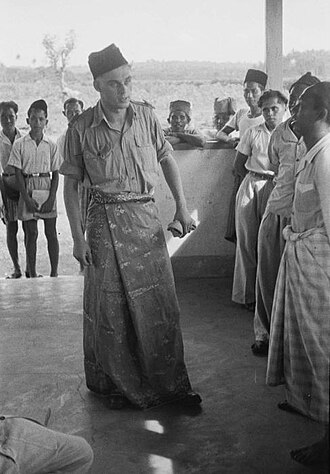
- A length of cloth wrapped around the waist as a skirt. A sash-and-sarong is required dress to enter a Balinese temple; most temples lend or rent them at the gate. A sarong or a sarung is a large tube or length of fabric, often wrapped around the waist, worn in Southeast Asia, South Asia, West Asia, North Africa, East Africa, West Africa, and on many Pacific islands. The fabric may be brightly colored by means of batik or ikat dyeing. Many modern sarongs have printed designs, often depicting animals or plants. Different types of sarongs are worn in different places in the world, notably the lungi in the Indian subcontinent and the izaar in the Arabian Peninsula. Read more on Wikipedia ↗
- sate lilit
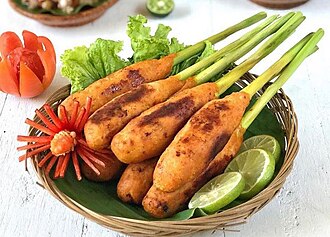
- Balinese satay of minced, spiced meat or fish moulded onto a lemongrass or bamboo skewer and grilled — 'lilit' means to wrap around. Sate lilit is a satay variant in Indonesia, originating from Balinese cuisine. This satay is made from minced pork, fish, chicken, beef, or even turtle meat, which is then mixed with grated coconut, thick coconut milk, lemon juice, shallots, and pepper. The spiced minced meat is wound around bamboo, sugar cane or lemongrass sticks, it is then grilled on charcoal. Unlike skewers of other satay recipes which is made narrow and sharp, the bamboo skewer of sate lilit is flat and wide. This wider surface allowed the minced meat to stick and settle. Read more on Wikipedia ↗
- sekala / niskala
- The Balinese pairing of the seen world (sekala) and the unseen world (niskala); daily ritual keeps the two in balance.
- Shaivite
- Belonging to Shaivism — the strand of Hinduism centred on the god Shiva, and the dominant Hindu current in Bali. Shaivism is an umbrella-term for a number of Hindu religious traditions, which worship Shiva as the supreme being. The followers of Shaivism are called Shaivas or Shaivites, numbering about 385 million people, across South Asia predominantly in India, Sri Lanka, and Nepal. Read more on Wikipedia ↗
- sor singgih basa
- The speech levels of Balinese: parallel low/common and high/refined vocabularies a speaker chooses between according to the caste, age and status of whoever they're speaking to and about. Balinese is an Austronesian language spoken primarily by the Balinese people on the Indonesian island of Bali, as well as Nusa Penida, Western Lombok, and Eastern Java, and also spread to Southern Sumatra, and Sulawesi. Most Balinese speakers also use Indonesian. The 2000 national census recorded 3.3 million people speakers of Balinese with only 1 million people still using the Balinese language in their daily lives according to the Bali Cultural Agency estimated in 2011. Read more on Wikipedia ↗
- subak
- Bali's thousand-year-old democratic irrigation cooperatives — farmer associations, tied to water temples, that share river water fairly across the rice terraces. UNESCO-listed as a living expression of Tri Hita Karana. Subak is the water management (irrigation) system for the paddy fields on Bali island, Indonesia. It was developed in the 9th century. For the Balinese, irrigation is not simply providing water for the plant's roots, but water is used to construct a complex, pulsed artificial ecosystem that is at the same time autonomous and interdependent. The system consists of terraced rice fields and water temples covering nearly 20,000 hectares. The temples are the main focus of this cooperative water management, known as subak. Read more on Wikipedia ↗
- subak abian
- The highland farming cooperative that manages Bali's dryland plantation crops — coffee, citrus, cloves — a cousin of the subak rice-irrigation associations, run on the same Tri Hita Karana ethic of balance between people, nature and the divine. Subak is the water management (irrigation) system for the paddy fields on Bali island, Indonesia. It was developed in the 9th century. For the Balinese, irrigation is not simply providing water for the plant's roots, but water is used to construct a complex, pulsed artificial ecosystem that is at the same time autonomous and interdependent. The system consists of terraced rice fields and water temples covering nearly 20,000 hectares. The temples are the main focus of this cooperative water management, known as subak. Read more on Wikipedia ↗
- suksma
- 'Thank you' in Balinese (Basa Bali). The everyday form is suksma; matur suksma is the more refined, respectful version. A word travellers love to try, though Indonesian's terima kasih works everywhere.
- Syariah
- Islamic law, applied in Malaysia alongside civil law and governing Muslims in matters like family and morality. It's why alcohol and some conduct are treated differently for Muslims, and stricter in conservative states like Kelantan and Terengganu. Sharia, also transliterated as Sharī'ah, Shari'a, or Shariah, is a body of religious law that form the Islamic tradition based on scriptures of Islam, particularly the Qur'an and hadith. In Islamic terminology sharīʿah refers to immutable, intangible divine law, in contrast to fiqh, which refers to its interpretations by Islamic scholars. Read more on Wikipedia ↗
- Tantric Buddhist
- An esoteric form of Mahayana Buddhism working through ritual, mantra and symbolism — one of the older layers woven into Balinese religion. Vajrayāna, otherwise known as Mantrayāna, Guhyamantrayāna, Tantrayāna, Indo-Tibetan Buddhism, Tantric Buddhism, and Esoteric Buddhism, is a vehicle of the Mahāyāna Buddhist tradition that emphasizes esoteric practices and rituals aimed at rapid spiritual awakening. Emerging between the 5th and 7th centuries CE in medieval India, Vajrayāna Buddhism incorporates a range of techniques, including the use of mantras, dhāraṇīs, mudrās, mandalās, and the visualization of deities and Buddhas. Read more on Wikipedia ↗
- Tri Hita Karana
- A Balinese philosophy of harmony between people, the divine and nature. The values are old; this neat three-part formulation was coined in the late 1960s. Tri Hita Karana is a central philosophy as part of Balinese Hinduism the dominant religion practiced on the island of Bali, Indonesia. The literal translation is roughly the "three causes of well-being" or "three reasons for prosperity." Read more on Wikipedia ↗
- warung
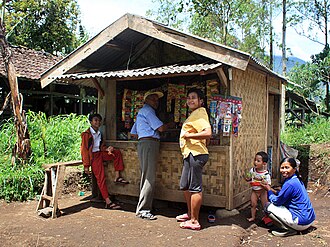
- A small family-run Balinese eatery or shop — the cheapest, most authentic place to eat, where a plate of nasi campur costs a fraction of the tourist restaurants. A warung is a type of small family-owned business — small retail, eatery, or café — in Indonesia. A warung is an essential part of daily life in Indonesia. Over time, the term warung has shifted somewhat — especially among foreign visitors, expatriates, and people abroad — to refer more specifically to a modest Indonesian eatery or a place that sells Indonesian retail items. But for the majority of Indonesians, it still refers to a small, neighborhood convenience shop, often a front room or booth in a family's home. Read more on Wikipedia ↗
- yadnya
- Ritual sacrifice or offering — the system of daily and ceremonial acts at the heart of Balinese religious life.








Definitions are ours; where a term links out, the background is from Wikipedia (CC BY-SA).