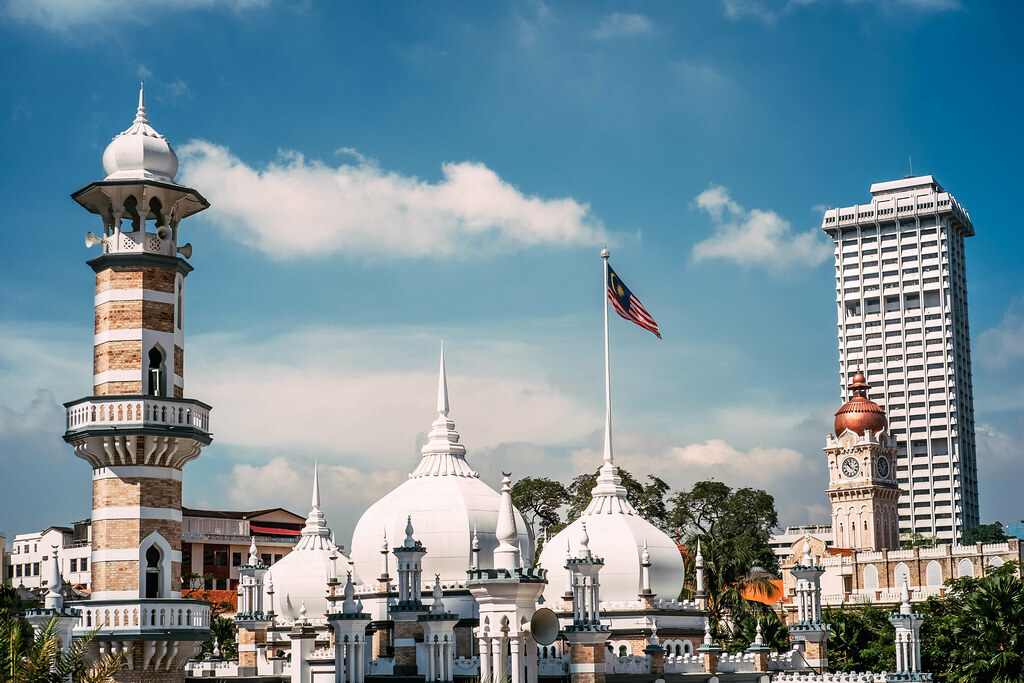
Masjid Jamek sits at the exact spot Kuala Lumpur is named after — the muddy confluence (kuala lumpur) of the Klang and Gombak rivers, where tin miners first settled in the 1850s. Built in 1909, it's one of the city's oldest mosques, and its striped brick domes and palm-lined courtyard still feel like a pause button in the middle of the old commercial district.
Why this spot matters
Before there was a KLCC or a golden triangle, there was this riverbank — the landing point where prospectors coming up the Klang River to work the tin mines set up camp, and the name that stuck (kuala, "confluence," plus lumpur, "mud") became the name of the city around it. The mosque was built a few decades later, right on the point of land where the two rivers meet, by the British architect Arthur Benison Hubback, who gave it the same Moorish and Indo-Saracenic style — onion domes, scalloped arches, banded red-and-cream brick — he used on the railway station and other landmark buildings from the same era. Coconut palms and rain trees fill the small courtyard, which makes it one of the few genuinely shaded, quiet corners this close to Masjid Jamek station and the market streets around it.
| Built | 1909, designed by Arthur Benison Hubback |
|---|---|
| Style | Moorish / Indo-Saracenic — onion domes, banded brick, horseshoe arches |
| Location | Confluence of the Klang and Gombak rivers — the city's founding site |
| Nearest LRT | Masjid Jamek (Kelana Jaya & Ampang/Sri Petaling lines) |
| Non-worshipper visits | Free, outside prayer times, robes usually lent at the entrance |
Visiting as a non-Muslim
The mosque is an active place of worship first and a sight second, and it's treated that way — non-worshippers can generally step inside outside prayer times, and the mosque usually lends a robe at the entrance if your clothes don't already cover shoulders and knees. Women are typically asked to cover their hair as well as arms and legs; men in shorts or sleeveless shirts get covered up too. During prayer times the mosque closes to visitors entirely, so build in some slack rather than timing a visit precisely. Move quietly, keep voices down, and don't point a camera at anyone praying — this is someone's mosque, not a backdrop.
Tip
Confirm the current free-visit window and prayer-closure times before you go — mosque visiting hours shift with the prayer schedule and aren't fixed year-round.
The river confluence and River of Life
Step outside and the two rivers meeting at the mosque's feet are part of the River of Life project, which cleaned up and lit the Klang and Gombak so the water that used to be an open drain is now a walkable, illuminated stretch. After dark the confluence and the mosque's domes are lit up together, and the riverside walkway on both banks makes this one of the better free things to do in the old town once the day's heat drops off. It's a five-minute stroll from the covered market streets of Central Market and from Petaling Street, and connects north along the river towards Merdeka Square, so it works naturally as a stop on a heritage walk through the old colonial and shophouse core rather than a separate trip.
Getting there
Masjid Jamek LRT station — served by both the Kelana Jaya and Ampang/Sri Petaling lines — sits right beside the mosque, with an exit that puts you almost at the gate. It's also an easy walk from Central Market, Petaling Street, and the Pasar Seni area, so most people fold it into a walking loop rather than making a dedicated trip out to it.