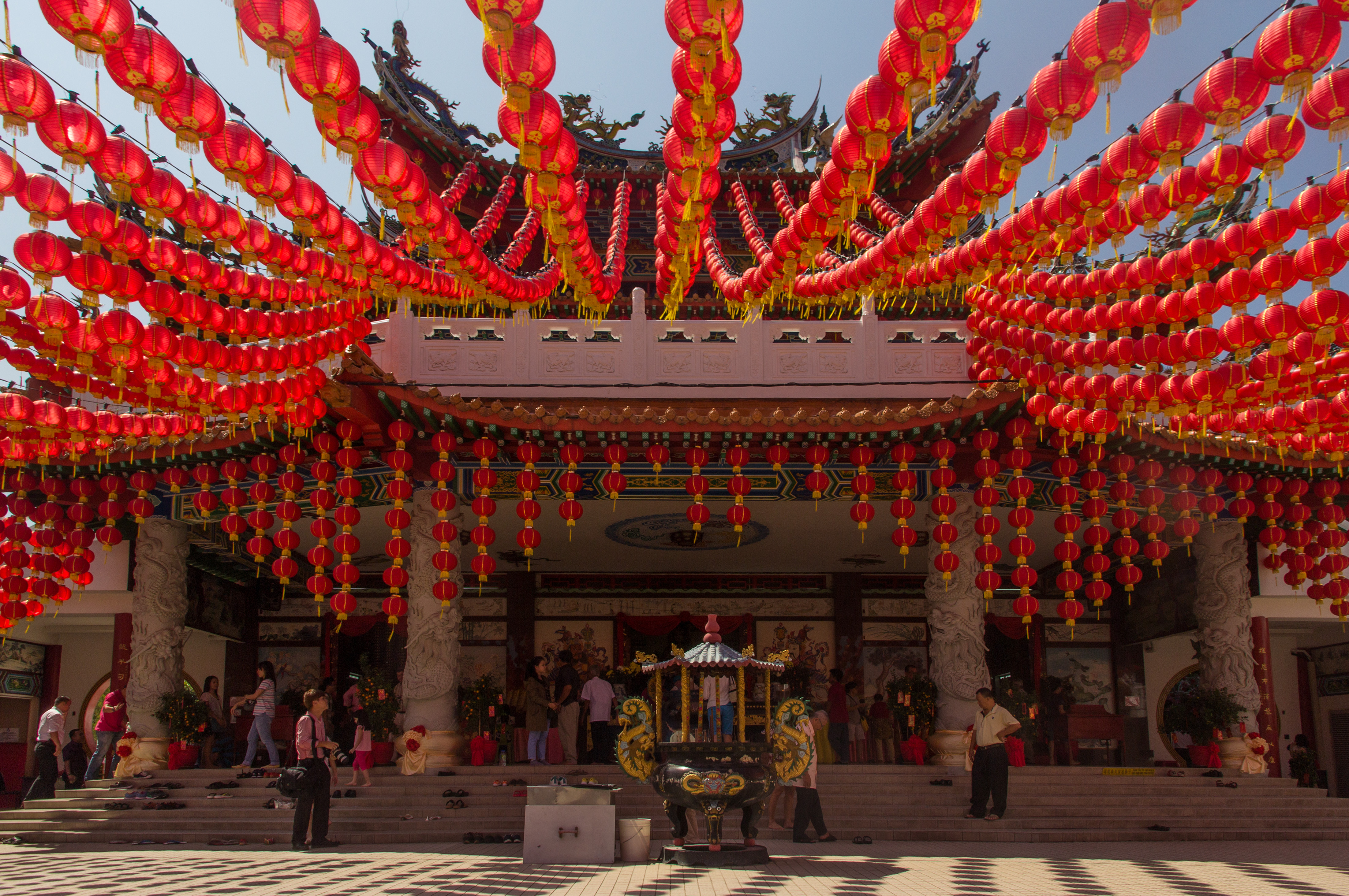
Thean Hou Temple is the six-tiered Chinese temple that sits on a hill in Robson Heights, between Bangsar and Mid Valley, built by the Hainanese community and dedicated to Mazu, the sea goddess. It's free to visit, it's one of the biggest Chinese temples in Southeast Asia, and it's also one of the easiest KL landmarks to get wrong logistically — you don't walk up this one.
What you're looking at
The temple climbs in three tiers up the hillside, roofs stacked in red and gold with dragon motifs along the ridgelines and a pair of carved dragon columns flanking the main altar hall. Inside, the main hall holds Mazu alongside Guan Yin, goddess of mercy, and Shui Wei Sheng Niang, another sea deity — a lineup that makes sense once you remember this was built by a clan association with roots in coastal Hainan, where the sea and its goddesses mattered more than almost anything else. Look up in the main hall and the ceiling is carved and painted rather than left plain, which is part of what makes this temple feel more like a small palace than a single prayer hall.
The signature image, the one everyone's phone is out for, is the red lanterns — hundreds of them, strung in tight rows across the courtyards and along the rooftop terraces. They're up year-round, but the display gets denser and more elaborate around Chinese New Year, when the temple adds extra lanterns and lighting and becomes one of the busiest CNY spots in the city. From the upper terraces you also get a genuine skyline view over Bangsar and Mid Valley toward the KL skyline — worth the climb on its own on a clear evening.
| Entry | Free |
|---|---|
| Opening hours | Roughly 7am–8pm daily |
| Best for photos | Chinese New Year (extra lanterns, lit up at night) or a quiet weekday morning |
| Dress | Modest — shoulders and knees covered, it's an active place of worship |
| Getting there | Not walkable — take a or taxi up the hill road |
Getting there
This is the part people underestimate: Thean Hou Temple sits on top of a hill with no footpath worth using and no direct rail stop at the entrance. The road up is steep, winds past a cemetery, and isn't built for walking in KL heat — practically everyone arrives by Grab, taxi, or their own car, and there's a car park at the top if you're driving. If you're coming from Bangsar or Mid Valley, it's a short ride, ten minutes or so depending on traffic, and a Grab back down afterwards is easy to summon from the car park. Don't try to walk it from the nearest LRT station — the distance looks short on a map and is genuinely unpleasant on foot.
When to go
A quiet weekday morning is the calmest version of this temple — soft light on the lanterns, thin crowds, and time to actually look at the carving instead of queuing for a photo spot. Chinese New Year is the opposite experience: dense crowds, extra lanterns, and a festival energy that's worth seeing once even if you have to share the terraces with everyone else in the city who had the same idea. Either way, it's a working temple with people praying, not a photo backdrop, so keep the volume down near the altars and check before pointing a camera at anyone mid-prayer.