Malaysia · Understand
Etiquette in Malaysia: The Small Courtesies That Go a Long Way
None of this is complicated — a few easy courtesies and Malaysia opens right up to you.
Malaysia is a majority-Muslim, genuinely multi-faith country, and most of its etiquette comes down to a handful of easy habits: dress a little more modestly than you might at home, take your shoes off where you see other shoes lined up, and use your right hand for eating and giving. None of it is exotic or hard to get right — it's just worth knowing before you're standing at a mosque door wondering what to do.
Dress: how modest, and where
Malaysia is more relaxed about dress than people expect, especially in cities and beach resorts — shorts and swimwear are completely normal in Kuala Lumpur malls or on a Langkawi beach. Where it tightens up is at religious sites and in the more conservative east-coast states like Kelantan and Terengganu, where covering shoulders and knees is the polite default even outside a mosque.
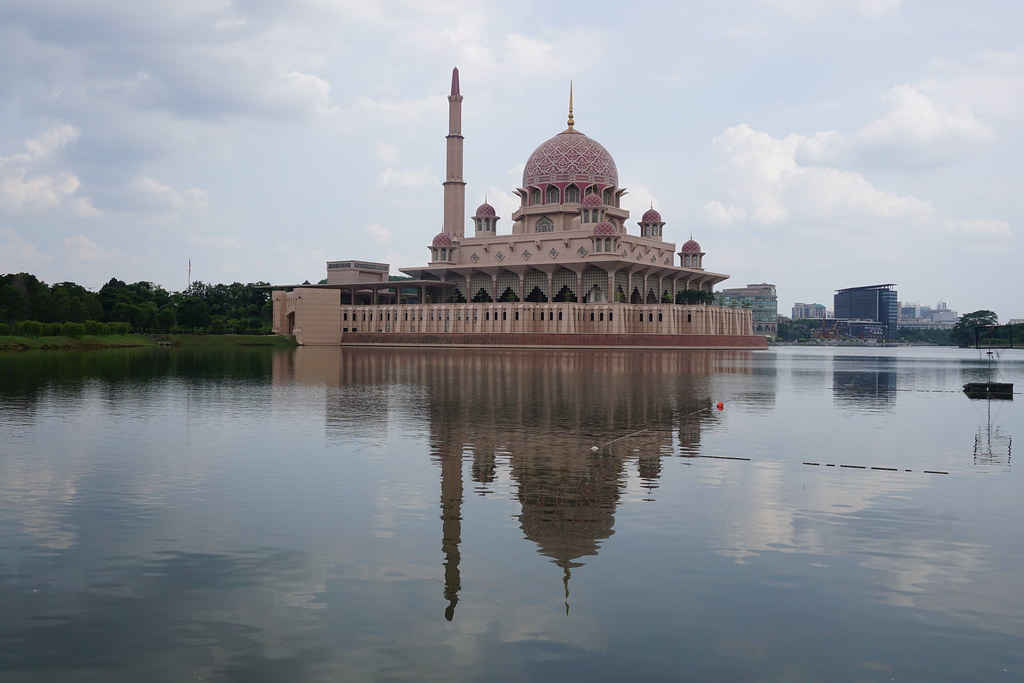
At any mosque, dress modestly and expect to take your shoes off before entering. Women are usually asked to cover their hair — most mosques that welcome visitors keep a basket of loose robes and scarves at the door, so you don't need to bring your own. The same shoes-off, modest-dress instinct applies walking into a Hindu temple or a Buddhist temple, even though the specifics differ slightly site to site.
| Mosque dress | Shoulders and knees covered; scarf for women (usually provided at the door) |
|---|---|
| Shoes off | At mosques, temples, and any home with shoes lined up outside |
| Right hand | For eating, giving and receiving — the left is considered unclean |
| East coast | Kelantan and Terengganu run more conservative than KL or the resort coasts |
Ramadan: the month that changes the rhythm
During the fasting month of Ramadan, Muslims don't eat, drink or smoke between dawn and sunset — and the considerate thing as a visitor is to avoid eating or drinking conspicuously in front of people who are fasting, particularly in public and in smaller towns. You won't be told off for having a coffee on a hotel terrace, but doing it right in front of a fasting food-stall owner is the kind of thing locals notice.
The flip side is that Ramadan is genuinely one of the best times to be out in the evening: night markets and buka puasa (breaking of the fast) stalls spring up everywhere at sunset, piled with food that barely exists the rest of the year. The month ends with , Malaysia's biggest holiday — expect closures, packed transport and a genuinely festive country for a few days around it.
Note
Ramadan and Hari Raya fall on different dates every year, since they follow the lunar calendar and shift roughly 10–11 days earlier annually — check the current year's dates before you plan a trip around (or need to plan around) them.
Homes, hands and public affection
Take your shoes off before entering someone's home — you'll usually see a pile of sandals by the door as the cue. Use your right hand to eat, to pass money, or to hand someone something; the left is traditionally seen as unclean, so avoid using it alone for these things even if it feels natural to you.
Public affection between couples is usually kept low-key across Malaysia — a hand held is fine, anything more is better saved for private. It's a small thing, but it's one of the easiest ways to read as a considerate guest rather than an oblivious one.
Three communities, and Borneo besides
Malaysia's population is roughly split between Malay, Chinese and Indian communities, each with its own festivals, food and customs running alongside each other — Hari Raya, Chinese New Year and Deepavali are all genuinely major national holidays, not minority observances tucked to one side. Over in Sabah and Sarawak, Malaysian Borneo is home to dozens of indigenous peoples — Iban, Kadazan-Dusun and many others — with their own languages, longhouses and harvest festivals that predate all three.
The respectful move as a visitor is simple curiosity without assumption: ask rather than guess someone's background or beliefs, and don't expect any one community to stand in for "Malaysian culture" as a whole — the whole point is that it's several, living comfortably side by side.
Alcohol, Syariah, and who it applies to
Malaysia runs a dual legal system: civil law for everyone, and law that applies specifically to Muslims, covering things like alcohol consumption and public conduct. In practice this means alcohol is legally sold to non-Muslims in most of the country, while Muslims are expected to abstain under Syariah — it's not your job as a visitor to police this, just to understand why the rules around food and drinking spots aren't uniform from state to state. The details of where you can actually buy and drink are worth a proper look before you travel.
Note
None of this etiquette is about walking on eggshells. Malaysians are used to visitors, genuinely welcoming, and quick to forgive an honest mistake — cover up at the mosque, take your shoes off, eat with your right hand, and you're already most of the way there.