Malaysia · Understand
Malaysian Food: The National Dish Landscape, Explained
Malaysian food is what happens when three cuisines share one table and none of them lose.
Ask a Malaysian what the national dish is and you'll get an argument, not an answer — which is the point. Malay, Chinese and Indian food traditions have shared this country for generations, borrowed from each other constantly, and the result is one of the best-eating countries anywhere, most of it served on a plastic stool for the price of a coffee back home.
Is there a "national dish"?
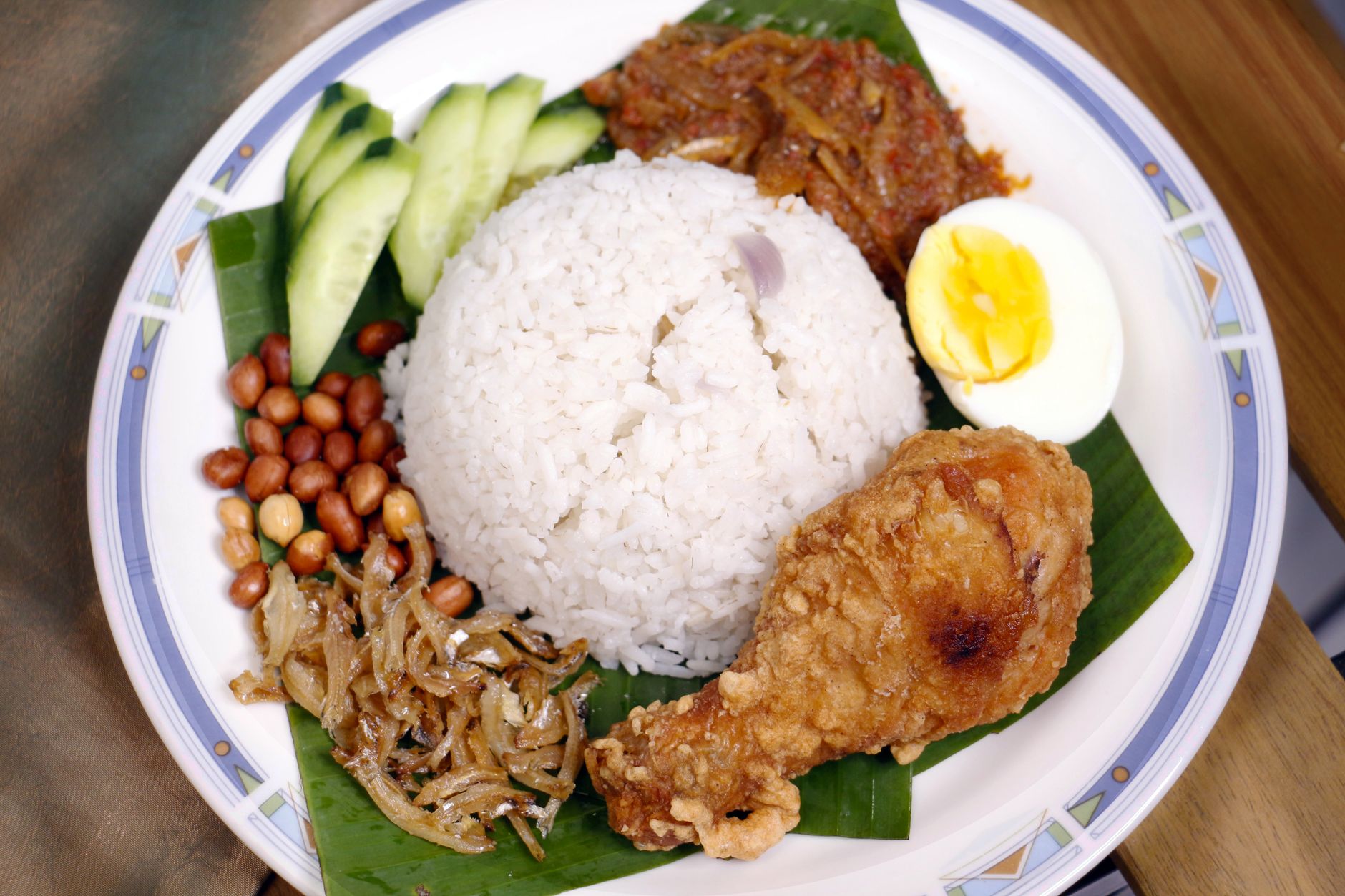
Unofficially, yes: nasi lemak. Coconut rice cooked in pandan leaf, served with sambal, fried anchovies (ikan bilis), roasted peanuts, cucumber and a boiled or fried egg — traditionally a breakfast, now eaten at any hour, from a banana-leaf wrap at a roadside stall to a plated version in a hotel restaurant. It's the dish most likely to appear on a "welcome to Malaysia" tourism poster, and it earns the spot.
| Nasi lemak | Coconut rice, sambal, anchovies, peanuts, egg — the everyday national dish |
|---|---|
| Roti canai | Flaky flatbread with dhal or curry, a mamak breakfast staple |
| Laksa | Noodle soup with regional variants — asam (sour, Penang), curry (coconut), Sarawak (its own thing entirely) |
| Satay | Grilled skewered meat with peanut sauce, sold by the stick |
| Char kway teow | Wok-fried flat noodles, prawns, egg, cockles — smoky from a hot wok |
Three communities, one table
Malaysian food makes most sense once you know it's really three overlapping food cultures, not one cuisine: Malay, Chinese and Indian, each brought by migration and settlement over more than a century, each still distinct and constantly trading dishes and techniques across the lines.
Malay food leans on rice, coconut milk, chilli and dried spice — sambals, curries, grilled satay, and nasi lemak itself. Chinese Malaysian food carries southern Chinese cooking (mostly Hokkien, Cantonese and Teochew roots) reworked with local ingredients — char kway teow, Hainanese chicken rice, wonton noodles, and the kopitiam breakfast. Indian Malaysian food, largely South Indian in origin, gave the country roti canai, banana-leaf rice, fish head curry and the stall. None of these stayed in their lane — nasi kandar and mee goreng mamak are Indian-Muslim inventions that read as thoroughly Malaysian now, and you'll find a Chinese hawker selling a Malay-style noodle dish two stalls down from an Indian one selling Chinese-style fried rice.
Mamak culture and teh tarik
The stall deserves its own mention: an Indian-Muslim eatery, often open into the small hours, serving roti canai, nasi kandar, noodles and endlessly refillable tea. It's less a place to eat and more a Malaysian social institution — students, shift workers and families all end up at a mamak table at some point in the night, usually over a glass of teh tarik, "pulled tea", stretched between two cups until it froths. Football on a wall-mounted TV and a plate of roti canai torn by hand into the curry: that's the scene, in most towns, most nights.
Kopitiam mornings
The Chinese counterpart is the kopitiam — an old-style coffee shop, often tiled and fan-cooled, serving thick local coffee (kopi) brewed with condensed milk, soft-boiled eggs eaten straight from the shell with soy sauce and white pepper, and kaya toast: bread grilled over charcoal and spread with a coconut-and-egg jam. It's the breakfast equivalent of the mamak's late-night table, and just as much a fixture of daily life.
The dishes worth knowing before you order
Roti canai — a flaky, pan-fried flatbread torn and dipped in dhal or curry, the mamak breakfast staple, and endlessly variable (egg roti, banana roti, cheese roti). Satay — skewered, char-grilled meat (chicken, beef, sometimes lamb) with a peanut dipping sauce, sold by the stick at night markets and satay-specific stalls. Laksa isn't one dish but a family: asam laksa (a sour, tamarind-and-fish broth, strongly associated with Penang), curry laksa (coconut-milk based, closer to what most visitors picture), and Sarawak laksa (its own spice paste entirely, a Borneo specialty). Char kway teow — flat rice noodles fried hard and fast in a seasoned wok with prawns, egg, bean sprouts and Chinese sausage, best from a stall that's clearly been doing it for decades. Hainanese chicken rice — poached chicken and rice cooked in its fat and stock, served with chilli and ginger sauces, a Chinese Malaysian dish now claimed just as firmly by Singapore. Nasi kandar — an Indian-Muslim rice dish where you point at a tray of curries and sides and they get ladled together over rice, originally a northern (Penang) specialty that's spread nationwide.
Halal, and the pork question
Malaysia is Muslim-majority, and most eateries — including nearly all Malay and mamak places — are : no pork, no alcohol, meat slaughtered to ritual. Chinese-run restaurants are often not halal, and pork is common on their menus (char siu, roast pork rice, bak kut teh) — these places generally say so clearly, and Muslim customers know to look for the halal certificate near the till rather than guess. As a visitor this mostly just means: if you're vegetarian, vegan or avoiding pork, ask, and don't assume either way from the outside of a shop.
Durian and the fruit stand
Durian earns its reputation before you've tasted it — the smell alone gets it banned from hotel rooms and public transport across the country — and opinions split hard between people who consider it the best fruit alive and people who can't be in the same room as it. If you're curious, a fresh one from a roadside stall in season beats anything vacuum-packed. Beyond durian, Malaysia's fruit stands are worth stopping at on their own merits: rambutan, mangosteen, dragon fruit, starfruit and jackfruit all turn up cheap and genuinely good, especially outside the big cities.
Eating cheaply, and eating well
The best Malaysian food is rarely the expensive kind. Hawker centres and night markets (pasar malam) are where the country actually eats — rows of stalls, each doing one or two dishes for years, plastic tables shared with strangers, and a full meal for the price of a coffee elsewhere. The pattern repeats in every town: find where the locals queue, not the place with the English menu and photos out front.
Every city in Malaysia has dishes and stalls it's known for — Penang's hawker scene, KL's specific nasi kandar houses, Ipoh's own noodle culture — and those belong on that city's own guide, not here. This page is the country-wide shape of what you'll be eating; the local specialties are where it gets interesting.