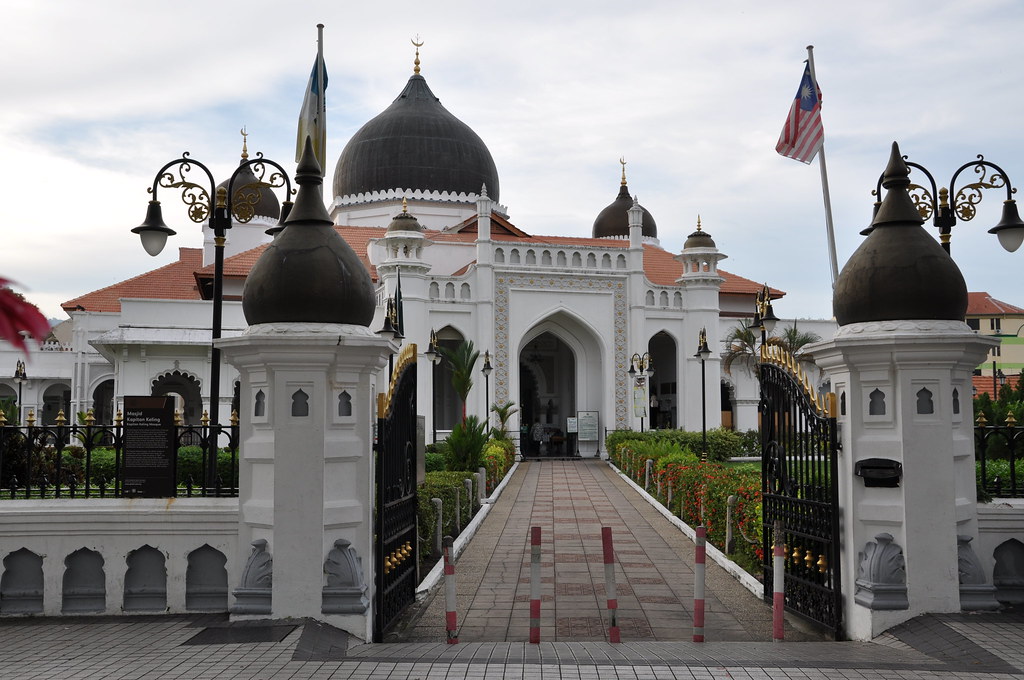
Kapitan Keling Mosque is George Town's oldest mosque, and the one that gives the street around it its nickname — the Street of Harmony. Onion domes, a tall minaret you can pick out from most of the old town, and a history that starts with the South Indian Muslim traders who built it in the early 1800s and named it after their community leader, the Kapitan Keling.
Why this mosque, on this street
Penang's earliest Muslim community here wasn't Malay — it was South Indian, merchants and traders who arrived with the British East India Company in the late 1700s and settled around what's now Jalan Masjid Kapitan Keling. Their leader held the title Kapitan Keling, a community-headman role the British recognised for several of Penang's ethnic groups, and it's his name the mosque still carries. The original mosque here dates to around 1801; what stands now is a later rebuild in a Mughal-influenced style — bulbous domes, a minaret with a viewing gallery, arched colonnades — that reads closer to North Indian mosque architecture than to the Malay wooden mosques found elsewhere on the island.
| Built | Original mosque c.1801, rebuilt in its present Mughal-influenced style in the early 20th century |
|---|---|
| Style | Mughal-influenced — onion domes, tall minaret, arched colonnades |
| Founded by | South Indian Muslim () traders, named for their community leader |
| Non-worshipper visits | Free, outside prayer times, robes usually lent at the entrance |
| Nearest landmark | On Jalan Masjid Kapitan Keling, the "Street of Harmony" |
The Street of Harmony
Step out of the mosque gate and within a few hundred metres you pass the Sri Mahamariamman Temple, Penang's oldest Hindu temple; the Goddess of Mercy Temple, George Town's oldest Chinese temple; and St. George's Church, the oldest Anglican church in Southeast Asia. It's this cluster — mosque, temples and church built by different communities within a few decades of each other, and still standing shoulder to shoulder — that earned the street its nickname, and Kapitan Keling Mosque is the anchor at one end of it. Walking the street in order rather than picking one stop is the better way to take it in; each building makes more sense next to the others than it does alone.
Visiting as a non-Muslim
This is an active mosque first, not a sight — the community here still prays five times a day, and the building is treated accordingly. Outside prayer times, non-worshippers can generally step into the courtyard and designated visiting areas, and a robe is usually lent at the entrance if your own clothes don't already cover shoulders and knees. Women are typically asked to cover their hair as well as arms and legs; men in shorts or sleeveless shirts get covered up too. During prayer times the mosque closes to visitors entirely, so treat any visit as flexible rather than timed to the minute.
Tip
Confirm the current free-visit window and prayer-closure times before you go — like most working mosques, visiting hours here shift with the prayer schedule rather than sitting fixed year-round.
Move quietly, keep your voice down, and don't point a camera at anyone mid-prayer — courtesy here isn't a rule for tourists, it's just how you'd behave in anyone's place of worship. The minaret's viewing gallery, where it exists, is usually the one part visitors are actively invited up into; the prayer hall itself is for worshippers.
Getting there
The mosque sits inside George Town's compact heritage grid, an easy walk from Little India and Chulia Street and directly on the route most people already take between the clan jetties and the old town's temple cluster. As with the rest of the Street of Harmony, there's no reason to it — the whole point of this stretch of George Town is that it's built for walking, and the mosque, temples and church only make sense as one slow loop rather than four separate stops.