Home › Bali › Festivals & Nyepi
Bali · Culture & calendar
Festivals, Ceremonies & Nyepi
Bali runs on a ceremonial calendar, not a tourist one — including one day a year the whole island, airport included, shuts down.
Bali doesn't hold festivals for tourists — it runs on a religious calendar that happens to be one of the most photogenic on earth, and you're a guest at it. The single fact worth knowing before you book flights: once a year the entire island shuts down for Nyepi, and the airport closes with it. Get that date right and the rest is upside — you'll stumble into processions, gamelan, and offerings almost daily without trying.
The one that can wreck your trip: Nyepi
, the Balinese Day of Silence, is the island's new year — and unlike any "holiday" you've planned around before. For 24 hours (roughly 6am to 6am) the whole island stops: no flights in or out, no driving, no shops, no lights after dark, and in principle no going outside at all. It usually falls in March (the date shifts with the Saka lunar calendar).
This is not a soft rule for visitors. Your hotel will feed you and you can move around the grounds, but you cannot leave the property, and pecalang (traditional village security) patrol the streets. Wi-Fi and mobile data are often cut too.
Watch out
Do not schedule an arrival or departure on Nyepi or you will be stranded — Ngurah Rai airport genuinely closes for the full day, the only airport in the world that does this for a religious observance. Book to land at least a day before and leave a day after. If Nyepi falls mid-trip, pick a hotel with a pool and good food and treat it as an enforced rest day — many travellers end up loving it.
The monsters the night before: ogoh-ogoh
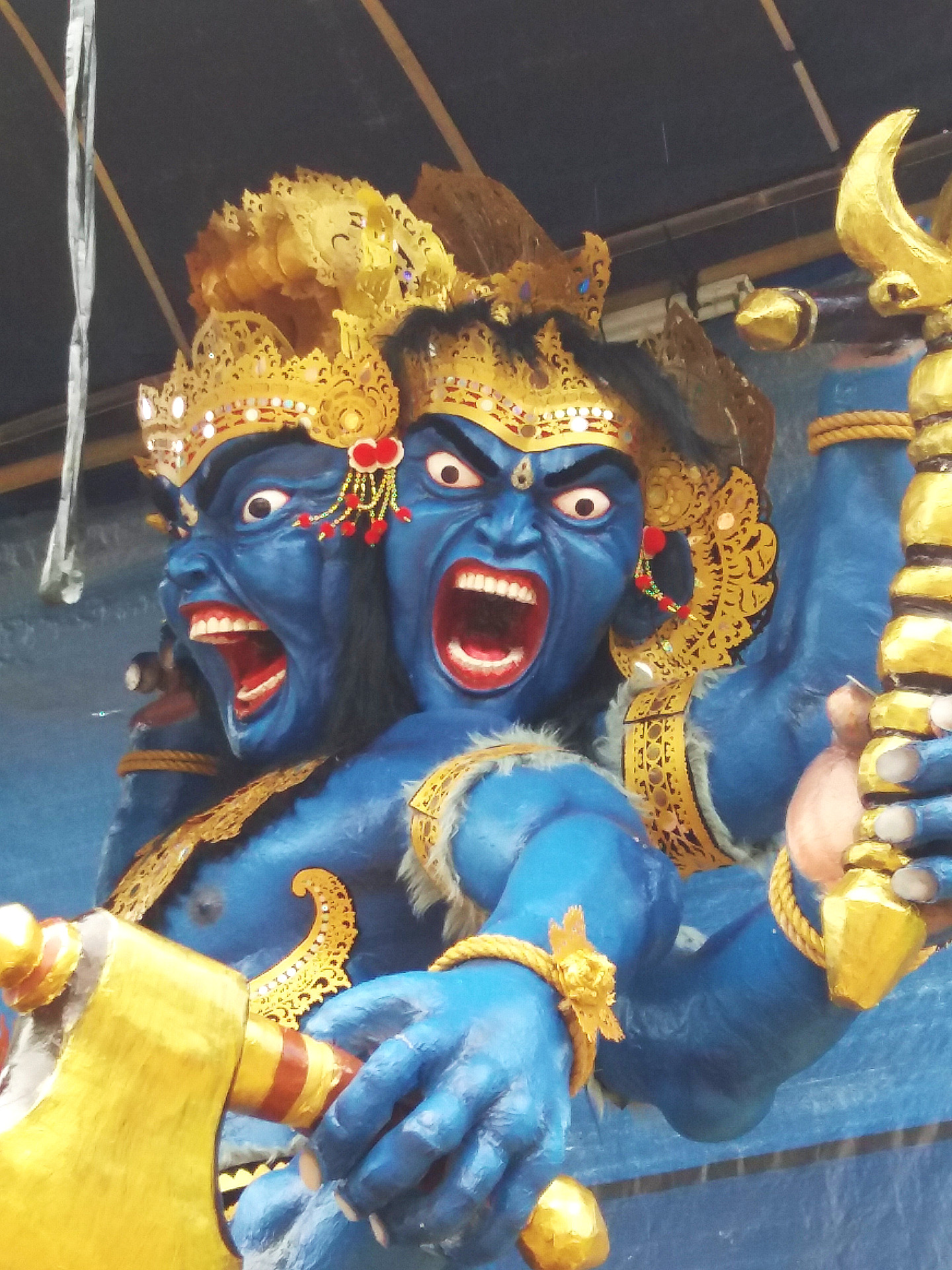
The evening before Nyepi is the opposite of silence. Each village spends weeks building — towering papier-mâché demons, some four metres tall — then parades them through the streets on bamboo lattices, spinning them at crossroads to confuse and drive out evil spirits before the cleansing quiet of the new year. It's loud, torch-lit, and genuinely thrilling, and it's the one pre-Nyepi event visitors can usually watch from the roadside. Ask your host where the local parade forms up — the big Denpasar routes are crowded; a neighbourhood parade is often better.
Galungan & Kuningan: the penjor season
If you see graceful arching bamboo poles — decorated with young coconut leaf, fruit and rice, curving over every gateway down an entire street — you've arrived during , the ~10-day period celebrating the victory of dharma (order) over adharma (chaos), when ancestral spirits return to their family homes. Those poles are , and a street lined with them is one of Bali's loveliest sights. The season closes with , when the spirits depart. Galungan lands on the 210-day Balinese pawukon calendar, so it comes around roughly every seven months — not annually.
Odalan: the temple anniversary you'll actually witness
You don't need to time a big festival to see ceremony in Bali. Every one of the island's thousands of temples holds an — its own founding anniversary — on the pawukon cycle, so on any given day dozens are happening somewhere. This is what you'll most often walk into: whole families in white and gold, tiered offerings of fruit carried on heads, a playing, incense everywhere. Anyone in ceremonial dress can usually enter — respectfully, and dressed correctly.
Ngaben: the cremations
Balinese cremation () is a celebration, not a mourning — a release of the soul, often staged months after death and pooled across families to share the huge cost, with the body carried in a vivid tower and a bull-shaped sarcophagus. Tourists sometimes attend the large public ones, and it can be a profound thing to witness. But read the room: this is a family's actual funeral, not a show. Keep back, don't climb for photos, don't block the procession, and follow any guidance from those attending.
Being there respectfully
| Dress | Sarong + sash minimum; for a ceremony, a proper kebaya or collared shirt and sash is better. Cover shoulders and knees. |
|---|---|
| Offerings | The little palm-leaf trays () are everywhere on the ground — never step over or on them. |
| Position | Never stand higher than a priest or a praying worshipper; don't point your feet at shrines or offerings. |
| Photos | Generally fine at public ceremonies, but don't use flash, block the procession, or stick a lens in a praying face. |
| Menstruation | The temple-entry restriction applies at ceremonies too — it's a ritual-purity rule, not a judgement. See the Hinduism guide. |
The whole calendar makes more sense once you know the belief behind it — the balance of seen and unseen, the offerings, the reason a demon parade precedes a day of silence. That's the Balinese Hinduism guide, and the sound and movement of it all is the dance & gamelan guide.
Tip
The easiest way to see real ceremony isn't a ticketed "cultural show" — it's having a Balinese driver-guide who knows what's happening in the villages that week and can get you there dressed right and behaving well. Worth far more than any staged performance.
Hire a private driverCheck availabilityA closer look
Go deeper
The newsletter
I'm writing Bali the way I wish someone had written it for me
The ceremonies, the temples, the food — one honest, been-there guide at a time. Want the next one?