Home › Bali › Wildlife & Nature
Bali · Nature
Bali's Wildlife & Nature
Macaques with a phone-theft racket, a bird down to its last wild dozens, reefs full of turtles and mantas — and a tourism industry that cages the cute ones. Here's what's real.
Most of the "wildlife" a Bali trip puts in front of you is staged: a caged civet beside a coffee stall, a chained "dancing" monkey, a turtle in a concrete tank. The genuinely wild Bali — macaques running a phone-theft racket, a bird so rare it's nearly a ghost, reefs thick with turtles and manta rays — is out there too, and it's better. This is how to tell the two apart.
The macaques: clever, wild, and after your phone
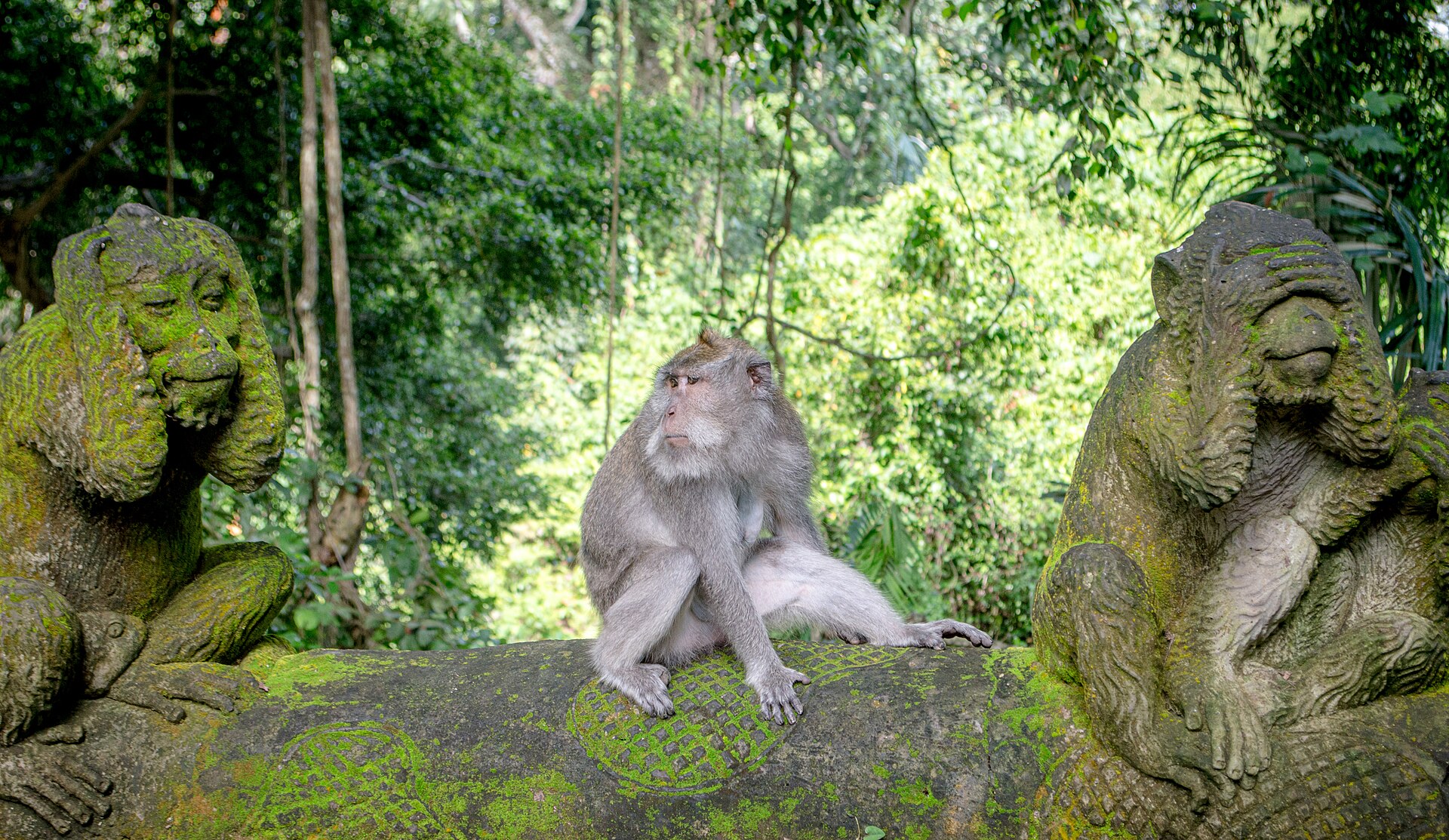
The animal you'll actually meet is the long-tailed macaque (Macaca fascicularis), at temple sites like Uluwatu and the Ubud Monkey Forest. They are wild, habituated, and smart. At Uluwatu especially, they run what amounts to an organised theft operation — grabbing sunglasses, phones and hats, then trading them back to on-site handlers for fruit.
Watch out
Treat them as wild animals, not photo props. Don't feed them, don't make eye contact while holding food or something shiny, and never try to grab a stolen item back. Rabies is endemic in Bali: a bite or a scratch counts as exposure — wash it for 15 minutes with soap and water and get to a clinic for the vaccine promptly.
The Bali starling: the island's rarest resident
The Bali starling (Leucopsar rothschildi) — snow-white with a sky-blue eye mask — is Bali's only endemic bird and one of the most endangered on earth. Trapping for the cage-bird trade pushed the wild population to a literal handful of birds in the early 2000s; captive breeding and protected releases have since nudged it back, but it remains critically endangered. Its stronghold is West Bali National Park and nearby Nusa Penida. Seeing one in the wild is a genuine stroke of luck, not a scheduled attraction.
Under the water: turtles, mantas, and a real reef
Bali's marine life is the easiest wild spectacle to see honestly. Green and hawksbill sea turtles graze the reefs around Amed, Menjangan and the Gili-facing coasts; manta rays cruise cleaning stations off Nusa Penida (Manta Point) most of the year; and the wreck at Tulamben and the wall at Menjangan are among the best beginner-friendly dives in Indonesia.
| Manta rays | Nusa Penida (Manta Point / Manta Bay), year-round but sea can be rough; peak sightings often Apr–Oct |
|---|---|
| Sea turtles | Reliable at Amed, Tulamben, Menjangan and Gili-side reefs — in open water, not tanks |
| Mola mola (sunfish) | Nusa Penida, cold-water season roughly Jul–Oct — advanced dive |
| Reef health | Patchy — some sites bleached or fished out, others recovering; a good operator picks the living ones |
Tip
See turtles and mantas where they actually live. A reputable dive or snorkel operator takes you to wild reefs and cleaning stations — no tanks, no handling, no touching the animals. Pick one that briefs you on not chasing or standing on the reef.
Book a dive / snorkel tripCheck availabilityRice-paddy ecology: the wildlife you'll actually walk past
The everyday nature of Bali is in the rice terraces. Flooded paddies are working wetlands: egrets and herons stalk the shallows, dragonflies swarm at dusk (they were traditionally caught and eaten), frogs call after rain, and the whole system is tuned by the ancient subak irrigation cooperatives. It's quiet, unstaged, and free — the antidote to the caged attractions.
The soundtrack: geckos and the tokay
Two lizards run Bali's ambient noise. The little house geckos ticking on your villa wall are harmless and useful — they eat mosquitoes. The big one is the tokay gecko, up to 30 cm, blue-grey with orange spots, whose loud, barking "to-kay… to-kay" call from the rafters startles every first-time visitor. Leave both alone and they'll quietly cut your bug population.
The traps: what to refuse
This is the honest part. A lot of Bali's animal "attractions" are welfare disasters dressed up as culture or novelty:
- Kopi luwak ("civet coffee"). The romantic story is wild civets choosing the best berries. The reality at most roadside plantations is caged, force-fed civets on a stress diet, for a coffee that's mediocre and wildly overpriced. Skip it.
- "Turtle islands" and turtle hatcheries (around Tanjung Benoa and Serangan). Many are photo-op tanks charging for handling; a few are legitimate conservation projects. If they let tourists hold the turtles, that's your answer.
- Elephant "sanctuaries" and rides. There are no wild elephants in Bali — every one was imported for tourism. Riding and bathing setups are the exploitative kind, whatever the "rescue" branding says.
- Chained monkeys, caged fruit bats, and "dancing" animals at photo stalls — walk on.
Watch out
Rule of thumb: if you can touch it, hold it, feed it on cue, or ride it, it's an attraction, not conservation. Wild Bali doesn't pose.
Where the wild things actually are
For the fullest dose of genuine wilderness, West Bali National Park and Menjangan Island are the payoff: dry monsoon forest, the starling's last wild ground, and a reef wall that still has its turtles. Closer to the tourist centres, the Ubud Monkey Forest and the rice terraces give you wild-ish nature without a long drive.
The newsletter
I'm writing Bali the way I wish someone had written it for me
The honest version — which reefs still have turtles, which "sanctuaries" to skip, one been-there guide at a time. Want the next one?