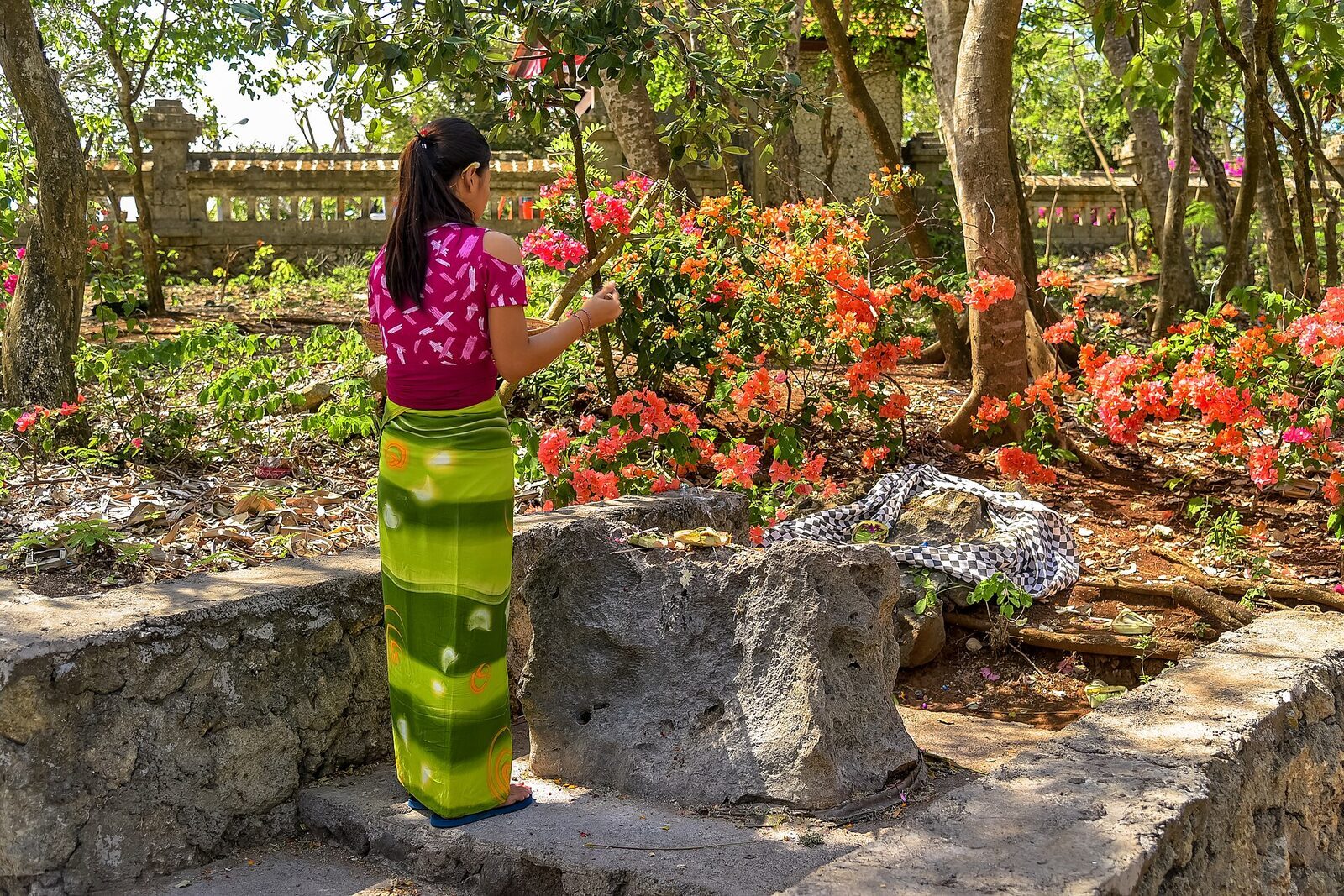
Balinese Hinduism () isn't "Indian Hinduism transplanted." It's a distinct island religion braided from three strands — Hindu, /Tantric Buddhist, and an older indigenous layer of ancestor and nature worship — where daily ritual, not doctrine, is the living core. And a couple of its most-quoted ideas are more modern than the guidebooks admit.
The offerings you'll see everywhere
Those small woven palm-leaf trays of flowers, rice and incense are — daily offerings of gratitude, placed and blessed each morning to keep the balance between (the seen world) and niskala (the unseen). Don't step on them. They're the most visible thread of a whole system of ritual sacrifice ().
Two famous ideas that are surprisingly recent
Guides often present these as timeless. They aren't, quite — and the real story is more interesting:
- "One supreme God" (). The monotheistic framing is largely a 20th-century achievement. After Indonesian independence, the state only recognised monotheistic "religions"; to qualify (and avoid being dismissed as mere custom), Balinese reformers foregrounded a single supreme principle and declared the many gods its manifestations. They didn't invent a god — they elevated an existing formless-absolute idea, , "the Unthinkable."
- — the lovely "harmony between people, the divine, and nature." The values are genuinely Balinese, but the three-part formulation was coined in the late 1960s and later became tourism and development branding. Real, but not ancient scripture.
Mountains, seas, and why Uluwatu is special
Balinese space runs on an axis: (toward the mountains — Gunung Agung, the pure, divine pole) and kelod (toward the sea — the powerful, dangerous pole). Here's the quiet paradox that makes Uluwatu remarkable: it's a sea temple sitting at the impure kelod edge, yet it's one of Bali's holiest — a guardian of that wild seaward frontier, not despite it.
A few things worth knowing before you go
- Temple etiquette: sarong and sash, cover shoulders, don't climb shrines, don't stand above a praying worshipper, use your right hand.
- The menstruation rule — women who are menstruating can't enter temple inner areas. It's easy to misread as "women are unclean"; it isn't. It's the purity system, triggered equally by blood, birth, and death — so it also bars men with open wounds and people in mourning. A ritual-purity concept, not a moral judgement.
- , the Day of Silence — the Balinese new year, when the entire island stops: no travel, lights, work, or noise, and the airport closes. Extraordinary; plan around it.
- — purification at holy springs (like Tirta Empul near Ubud); visitors can often take part respectfully with guidance.