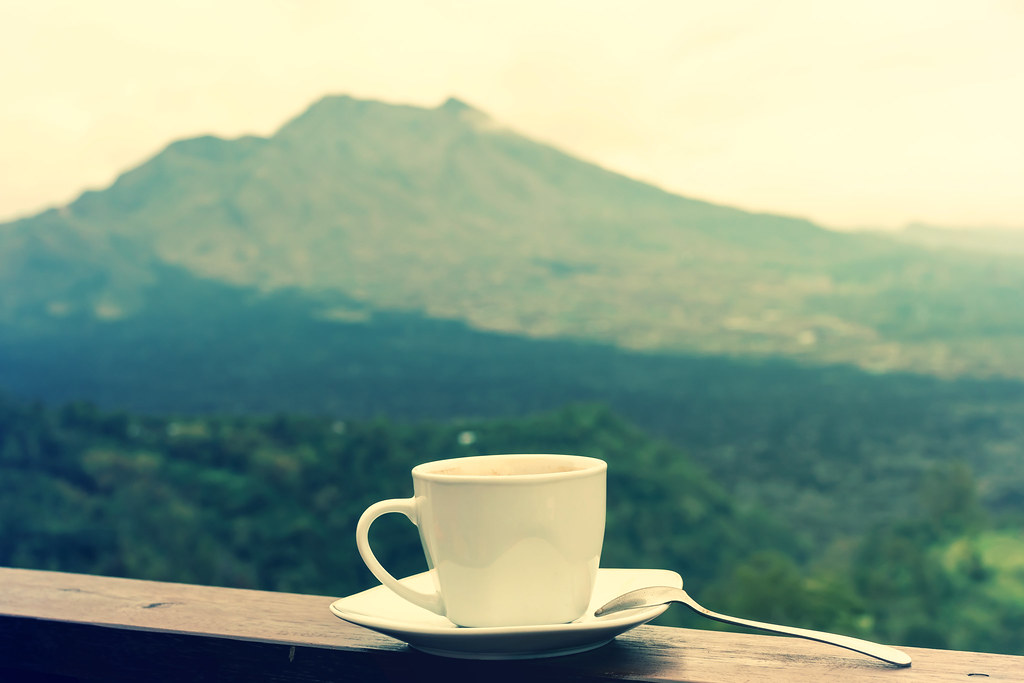
Bali · Coffee & tea
Coffee & Tea Plantations in Bali
A free tasting flight in a spice garden, a caged civet you should refuse, and a genuinely good volcanic arabica hiding behind the tourist stops. Here's how to tell them apart.
A "coffee plantation" on the Bali tourist circuit is almost never a working estate — it's a free-entry agrotourism garden on the road between Ubud and Kintamani, or up near Munduk, where you walk a short loop of spice and coffee plants and are handed a free tasting flight of a dozen little cups: ginseng coffee, coconut coffee, lemongrass tea, rosella, ginger. The catch is at the end — a paid cup of you should skip, and a gift shop that sells the same coffee at a steep markup. Know the model and it's a pleasant, low-pressure hour. The genuinely good Bali coffee — highland volcanic arabica — is a separate thing, and this is where to find it.
What a "plantation visit" actually is
Picture a garden, not an estate. You pull off the Ubud–Kintamani road, walk a signed loop of maybe fifty metres past coffee bushes, a cacao tree, some vanilla and lemongrass, while a guide names each plant. It takes ten minutes. Then you sit down at a shaded terrace — often with a view over a valley or terraced paddy — for the tasting. Entry is free, and there's no obligation to buy anything. The business runs on the paid luwak cup and the gift shop, which is why the walk is short and the tasting is generous.
This is not a con so much as a format. If you arrive expecting a rigorous farm tour of a real working plantation, you'll be disappointed. If you arrive knowing it's a free tasting garden with a soft sell at the end, it's a genuinely nice stop to break up a day trip — good coffee smell, a valley view, a dozen things to taste.
The free tasting flight
The tasting is the actual reason to stop. You get a tray — usually a wooden board with a dozen or more small cups — running through the range: plain Bali coffee, ginseng coffee, coconut coffee, vanilla, chocolate, then the teas: lemongrass, ginger, rosella (hibiscus), sometimes a "Bali" blend or a butterfly-pea. Most are pre-sweetened and frankly more about novelty than quality, but it's fun, and it's free.
The one cup that isn't free is the kopi luwak, offered at the end for a price that can be many times a normal coffee. You are under no pressure to order it, and — see below — you shouldn't.
Tip
A plantation stop pairs naturally with a Kintamani or Ubud day trip — it sits right on the road up to the volcano, and slots in between the rice terraces and the crater view without adding much time. If you'd rather have a driver handle the whole loop (terraces, plantation, volcano viewpoint) than negotiate stops yourself, a day tour is the easy way.
Find a Kintamani day tripCheck availabilityKopi luwak: skip the cup
Here's the honest part. Kopi luwak is coffee made from beans eaten and passed by the Asian palm civet — a small nocturnal mammal — the idea being that the animal picks the ripest cherries and its gut ferments the bean. The romantic story is of wild civets foraging free. The reality at most roadside stops is a caged civet, often kept awake in daylight and fed a monotonous diet of cherries to keep production up. It's a welfare problem, plainly, and I cover it in more depth on Bali's wildlife page.
Set the ethics aside for a second and it still doesn't add up: the coffee is mediocre. It's a novelty priced as a luxury, and the caged-animal version can't be distinguished by taste from ordinary beans anyway. Skip the luwak cup. You lose nothing but a gimmick, and you stop paying into the caging.
Watch out
The gift shop is the other soft trap. The coffee on the shelf — luwak and otherwise — is typically marked up well above what the same beans cost in a Kintamani village shop or an Ubud roaster. If you want to take real Bali coffee home, note the origin and buy it from a proper third-wave roaster in Ubud or Canggu, not the tasting-garden counter.
Where the real coffee is: highland Kintamani arabica
Bali's actually-good coffee grows where the tour buses only pause for the view: the Kintamani highlands, on the volcanic plateau around Mount Batur. Up here the arabica thrives — cool nights, rich volcanic soil, altitude — and it's grown in the traditional , the highland cousin of the subak rice-irrigation cooperatives, with coffee interplanted among citrus that lends the cup a characteristic bright, clean, faintly orange-citrus note. Kintamani arabica carries a protected Geographical Indication — a legal origin mark, the same idea as Champagne — which is a real signal of provenance, not a marketing sticker.
The lowlands, by contrast, grow robusta — hardier, higher in caffeine, blunter and more bitter — which is what fills most of the cheap local cups and much of what you taste in the roadside gardens. Neither is "bad," but if you want the coffee Bali is genuinely known for, you want highland arabica.
| Highland arabica | Kintamani plateau around Batur; volcanic soil, grown in the abian, citrus-bright, holds a Geographical Indication |
|---|---|
| Lowland robusta | The hardier, more bitter bean; most cheap local coffee and much of the tasting-garden pour |
| Other good ground | The Ubud–Kintamani road, the Munduk ridge in the north, and Pupuan in the west highlands |
| Where to actually drink it | Third-wave cafés in Ubud and Canggu roasting single-origin Kintamani and Bali beans |
The most reliable way to taste good Bali coffee isn't a plantation at all — it's a specialty café in Ubud or Canggu, where a proper roaster is buying single-origin Kintamani beans and treating them seriously. Order it black, filter or as a long black, and you'll understand what the highland fuss is about.
And the "tea"?
Be honest about the tea: Bali is not a tea island. Real tea — the Camellia sinensis leaf — is grown at scale on Java and Sumatra, not here. What the tasting sheds pour as "Bali tea" is almost all herbal infusion: lemongrass, ginger, rosella (dried hibiscus, tart and ruby-red), pandan, sometimes a butterfly-pea that turns blue. They're pleasant, they're local, and they're genuinely nice hot or iced — but they're tisanes, not tea, and it's worth knowing that before you buy a "tea" gift box expecting the leaf.
If you want actual tea culture on your trip, this isn't the island for it. If you want a jar of dried rosella or lemongrass to bring home a taste of the tasting terrace, that's a fair souvenir — just buy it knowing what it is.
Where these gardens are
Most of the tasting gardens cluster on the Ubud–Kintamani road, exactly where a day trip already runs — up past the rice terraces toward the Batur crater rim — with a second cluster near Munduk in the northern highlands. That's convenient: you don't need to make a special journey. Fold one into a day you're already spending on that road, taste the free flight, skip the luwak, and if the coffee grabs you, chase the real thing in a Kintamani village shop or an Ubud roaster on the way back.
So, is it worth stopping?
Yes — if you know what it is. Treat the roadside plantation as a free tasting garden and a pleasant break, not an authentic estate tour. Enjoy the dozen little cups, walk the loop, refuse the caged-civet coffee, and don't overpay at the gift counter. Then, if Bali coffee actually interests you, go find the highland Kintamani arabica where it's grown and where it's roasted well — that's the cup worth flying home remembering.
The newsletter
I'm writing Bali the way I wish someone had written it for me
Which tasting stops are worth it, which cup to refuse, where the real highland coffee hides — one been-there, honest guide at a time. Want the next one?