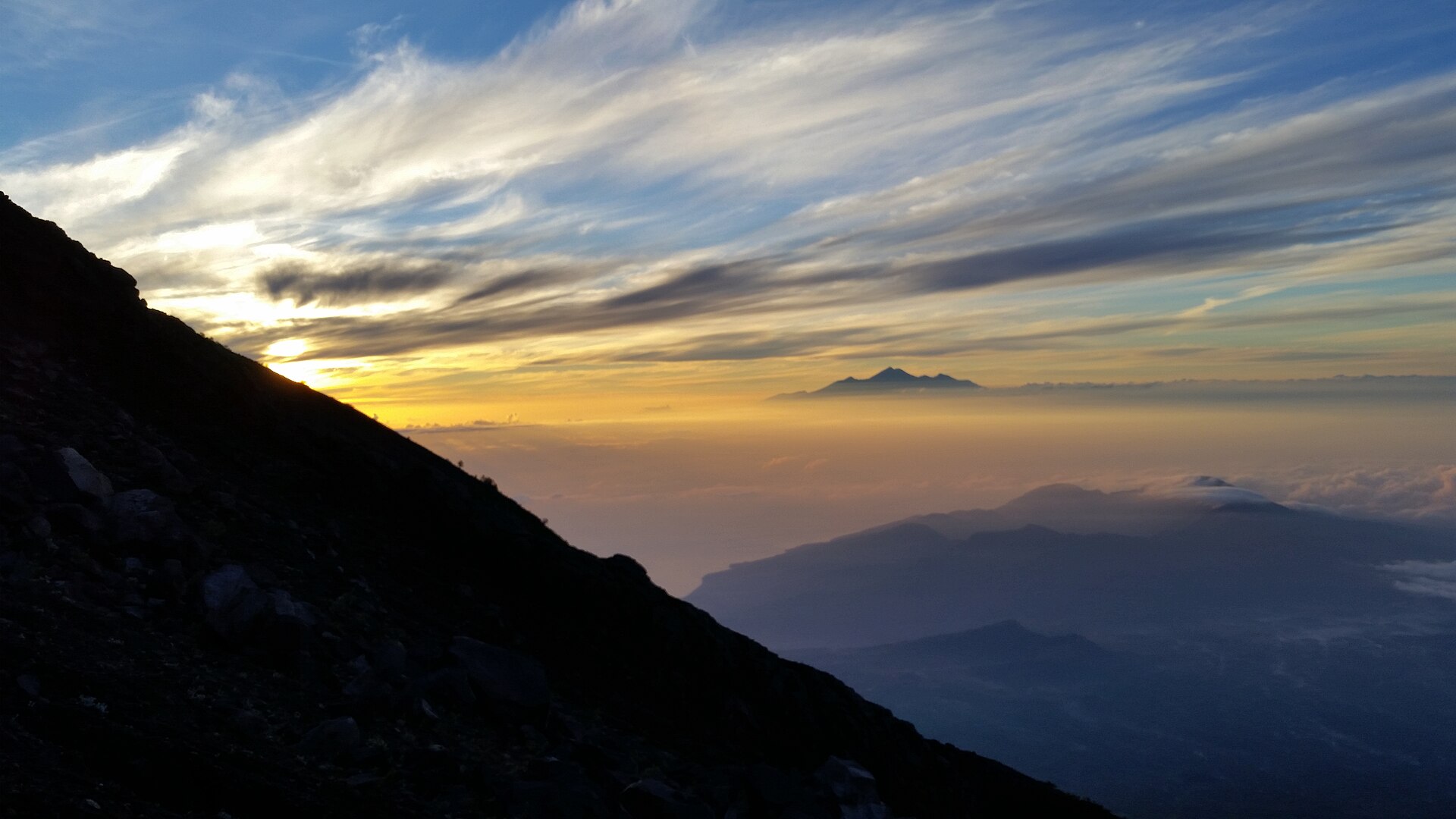
Mount Agung is Bali's highest point (3,031 m) and its most sacred — the mountain the whole island orients itself toward. It's also a serious pre-dawn climb, not a scenic viewpoint you drive to, and the single most useful thing to know is this: it is far harder than the Batur sunrise trek everyone lumps it in with. If you just want a volcano sunrise with minimal suffering, you probably want Batur. If you want the real summit of Bali, read on.
First, the honest expectations
Agung is a 6–8 hour round trip of relentless up and down, started around midnight, much of it in the dark on loose volcanic scree and, near the top, hands-on rock scrambling. There are no railings, no steps, no lights. Trekkers turn back every night. The reward — the shadow of the cone thrown across the clouds at dawn, sea and other volcanoes floating below — is genuinely one of the great sights in Indonesia. But it is earned.
Watch out
Agung is an active volcano. It erupted seriously in 1963 (one of the deadliest eruptions of the 20th century) and again in 2017–2019, when the summit was closed for long stretches and thousands were evacuated. Closures can happen at short notice on volcanic-activity grounds. Always check current status before you book, and treat any "summit guaranteed" sales pitch with suspicion.
The two routes
There are two common start points, and picking the right one matters more than most people realise.
| Pasar Agung (south) | The shorter, more popular route from the Pasar Agung temple. Roughly 3–4 hours up. It reaches the crater rim (~2,900 m), not the true summit — a big view, less commitment. |
|---|---|
| Besakih (southwest) | The longer, harder route from near the Mother Temple to the actual 3,031 m summit. Around 5–7 hours up, more scrambling, more elevation. This is the "real Agung." |
| Which to pick | Fit and want the summit → Besakih. Want the sunrise with a bit less punishment → Pasar Agung. Both start around midnight to hit dawn up top. |
| Season | Dry season (roughly April–October) only. Wet-season trails are dangerous and views are usually clouded out. |
Guides are mandatory — and that's fair here
You cannot and should not climb Agung without a licensed local guide. This isn't a tourist-tax formality: the trails are unmarked, the dark scree is genuinely disorienting, and — because the mountain is sacred — access is managed by the local community. A guide handles the route, the pace, headlamps, and often a light breakfast at the top. Prices vary by route and group size; budget in the region of 500,000–1,000,000+ IDR per person, more for the summit route and small groups.
Tip
The simplest way to sort a licensed guide, the midnight transfer, and the permit in one booking is a packaged sunrise trek — worth it here given the logistics and the safety stakes.
Find a tour with pickupCheck availabilityThe closure nobody warns you about: ceremonies
Beyond volcanic activity, Agung and Besakih close to climbers during major religious ceremonies — and because this is the holiest ground in Bali, those aren't rare. During big temple festivals it's considered improper to be treading above the sanctuaries. These closures can land with little notice on the tourist calendar, so build slack into your plans and confirm your date is clear before you commit non-refundable bookings.
Why the mountain matters so much
On the Balinese axis of (toward the mountains, the pure and divine) and kelod (toward the sea), Agung is the ultimate kaja pole — the direction temples face and beds are oriented toward across the island. On its southwest flank sits Besakih, the Mother Temple, the largest and holiest temple complex in Bali. Understanding that is half the reason to come to East Bali at all; the mountain isn't scenery here, it's the spiritual centre of gravity. (For the bigger picture, see Balinese Hinduism.)
Should you climb Agung or Batur?
The honest comparison most operators blur:
- Mount Batur (1,717 m) — the famous "Bali sunrise trek." About 2 hours up, doable by most reasonably fit people, cheaper, closer to Ubud, and often crowded. The right call for a first volcano or a casual sunrise.
- Mount Agung (3,031 m) — nearly twice the elevation, far more demanding, quieter, and spiritually the real thing. The right call if you're a confident hiker chasing the actual summit of Bali.
If you're on the fence, be honest about your fitness. Plenty of people book Agung on the strength of a Batur blog post and regret it on the scree at 3 a.m.
Practical notes
| Start time | Around midnight–01:00 to reach the top by sunrise (~06:00). |
|---|---|
| Bring | Proper hiking shoes (not sandals), warm layers — the summit is genuinely cold and windy — headlamp (guides usually supply), gloves for the scramble, 2+ litres water, snacks. |
| Fitness | Steep, sustained, loose underfoot. If long stair-climbs wreck you, reconsider the Besakih summit route. |
| Getting there | East Bali, roughly 2–2.5 hours' drive from Ubud or the south; treks usually include a night transfer. |
| Respect | It's a sacred mountain — follow your guide on where not to go, and don't bring beef up it (a local taboo). |
Go deeper
The newsletter
I'm writing Bali the way I wish someone had written it for me
The volcanoes, the water palaces, the quiet east — one honest, been-there guide at a time. Want the next one?