Home › Bali › Rice & the Subak
Bali · Landscape
Rice Terraces & the Subak
The terraces aren't just scenery — they're the visible surface of a thousand-year-old water democracy still running today.
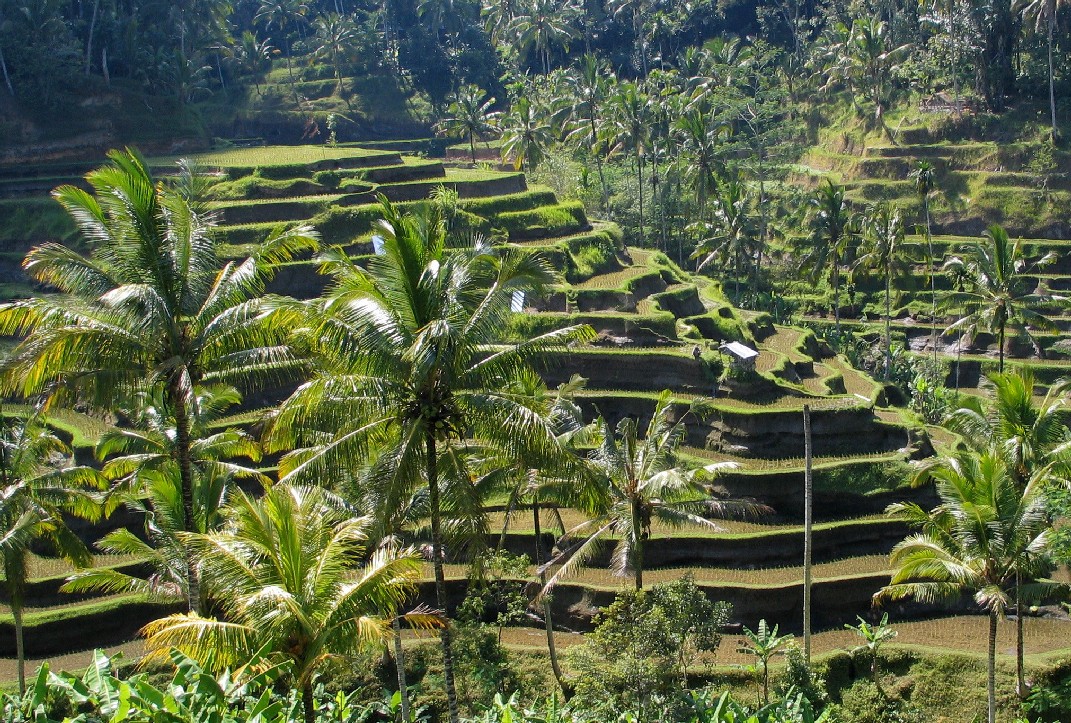
The terraces on every Bali postcard are real, and they are genuinely worth seeing — but the interesting part isn't the view. It's that those curves are the surface of a 1,000-year-old irrigation democracy called the , still run today by the farmers themselves. Understand that, and a rice field stops being a photo backdrop and starts being the most quietly radical thing on the island.
The subak, in one paragraph
A subak is a cooperative of farmers who share one water source — a spring, a river, a dam — and collectively decide who gets how much, and when. Each has its own assembly, its own written rules, and its own temple. Water flows downhill through a web of channels, tunnels and bamboo splitters, and the split is deliberately equal and transparent: a farmer upstream can't simply hoard the flow, because the whole system is governed by consensus and sealed by ritual. Dutch colonial officials, and later Green Revolution planners, both assumed it was inefficient peasant tradition. Both were wrong.
Why it's cultural, not just scenic
In 2012 UNESCO listed the Bali subak landscape as a World Heritage site — explicitly as a living embodiment of , the Balinese ideal of harmony between people, nature, and the divine. That's not a marketing gloss bolted on afterwards. The water is physically routed through a hierarchy of water temples, and planting schedules are set at temple meetings, not by an agriculture ministry.
Here's the part that startled scientists: in the 1980s the government pushed farmers onto continuous high-yield cropping and told them to ignore the temple calendar. Harvests collapsed under pests and water shortages. When ecologist Stephen Lansing modelled it, the old temple-coordinated, synchronised fallow-and-flood cycle turned out to be a near-optimal solution to pest control and water-sharing across a whole watershed. The priests had been running sophisticated resource management for centuries — dressed as religion.
Dewi Sri and the growing cycle
Rice in Bali is a goddess before it's a crop. , the rice-and-fertility goddess, presides over every stage, and you'll see her honoured in small shrines at the corner of paddies and in woven palm-leaf figures at harvest. The cycle runs roughly: flood the field, transplant the bright-green seedlings by hand, watch it deepen to gold over three to four months, then harvest — with offerings at planting, at the first flowering, and at the cutting. A field mid-cycle looks like glass; a field near harvest looks like it's on fire. The "perfect emerald terraces" of the photos exist for only part of the year — after harvest you get mud and stubble, which is honest, ordinary, and not what the drone shots promised.
Jatiluwih vs Tegallalang — the honest comparison
This is the decision most people actually need help with, so here it is straight.
| Tegallalang (near Ubud) | Small, steep, dramatic, and 20 minutes from Ubud — which is exactly why it's mobbed. It's a narrow valley you photograph from the road, not a landscape you walk into. Expect a "Bali Swing" and jungle-swing sprawl, plus repeated donation boxes as you descend — each farmer's plot has an informal toll. Go at 7–8am or skip it. |
|---|---|
| Jatiluwih (central highlands) | The UNESCO-listed one: vast, gently sloping, a working subak you can walk for an hour on marked trails. Far fewer people, cooler air, real farming. It's ~1.5–2 hours from Ubud or the south, so it filters out the drive-by crowd. If you want the actual thing, this is it. |
| Entry | Both charge a modest per-person fee (Jatiluwih also has a small car fee); think low tens of thousands of IDR each. Bring cash. |
| Best light | Early morning for calm water and soft light; late afternoon for gold. Midday is flat, hot, and busiest. |
Watch out
At Tegallalang the terraces are privately farmed, and the "free" viewpoint isn't really free once you walk down: individual owners collect a small donation at each section, and the famous swings are separate paid attractions. None of it is a scam — it's how the farmers monetise the foot traffic — but arrive knowing you'll pay in pieces, and keep small notes handy.
Tip
Both sets of terraces are far easier as a half-day trip with a driver than by scooter — the roads are winding, parking is chaotic, and a driver can pair Jatiluwih with a highland temple or waterfall. Negotiate a flat day rate, not per-stop.
Book a rice-terrace day tripCheck availabilityWalking a terrace without wrecking it
The paddy bunds — those narrow earth walls between fields — are someone's irrigation infrastructure and someone's crop, not a footpath network. Stick to marked trails, don't trample seedlings for a photo, ask before entering a field that isn't clearly open to visitors, and don't move or block the water splitters. A friendly farmer waving you along a bund is fine; wandering in solo is not.
What you're really looking at
Next time you see a Bali terrace, notice the water: where it enters, how it's split, and the little shrine at the inlet. You're looking at engineering, ecology, and religion doing the same job at once — which is exactly what Balinese Hinduism means by Tri Hita Karana, made visible in mud and moving water.
The newsletter
I'm writing Bali the way I wish someone had written it for me
The subak, the temples, the terraces worth the drive — one honest, been-there guide at a time. Want the next one?