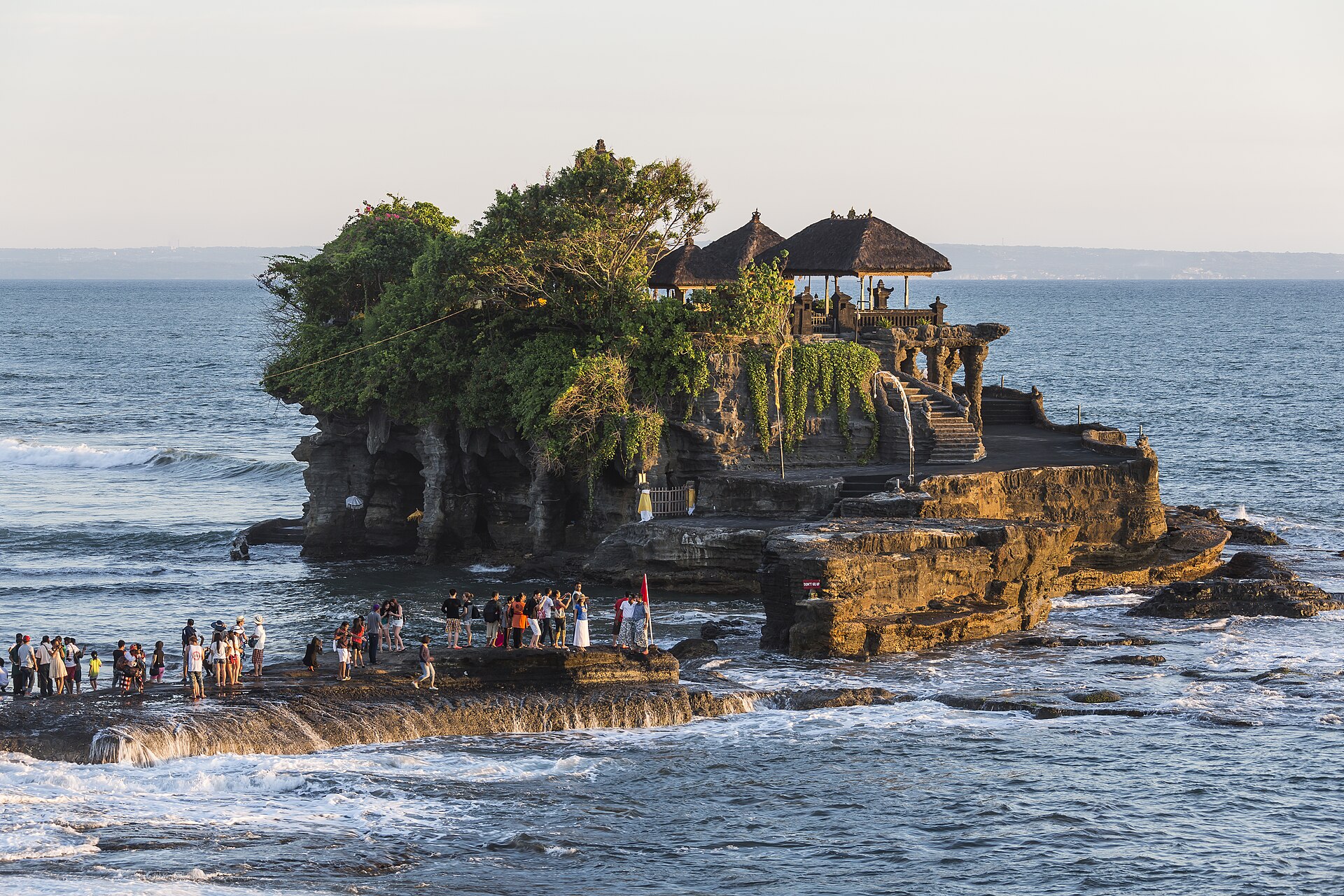
Tanah Lot is the sea temple on the postcard — a stubby pagoda-topped rock marooned in the surf, going black against an orange sky. It genuinely delivers that shot. It's also one of the most crowded, most commercialised sights in Bali, and you can't actually go inside the temple. Come for the silhouette, know what you're walking into, and you'll have a lovely evening. Arrive expecting a serene spiritual moment and you'll be annoyed.
What you're actually seeing
Tanah Lot ("Land in the Sea") is a said to have been established in the 16th century by the wandering priest , the same figure linked to Uluwatu and much of Bali's coastal temple chain. It sits on a small tidal islet, and it is one of Bali's most important sea temples — a working place of worship, not a museum.
The catch every first-timer discovers: only Balinese Hindus going to pray may climb up to the temple itself. Everyone else views it from the shore and the rocks around its base. That's fine — the temple is a silhouette experience, best from a distance anyway — but don't come expecting to wander its courtyards the way you might imagine.
The tide decides your visit
This is the single most useful thing to know, and most people don't check it.
- Low tide: you can walk across the exposed rock right up to the foot of the temple, poke around the sea caves, and get close to the base. This is where the "holy snake" and the blessing spring are (more on that below).
- High tide: the rock becomes a true island, cut off by surf. You view it only from the mainland cliffs and the shore — which, honestly, is the better photo anyway, since the water around the base is what makes the silhouette read.
Sunset is the whole point, so the ideal is a sunset that happens to fall near low tide — check a Bali tide table for your date before you commit to an evening.
Watch out
The "holy snakes" and the "blessing spring" at the base are a manufactured tourist ritual, not an ancient rite you must do. An attendant shows you a (harmless, docile) sea snake said to guard the temple, or dabs holy spring water on your forehead and sticks a grain of rice on — then expects a "donation," often steered toward a specific amount. It's harmless and mildly fun if you're curious; it is not obligatory and not a scam exactly, but it is a paid photo-op. Decline politely if you'd rather not, and don't feel you've missed the "real" temple by skipping it.
The crowds and the gauntlet, straight
Let's be honest about the approach. From the car park to the viewpoint you walk through a dense, several-hundred-metre gauntlet of souvenir stalls, , and hawkers — sarongs, ice cream, magnets, "massage." It's one of the most heavily commercialised temple approaches on the island, and at sunset in high season the shoreline viewpoints are shoulder-to-shoulder, phones up.
None of this means don't go. It means: plan your position. The classic shot is from the northern cliff (near the Batu Bolong temple / café terraces) looking back at Tanah Lot with the sun behind it. Get there early, claim a spot, and let the crush build around you rather than fighting into it at 5:55pm.
Batu Bolong, the underrated neighbour
A five-minute walk north sits Pura Batu Bolong, a smaller temple on a cliff-arch with the sea washing through a hole in the rock beneath it. It's far less mobbed, and it's arguably the better foreground for your Tanah Lot sunset. Most people miss it — don't.
| Getting there | ~45–60 min from Canggu/Seminyak, ~1.5–2 h from Ubud. No reliable public transport — driver, scooter, or tour. |
|---|---|
| Entry | ~75,000 IDR foreign adult (~40,000 child), plus a small parking fee (~5,000 IDR car); cash, paid at the gate. |
| Hours | Roughly 07:00–19:00 daily; most visit late afternoon for sunset. |
| Best time | Arrive ~1.5 h before sunset. Dry season (May–Oct) for reliable skies; check the tide table for a low tide near dusk. |
| Bring | IDR cash, sun protection, and a scarf/sarong if you plan to pay respects nearby. |
Is it worth it?
Yes — with the right expectations. As a photograph and a piece of Bali's cultural scenery, Tanah Lot is genuinely iconic and worth one evening.
As a peaceful temple visit, it isn't; it's a busy, monetised attraction. Treat it as a sunset outing, pair it with the quieter Batu Bolong and maybe the Jatiluwih terraces inland earlier in the day, and go in clear-eyed. The people who leave disappointed are usually the ones who expected solitude.
Tip
Easiest way to do it — a half-day driver or a sunset tour handles the awkward drive out to Tabanan and back (and can stack Tanah Lot with Jatiluwih or a rice-terrace stop), so you're not negotiating a ride home in the post-sunset car-park crush.
Book a guided day tripCheck availabilityGo deeper
The newsletter
I'm writing Bali the way I wish someone had written it for me
Sea temples, rice terraces, the quiet corners between the famous shots — one honest, been-there guide at a time. Want the next one?