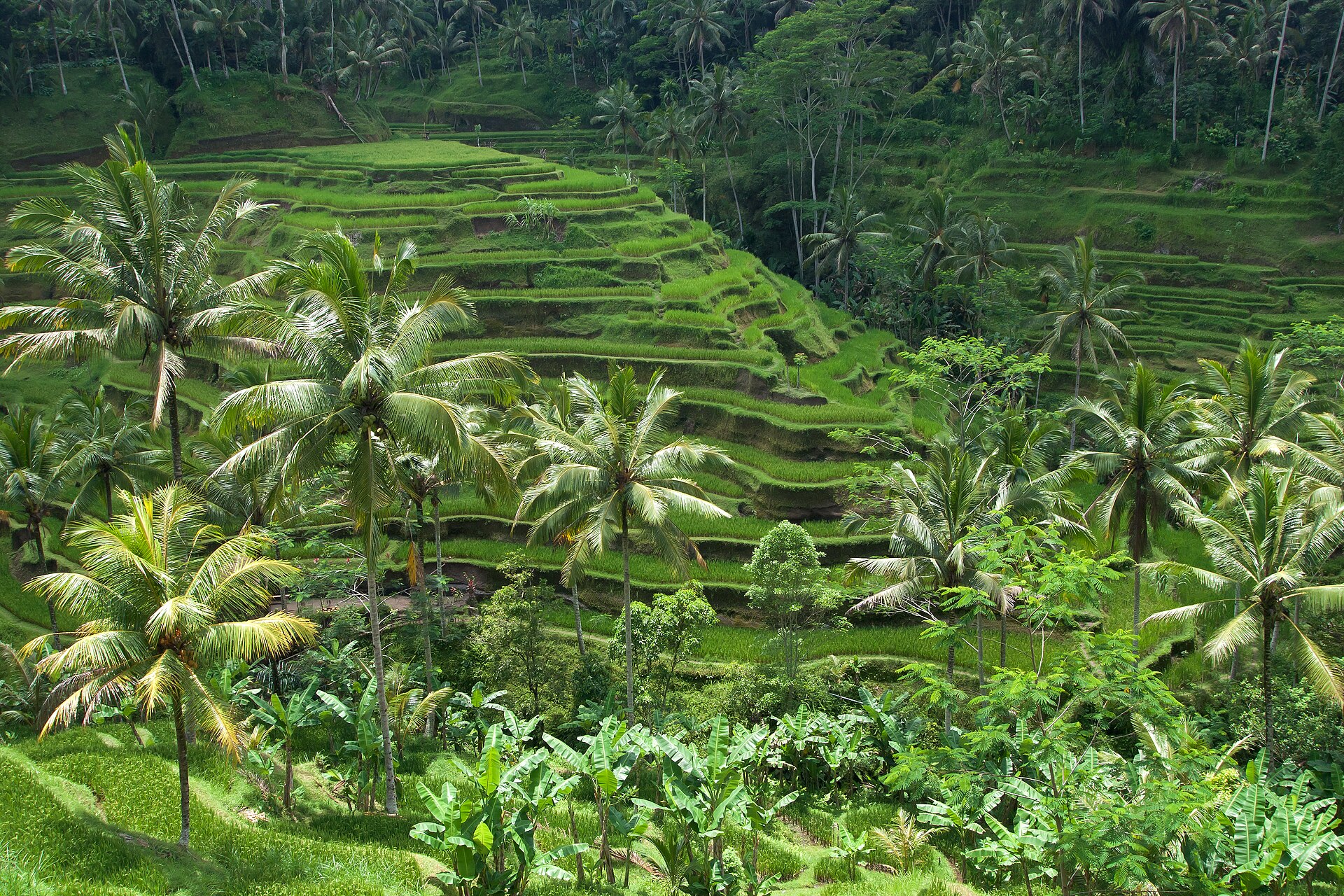
Tegallalang is the rice terrace you've seen a thousand times on Instagram, and the first thing to know is that it's small — a single steep valley you can walk in under an hour, not an endless green sea. The second thing: the walk down is lined with "donation" checkpoints, informal gates where locals ask for a few thousand rupiah to pass. Go early, bring small cash, keep your expectations calibrated, and it's a genuinely lovely 45 minutes. Go at midday expecting solitude and you'll be disappointed.
The donations, explained
This trips up almost everyone. Beyond the official entry fee at the top, the path down through the paddies passes several informal donation posts run by families whose land the trail crosses. They'll hold out a box and ask for a contribution — typically 10,000–20,000 IDR each. It's not a scam exactly; the terraces are working farmland and the trail cuts through private plots. But it's also not clearly signposted, and the asks stack up fast.
Watch out
Carry a stack of small notes (5k–10k) and decide your budget before you start down. You can politely decline, but expect some persistence. The famous swings and "nests" along the rim are a separate paid attraction — usually 100,000–350,000 IDR per person for a swing session, harnesses included.
Is it actually worth it?
Yes, with the right frame. The valley is genuinely beautiful — sculpted -fed paddies climbing both sides of a narrow gorge, coconut palms on the ridgelines, the light doing lovely things early and late. But it is one compact valley, heavily developed along the rim with cafés and swing operators, and busy. Treat it as a photogenic 45-minute stop, not a half-day nature immersion, and you'll leave happy.
When to go
Early morning is the whole game. Arrive by 7–8am and you get soft light, cooler air, far fewer people, and vendors who haven't fully set up yet. By 10am the tour buses and the heat both arrive. Late afternoon (~16:30) is a decent second choice for light, but crowds linger and the valley falls into shade earlier than you'd expect.
The paddies are greenest and most sculpted in the growing season — roughly the months after planting, before harvest leaves the terraces brown and stubbled. There's no single perfect month, but a lush, flooded-and-green valley is luck of the draw, so it's worth asking your driver what the fields look like right now.
| Getting there | ~20–30 min north of central Ubud by car/scooter (about 9–10 km); the road (Jl. Raya Tegallalang) is narrow and parking is chaotic. |
|---|---|
| Entry fee | ~25,000 IDR per person at the top, plus the informal donation posts on the walk down. |
| Best time | 7–8am for light, cool, and space. Avoid 10am–3pm. |
| Time needed | 45–90 min including the loop down and back up (it's a real climb returning). |
| Bring | Small-denomination cash, water, and shoes with grip — the steps get slick. |
The quieter alternative: Jatiluwih
If you want the endless rice-terrace feeling — the vast, calm, no-swings-no-hawkers version — go to Jatiluwih instead, about 1.5–2 hours northwest. It's a UNESCO-listed landscape, far larger, far quieter, and built around real walking trails through working farmland rather than a photo rim. It's less convenient and less dramatic in a single frame, but it's the honest choice if crowds are what put you off Tegallalang.
Tip
The easiest way to do Tegallalang well is with a private driver who gets you there at opening and can chain it with Tirta Empul, a coffee-and-luwak stop, or push on to Jatiluwih. You skip the parking scrum and set your own pace.
Hire a private driverCheck availabilityWhat to pair it with
Tegallalang sits on the classic Ubud north loop. Combine it with Tirta Empul for a morning of terraces-then-holy-spring, or keep it simple and cap an Ubud day with the free, uncrowded Campuhan Ridge Walk at dusk. See the whole area in the Ubud guide.
The newsletter
I'm writing Bali the way I wish someone had written it for me
Ubud, Nusa Penida, the Bukit beaches — one honest, been-there guide at a time. Want the next one?