Home › Bali › Ubud › Tirta Empul
Ubud · Holy spring
Tirta Empul
A working 10th-century water temple where Balinese come to be purified — and where, with a little respect, you can wade in too.
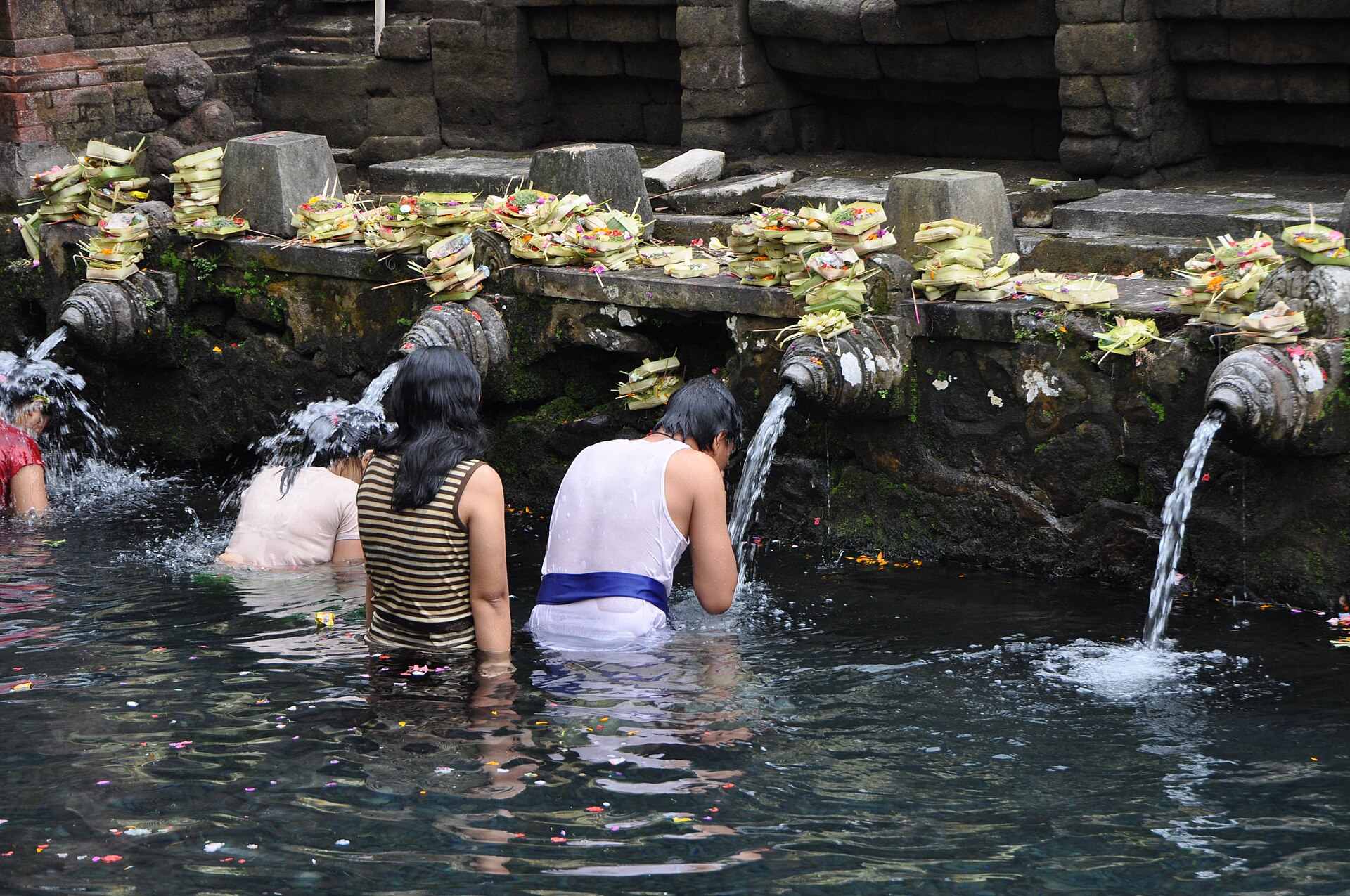
Tirta Empul is a living temple, not a photo backdrop — Balinese families queue at the spouts to be spiritually cleansed, and the number-one way visitors get it wrong is treating the bathing pools like an Instagram water feature. Go in understanding the ritual () and you can take part respectfully. Go in clueless and you'll either offend someone or waste the trip filming from the edge.
What it actually is
A spring has bubbled up on this spot for over a thousand years — the temple around it dates to roughly 962 CE. The water is considered tirta, holy water, and the two long stone pools are fed by it through a row of carved spouts. People come to perform melukat: praying at each spout in turn, ducking their head under the flow, and letting the water carry away spiritual impurity and bad luck. It's genuinely one of Bali's most important water temples — and unlike a lot of the island's "attractions," it's still doing exactly what it was built to do.
The two-temple photo confusion
Here's the trap that catches almost everyone. The famous shot of a person under a spout in front of a huge, symmetrical reflecting pond with a black gate behind them? That is usually NOT Tirta Empul. That's the private temple at the Gunung Kawi Sebatu area, or more often the ornamental pool at a different site entirely. Tirta Empul's real bathing pools are lovely but busy and workmanlike — grey stone, crowds, algae on the edges. Come for the ritual and the atmosphere, not for a magazine cover you saw online. Adjusting that expectation is half of enjoying the place.
Doing melukat without getting it wrong
You're welcome to bathe, but only under real conditions. Take it seriously or skip it.
Watch out
Do not enter the pools if you're menstruating, bleeding from a wound, or in mourning. This isn't arbitrary — it's the purity rule (see Balinese Hinduism), which bars anyone in a state of ritual impurity, men included. Entering anyway is a real breach, not a technicality.
- Wear a proper sarong for the water. You'll be given/rent one; there are usually separate wet sarongs for bathing and a changing area. Don't bathe in a bikini or shirtless — cover up.
- Follow the order. Start at the leftmost spout and move right, one at a time, cupping and drinking is not the point — you bow, splash your face, then put your head fully under the flow three times.
- Skip specific spouts. A couple of spouts near the far end are reserved for funeral and death purification rites — locals skip them and so should you. If you can't tell which, ask an attendant or simply stop a few spouts before the end.
- Bring a small offering / donation and keep valuables in a locker — you're going in the water.
Tip
Easiest way to do it right: go with a driver-guide who can walk you through the ritual order, handle the sarong and offering, and pair Tirta Empul with Tegallalang or Goa Gajah so the ~1-hour drive from Ubud isn't wasted on one stop.
Book a guided day tripCheck availabilityCrowds, timing, and whether it's worth it
Worth it? Yes — if you actually bathe or come early. As a look-from-the-edge stop it's a middling temple with a big car park. As a participatory ritual at the right hour it's memorable.
| Getting there | Tampaksiring, ~40–60 min northeast of central Ubud; pair with Tegallalang. |
|---|---|
| Hours | Roughly 08:00–18:00 daily; last entry earlier. |
| Entry | 75,000 IDR adult, 50,000 IDR children 5–12; sarong loan included. |
| Best time | Right at opening (~08:00) or late afternoon. Mid-morning to ~2pm the tour buses arrive and the pools get shoulder-to-shoulder. |
| Bathing kit | Bring a dry change of clothes, a towel, and flip-flops; use the paid lockers. |
The rest of the temple (don't skip it)
Most visitors mob the pools and miss the inner courtyard past them, where the actual spring wells up — you can see the sand boiling at the bottom of a clear tank, which is the whole reason the temple exists. There are handsome tiered shrines and, on the hill above, a Sukarno-era presidential rest house overlooking the complex — a slightly odd modern footnote to a 1,000-year-old spring. And yes, you exit through the obligatory gauntlet of souvenir stalls; that's normal, just keep walking if you're not buying.
One more etiquette note
This is a place of worship first. If a Balinese family is praying at a spout, wait — don't crowd in for your turn or your photo. Keep your camera down around people mid-ritual unless you've asked. The staff are used to respectful visitors bathing alongside locals; what wears on them is people treating a sacrament like a splash pool.
The newsletter
I'm writing Bali the way I wish someone had written it for me
Ubud's temples, terraces and ridge walks — one honest, been-there guide at a time. Want the next one?