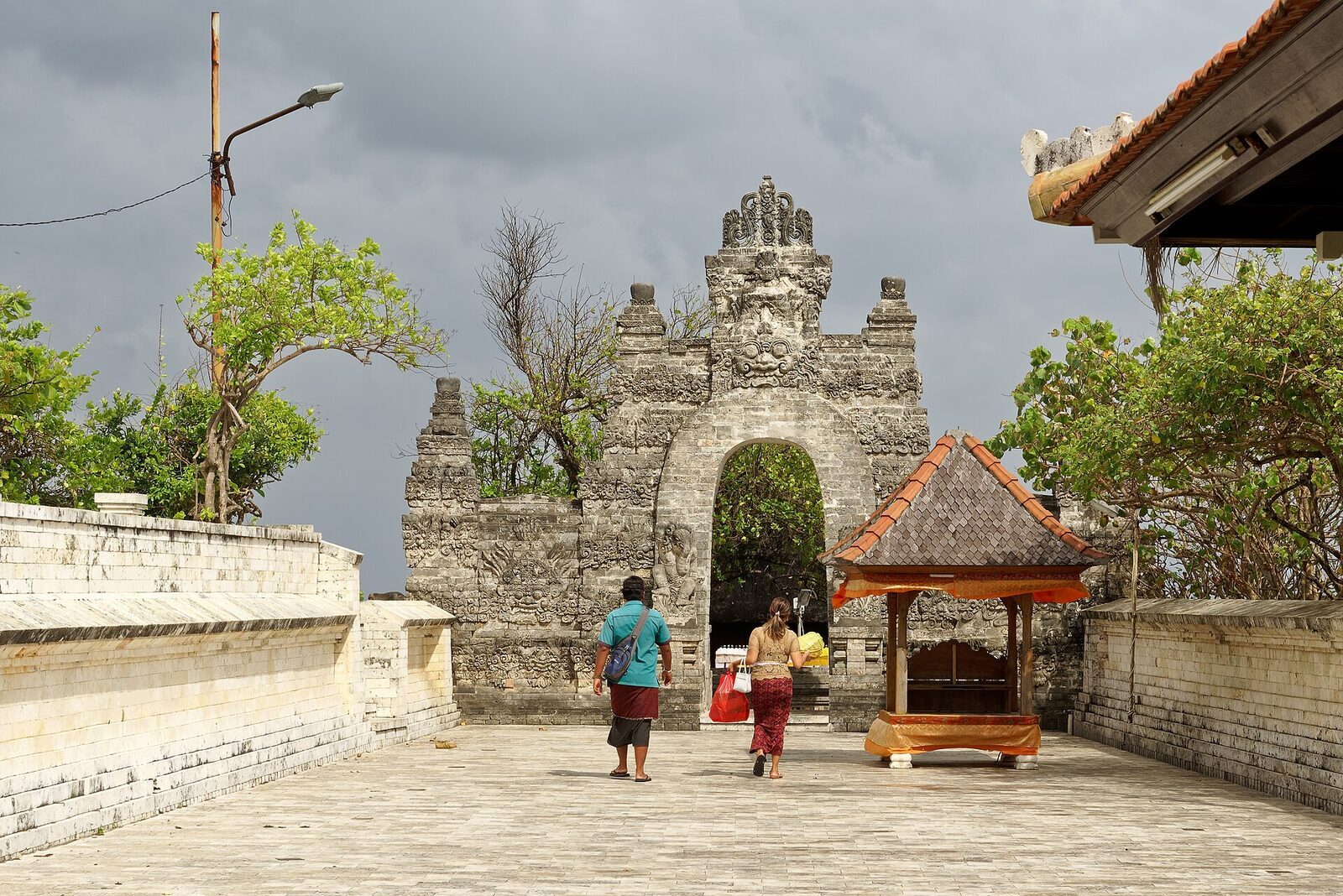
Almost every Uluwatu guide gives you a confident founding date. The honest answer is more interesting: there's no firm archaeological founding date for Uluwatu. Its origins are traditional and legendary; the earliest evidence anyone can actually date is a 16th-century building phase. Here's what holds up — and what's just repeated.
A temple at land's end
The name is solid ground. In Balinese, ulu means "head" or "land's end" and watu means "rock" — the temple on the rock at the end of the land, at the south-western tip of the Bukit Peninsula. It's a (sea temple) facing the open Indian Ocean, and it's one of the island's great directional sanctuaries.
The 11th-century story — a tradition, not a fact
You'll read that Uluwatu was "founded in the 11th century by Mpu Kuturan." That's a traditional attribution — it comes from an old Balinese text (the Usana Bali), not from inscriptions or archaeology. Kuturan himself is a hazy figure: scholars suspect the name may actually cover more than one person across different eras. So the accurate way to say it is "tradition credits the temple to Kuturan," not "Kuturan built it." Be especially wary of the "886 CE" date some sites cite — no scholar supports it.
The one figure we can actually date
The temple is bound up with , a travelling priest of huge influence on Balinese Hinduism — and he was genuinely real: a manuscript colophon dated 14 July 1537 places him active in Bali, at the Gelgel court. Tradition holds he attained (spiritual liberation) on this cliff — the "ngeluhur" ("going up") that some link to the name Luhur. That death-story, with its shawl turned to stone, comes from a hagiographic text (the Dwijendra Tattwa) written by his descendants — beautiful, but legend, not record.
Archive
What the stones actually show
The earliest firmly datable evidence at Uluwatu is a 16th-century building phase, and here's a detail no travel guide mentions: its winged gate is stylistically comparable to the Sendang Duwur mosque gate in East Java — a real trace of -era architecture spreading across the archipelago. Two more grounding facts: the temple was effectively closed to visitors until 1983, and a 1999 lightning strike and fire prompted later restoration.
Is it one of the "six sea temples"?
Usually listed among the — Bali's great sanctuary temples — but the list is not fixed. Only Besakih and Uluwatu appear on nearly every version; the other slots vary from source to source, and the formal roster you'll see quoted was only standardised in a 1980 inventory. So "one of the six" is a modern tidy-up of something messier and older.