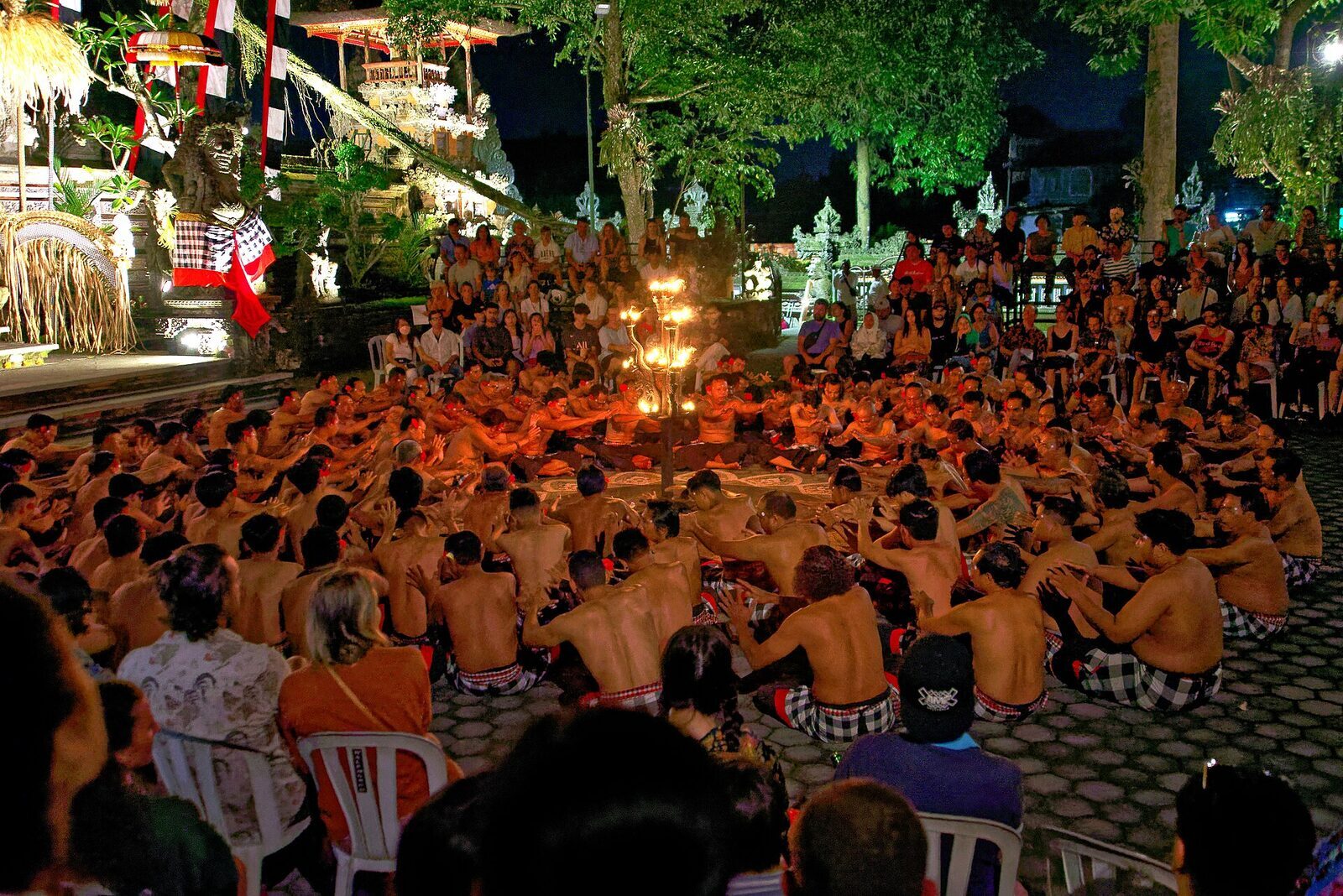
Each evening, dozens of men fill Uluwatu's clifftop amphitheatre with the interlocking "cak-cak-cak" chant, staging the Ramayana as the sun drops into the sea. It's spectacular — and it's worth seeing it for what it actually is, because nearly every guide gets the story wrong.
Not ancient — and better for it
Kecak is often sold as an "ancient sacred temple ritual." It isn't: as a Ramayana dance-drama it's a 1930s creation, made for audiences, and it has been a performance genre its whole life. What is old is its raw material — the hypnotic chorus comes from the trance rituals, where a "voice " accompanied possession. (So the chant doesn't "imitate monkeys," as you'll often read — that idea was attached later, along with the Ramayana plot.) None of this makes it less worth seeing. It's a living Balinese art form built from genuinely old roots: spectacular and recent, both true at once.
Archive
Who really made it
The popular line — "Walter Spies invented Kecak" — is the least accurate thing said about it. Scholars (Kendra Stepputat, I Wayan Dibia) describe a cooperative development led by Balinese artists. Credit belongs first to the dancer I Wayan Limbak (who brought warrior-dance movement into it in the 1920s, before Spies was involved) and the villagers of Bedulu and Bona; the German painter Spies and the American dancer Katharane Mershon were catalysts and promoters, not authors. Spies himself called the secular Kecak "a Balinese creation."
The story — and that fire
The dance stages an episode of the : Rama, his wife Sita abducted by the demon king Ravana, and the monkey general Hanuman. The famous fire finale is usually a separate ritual bolted on at the end — the sanghyang jaran, a fire-horse trance dance where a performer treads through burning coconut husks — not the climax of the Ramayana itself. And there's no gamelan at all: unique among Balinese genres, the ~50–100 men are the entire orchestra, splitting a fast rhythm across the chorus by voice.
Why the Uluwatu show, specifically
Uluwatu's cliff performance is recent — it began in 1999 — and it's run by the local customary village, Desa Adat Pecatu, through two rotating troupes. A fixed share of every ticket goes back to the village. So when you buy a seat, you're not funding a private operator — you're supporting community livelihood and cultural upkeep. That, plus a 70-metre cliff facing the sunset, is what makes this the most famous Kecak on the island (and the most crowded — Ubud and Batubulan offer quieter versions).
Tip
See it without the stress — seats face the sunset and the good ones go fast; the show sells out in high season and the ride back from the Bukit at night is a hassle. Easiest is a combined sunset-and-Kecak tour with pickup, or pre-booked tickets.
Book the sunset + Kecak tourCheck availabilityJust the Kecak ticketPractical
| Shows | Two nightly — 18:00 (sunset) & 19:00 (darker, better fire); ~60 min each |
|---|---|
| Ticket | ~150,000 IDR adult, separate from temple entry |
| Get there | By ~16:30; the 6pm show can sell out by 17:00 in peak season |
| Best seat | Middle rows, slightly east; front rows = fire immersion but smoke/heat |
| If it rains | Usually goes on with ponchos, but the fire finale is often cut |