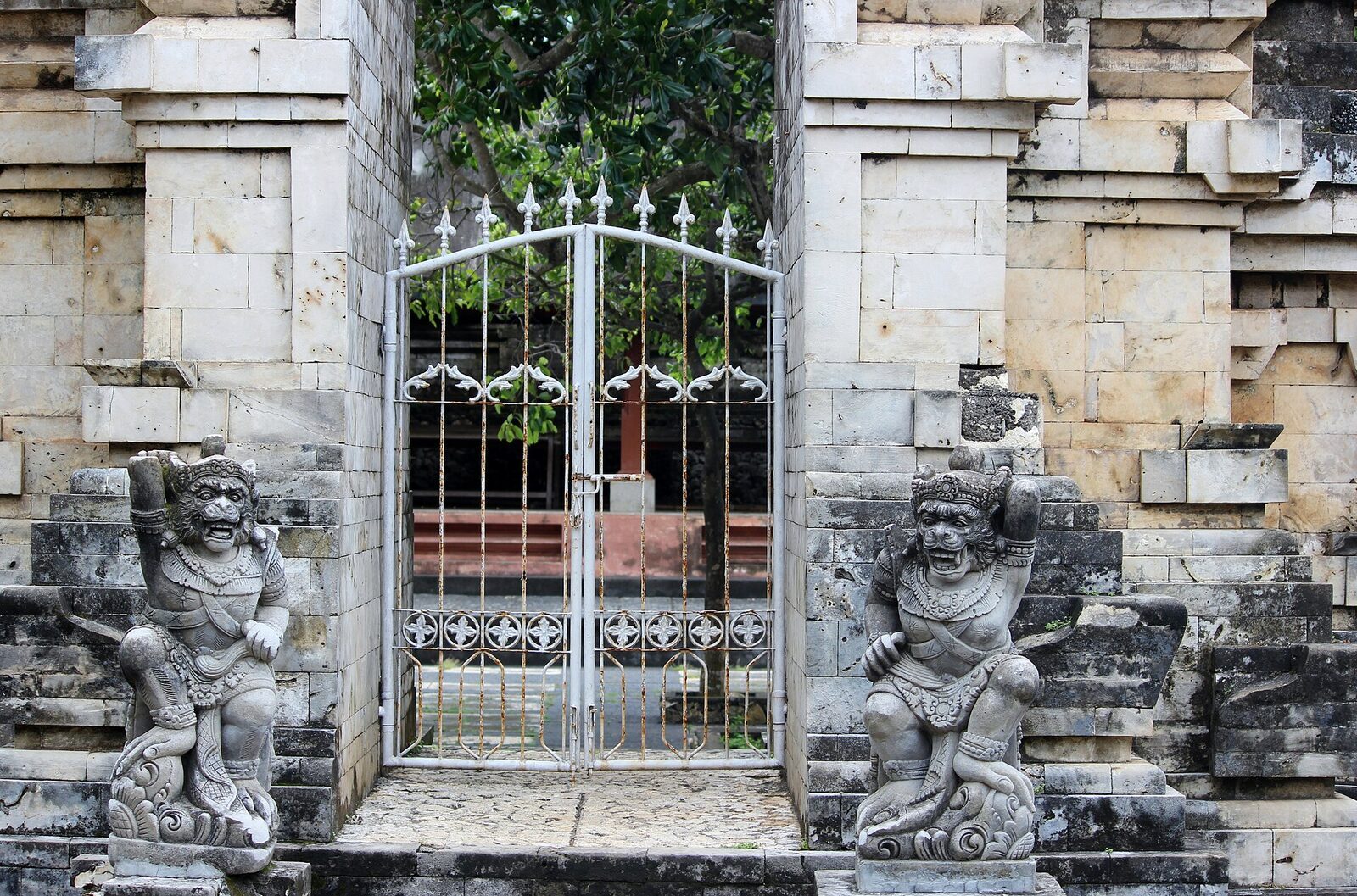
Uluwatu is a compact lesson in Balinese temple design — once you can read three things: the split gate (and the myth to drop), why its towers are deliberately modest, and the empty stone throne at its heart.
The split gate — and the myth to drop
You enter through a : a stone gate cleanly split down the middle, its two inner faces left sheer as if cleaved. Nearly every guide tells you it's "Mount Meru split in two." Here's the honest version: scholars consider its original meaning genuinely uncertain — quite possibly it's mostly architectural drama, a threshold effect before the compound, with symbolism read into it later. The form itself is well understood: it descends from 13th–14th-century Javanese temple architecture and marks the outermost boundary of the sacred space. So: enjoy the "split mountain" image, but know it's folklore, not fact.
Guardians and screens
Over the gate arch bulges a grotesque face — (or Kala). It's easy to read as a demon; it's actually a protector, a chthonic earth spirit that filters out negative forces and admits pure intentions. Just inside many Balinese gates stands a short free wall, the aling-aling — built on the old belief that malevolent spirits can only travel in straight lines, so a wall makes them turn away.
Why the towers are small (and that's the point)
Balinese — the tiered, black-thatched pagoda shrines — always have an odd number of tiers, and the count encodes the rank of the deity: eleven for the supreme gods (as at Besakih), fewer for lesser or local deities, and three for a deified master or ancestor. Uluwatu's meru are modest three-tier structures — one dedicated to Nirartha. So if you were expecting the towering pagodas of the postcards, they're at Besakih, not here — and Uluwatu's smaller ones are telling you exactly whose temple this is.
The empty throne
Look for the — a tall stone "lotus throne" with an empty seat. It's empty on purpose: it's the seat of the supreme, formless reality (, "the Unthinkable"), which has no image. It's credited as a Nirartha-era innovation — a 16th-century idea in stone.
One thing you can feel: the stone
Uluwatu is built of grey coral limestone quarried from the surrounding reef — harder than the soft volcanic paras used in most Bali temples. That's why its carvings have held their edges despite a thousand years of salt spray, and why the fabric looks and ages differently from inland temples. Remember, too, that the holiest inner courtyard (the utama mandala, on the highest point of the cliff) is closed to visitors — you're reading the temple from its gates and outer walls.