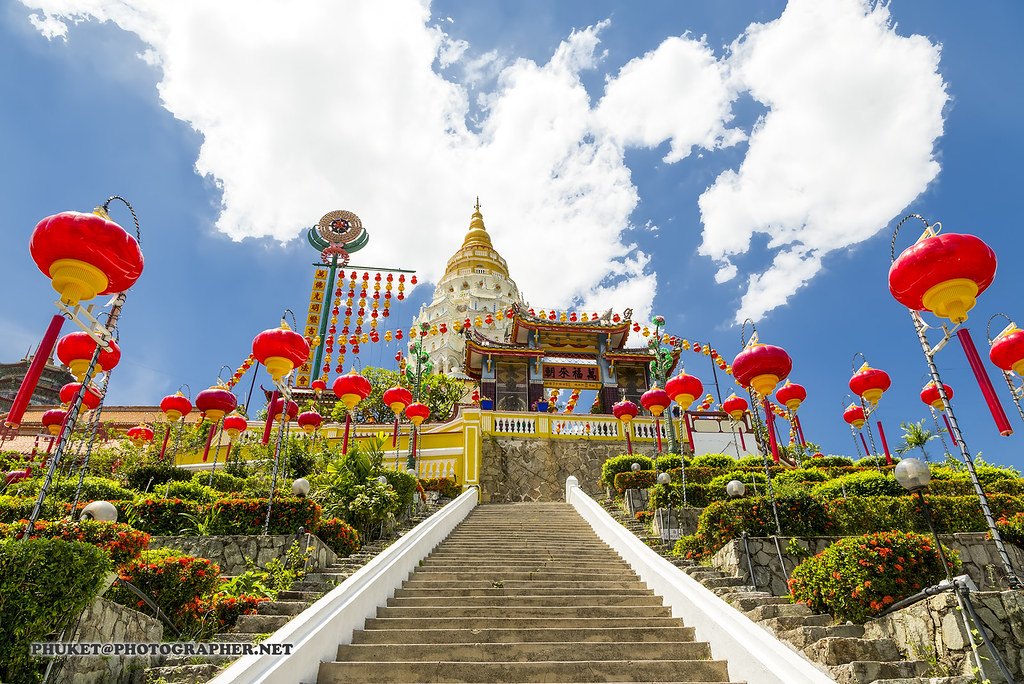
Kek Lok Si is Malaysia's largest Buddhist temple, built up the Air Itam hillside over more than a century and still growing — a seven-storey pagoda that mixes Chinese, Thai and Burmese architecture in one building, a 27-metre bronze Kuan Yin looking out over the strait from the terrace above it, and a climb up through souvenir stalls that tests your patience before either one comes into view.
What Kek Lok Si actually is
Construction started in 1890, led by a Chinese Buddhist monk who wanted a temple substantial enough to match the ambitions of the Hokkien community that had built up Penang's wealth by then, and it's been added to in phases ever since — the pagoda finished in 1930, the Kuan Yin statue and its surrounding pavilion only completed in 2002. The result reads less like one architect's vision and more like a century of donations stacked on top of each other, which is more or less what it is.
| Founded | 1890, still an active place of worship and pilgrimage |
|---|---|
| Pagoda | Seven storeys, mixing Chinese, Thai and Burmese design in one structure |
| Kuan Yin statue | Bronze, roughly 27m tall, on the highest terrace |
| Location | Air Itam, on the hillside above the reservoir |
The Pagoda of Ten Thousand Buddhas
The pagoda's official name gives away its design logic: a Chinese octagonal base, a middle tier of Thai styling, and a Burmese crown on top, each level housing rows of Buddha statues donated over the decades — the "ten thousand" in the name is more a statement of intent than a literal count, but it's not far off. You can climb the interior stairs for a closer look at each tier, and the base level alone holds enough statues that most visitors slow down without meaning to.
Tip
The pagoda's climb is worth doing before the terrace above — it's shaded inside, and you'll want the break before tackling the open-air walk up to the Kuan Yin statue.
The Kuan Yin statue — tram or steps
Above the pagoda, a separate terrace holds the bronze statue of Kuan Yin, the Buddhist goddess of mercy, set inside its own pavilion with views back down over Air Itam and, on a clear day, out towards the strait. You reach it either by an inclined tram that climbs the last stretch of hillside, or on foot up a long run of steps — the tram is the easier option in the heat, and the one most families with kids or older relatives take.
| Inclined tram | One-way fare to the Kuan Yin terrace |
|---|---|
| On foot | A steep but manageable stepped path, no charge |
The turtle pond
Partway up the complex, a pond holds turtles that visitors have historically released here as an act of merit-making — a Buddhist practice tied to compassion for living things. It's a quiet, shaded stop on the climb, though the pond's condition and the ethics of adding more turtles to an already-crowded enclosure are worth being aware of before you buy food to feed them from the stalls nearby; I'd treat that particular souvenir-stall offer as one to skip.
The tunnel of stalls — the honest bit
Getting from the entrance to the pagoda means walking through a long, covered run of souvenir and snack stalls selling prayer beads, incense, trinkets and Buddhist-themed keepsakes — it's essentially a market built into the approach, and it's the part of Kek Lok Si people complain about most. None of it is required; you can walk through without buying anything, but the density of stalls and the press of other visitors, especially in the middle of the day, is real and worth going in expecting.
Watch out
The stall tunnel and the temple's lower terraces get genuinely crowded by mid-morning, particularly on weekends and Buddhist festival days. Early — temple grounds typically open before most tour buses arrive — is the quieter window, and it's also cooler for the climb.
Donations and etiquette
This is an active place of worship, not a museum — dress modestly (shoulders and knees covered is the safe default), keep voices down near the shrine halls, and expect donation boxes at several points, including at the base of the pagoda and the Kuan Yin terrace. There's no fixed entry fee to the temple grounds themselves, but the pagoda climb and the tram both carry their own charges, and donation amounts for candles or incense are generally suggested rather than fixed.
Chinese New Year — the lantern light-up
Kek Lok Si's best-known spectacle isn't the architecture, it's what happens to it every Chinese New Year: the entire complex, pagoda included, is strung with thousands of lanterns and lit up after dark for the run of the festival, turning the hillside into one of Penang's most photographed sights of the year. Exact light-up dates track the lunar calendar and shift annually, so check the specific dates for the year you're travelling rather than assuming they match a previous trip.
Tip
If you're in Penang over Chinese New Year, an evening visit to Kek Lok Si during the light-up is worth prioritising over a daytime visit — go early in the evening, before the crowds peak, and expect the stall tunnel to be at its busiest of the entire year.
Getting there
Air Itam sits inland from George Town, at the base of Penang Hill, and Kek Lok Si is a short uphill walk from the Air Itam market and bus terminus. is the easier option from George Town if you're not combining the trip with Penang Hill, and buses running to Air Itam from the old town connect through the same terminus.
| From George Town | Grab or local bus to Air Itam, then a short walk uphill |
|---|---|
| Combine with | Penang Hill's funicular starts a short ride away |
| Currency | Priced in (RM) |
Go deeper
The newsletter
I'm writing Penang street by street, the way I actually know it
Air Itam, the hill, the temple stalls worth skipping — want the next guide as I write it?
</content> </invoke>