Penang · George Town
George Town
A UNESCO-listed grid of shophouses, clan jetties and a street where a mosque, temples and a church sit within a few hundred metres of each other — small enough to walk, hot enough that when you walk it matters more than what.
Heads up: some links here are affiliate links — book through them and I may earn a small commission at no extra cost to you. It never changes what I recommend.
George Town is the old core of Penang's capital — a grid of two- and three-storey shophouses laid out by the British East India Company in the 1780s, still lived and worked in rather than preserved behind glass, which is most of why UNESCO listed it in 2008 alongside Malacca. It's compact enough to cover on foot in a day, rich enough that most people wish they'd given it two, and hot enough that when you walk it changes what you actually see.
What George Town actually is
The old town sits on the northeast tip of Penang Island, where the British first landed in 1786 and built a trading post around a natural harbour. What grew up around that harbour — Hokkien, Cantonese and Teochew Chinese traders, South Indian merchants, Malay fishing families, Armenian and Jewish merchants, Eurasian clerks — is why George Town reads less like one heritage site and more like several communities' old towns overlapping on the same few streets.
| UNESCO status | Listed 2008 as part of "Melaka and George Town, Historic Cities of the Straits of Malacca" |
|---|---|
| Core zone | Roughly 1.5 sq km, walkable end to end in under an hour |
| Layout | A rectangular grid running back from the waterfront — easy to navigate once you've got the cross streets |
| Climate | Hot and humid year-round; midday heat is the main obstacle to walking it |
What makes the heritage zone different from a lot of restored old towns is that it never fully emptied out. Shophouses that were built as shop-below/family-above units are still used that way — a hardware store or a coffee shop on the ground floor, someone's actual home upstairs — so the old town has the texture of a place people live, not a museum piece.
The Street of Harmony
Jalan Masjid Kapitan Keling — nicknamed the Street of Harmony — is the single clearest way to see what George Town is about: within a few hundred metres you pass a mosque, a Hindu temple, a Chinese temple and an Anglican church, each built by a different community that settled here in the same few decades and, by and large, kept building next to each other rather than apart.
| Kapitan Keling Mosque | The city's oldest mosque, Indo-Islamic domes and minaret, built by South Indian Muslim traders |
|---|---|
| Sri Mahamariamman Temple | Penang's oldest Hindu temple, its gopuram tower thick with painted deities |
| St. George's Church | The oldest Anglican church in Southeast Asia, a plain white Georgian block behind iron railings |
| Goddess of Mercy Temple | George Town's oldest Chinese temple, thick with incense smoke most mornings |
I'd walk this street before anything else on a first visit — it's the fastest way to understand why "heritage zone" undersells the place. This isn't several religions politely coexisting for a tourist brochure; it's the actual settlement pattern of the port town, still standing.
The clan jetties
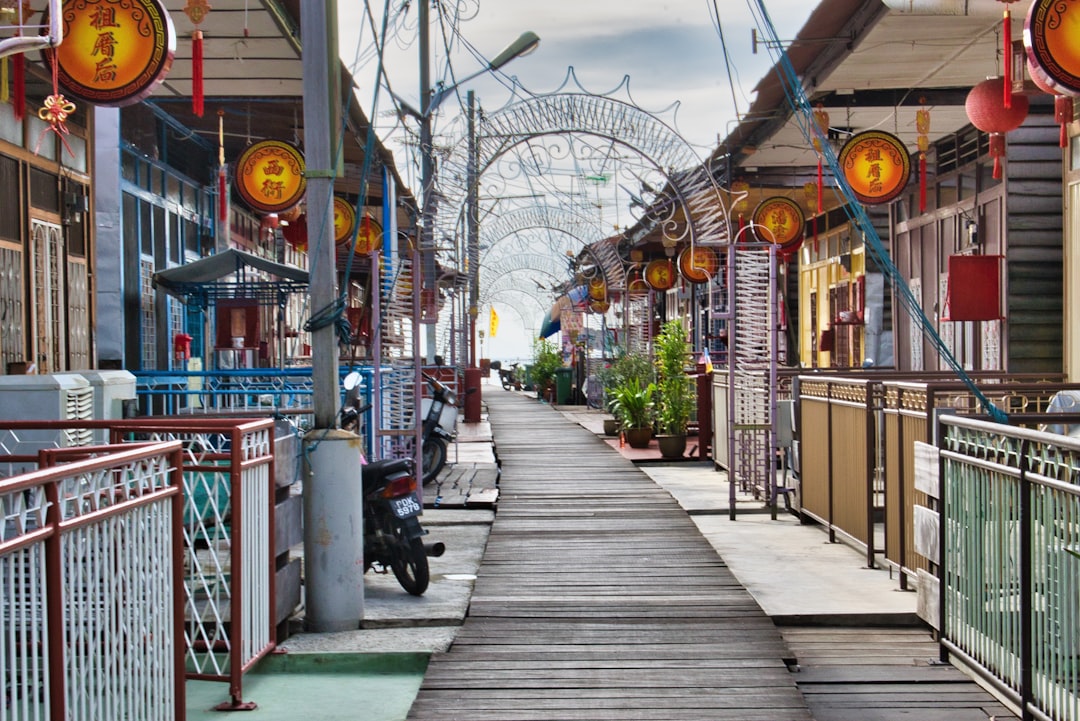
At the western edge of the waterfront, six wooden jetties run out over the water on stilts, each one built and still occupied by an extended Chinese clan sharing a surname — Chew Jetty is the largest and the one set up for visitors, with shops along its boardwalk, but people genuinely live in the houses behind them. The jetties date to the late 19th century, when dock-worker families without land rights built out over the water instead.
Tip
Chew Jetty gets crowded with day-trippers by mid-morning. Early or evening, when residents are out on their porches rather than tour groups filing through, is when it feels like a place rather than a photo stop.
See the clan jetties for which jetty to walk, what's respectful to photograph, and what isn't.
Street art and the murals trail
George Town's street-art reputation mostly traces back to Lithuanian artist Ernest Zacharevic's 2012 murals for the George Town Festival — the Children on a Bicycle mural on Armenian Street is the one everyone queues for, and it's since been joined by dozens more murals and steel-rod caricature sculptures scattered across the old town, some official, plenty added since by other artists and by the wear of a decade of tropical weather.
| Where to start | Armenian Street and Cannon Street, the densest cluster |
|---|---|
| Best light | Early morning — soft light and no queue for the famous ones |
| Condition | Murals fade and get touched up unevenly; treat any specific mural's survival as unconfirmed until you're there |
Armenian Street has the fuller map of which walls are worth the detour and which are reproductions of reproductions by now.
Kopitiam and hawker culture
The shophouse grid runs on stalls, Chinese coffee shops and standalone hawker stands as much as it runs on temples — George Town's food culture isn't a side activity here, it's arguably the main one, and it's the reason Penang as a whole gets called Malaysia's food capital. Most hawker fare isn't , since a lot of it comes out of Chinese kopitiam kitchens, so if that matters to you, look for stalls that say so or lean into the mamak side of things.
I've written the food itself up properly, stall by stall, rather than squeezing it into this page — see Penang hawker food for where I'd actually send you to eat.
The Peranakan layer
Alongside the Chinese, Indian, Malay and colonial threads sits a distinct one: the Peranakan (Straits Chinese) community, descended from Chinese traders who settled and intermarried locally, developing their own architecture, cuisine and dress. Their mansions — tiled courtyards, carved timber screens, English ironwork bolted onto a Chinese shophouse frame — are some of the best-preserved buildings in the old town, and their food (heavier on coconut milk, tamarind and local spice than mainland Chinese cooking) has its own stall lineage inside the hawker scene above. Penang Peranakan Mansion is the fullest look at that layer, restored down to the furniture.
The clan houses
The wealthiest Chinese clans built kongsi — clan association buildings that doubled as temple, meeting hall and status display — and Khoo Kongsi is the one that out-does the rest, rebuilt in 1906 after the original burned down (locals at the time reportedly said it had been "too grand for mortals"), with a roofline so densely carved and gilded it took years to finish. See Khoo Kongsi for visiting details.
How to walk it — compact, hot, go early or evening
George Town's old town is small enough that the map isn't the problem; the heat is. Streets are mostly shadeless by late morning, and the historic core has almost no through-traffic relief — you're walking on pavement between shophouse walls with the sun overhead for a good stretch of the day.
Watch out
Midday in the heritage zone is genuinely draining — direct sun, humidity, and shophouse streets with little shade. If you can only pick two windows, make it early morning (temples and murals both photograph and feel better before 10am) and late afternoon into evening (the Street of Harmony's calls to prayer, the jetties emptying of day-trippers, food stalls lighting up).
A across the old town is rarely worth it — the grid is small, one-way streets make short car trips slower than walking, and most of what's worth seeing is between buildings rather than inside them. Trishaws still operate around the tourist core if your feet need a break; agree the fare before you get in.
How long do you need — is George Town worth it?
Yes, clearly — this is the reason a lot of people add Penang to a Malaysia trip at all, and the heritage zone earns its listing rather than trading on it. The honest steer on time: a single focused day covers the Street of Harmony, one clan jetty, the densest mural cluster and a proper hawker meal, but it's a rushed day, and George Town rewards slowing down more than most heritage towns because so much of what's good here is texture rather than ticked-off sights.
If you've got it, two to three days lets you split temples/mosque/church from murals from clan houses and mansions, eat more than once, and catch both an early-morning and an evening walk rather than fighting the midday heat for all of it. One day works if George Town is a stop on a wider Penang or Malaysia itinerary; give it more if it's the main event.
Getting there and getting around
George Town sits on the island side, reachable by the Penang Bridge or the Butterworth–George Town ferry if you're coming from the mainland; Penang International Airport is on the island's south side, roughly 30–40 minutes from the old town by car depending on traffic. Once you're in the heritage zone itself, walking (or a trishaw) beats any vehicle — the grid is dense, parking is tight, and most streets worth seeing are narrow enough that a car adds nothing.
| From the airport | Grab or taxi, roughly 30–40 minutes to the old town |
|---|---|
| From the mainland | Penang Bridge by car, or the Butterworth ferry on foot/bike |
| Around the old town | Walk it — the grid is compact and mostly one-way for cars |
| Currency | Priced in (RM), same as the rest of Malaysia |
Go deeper
The newsletter
I'm writing Penang street by street, the way I actually know it
The Street of Harmony, the jetties, the stall you'd only find if someone local pointed you at it — want the next guide as I write it?