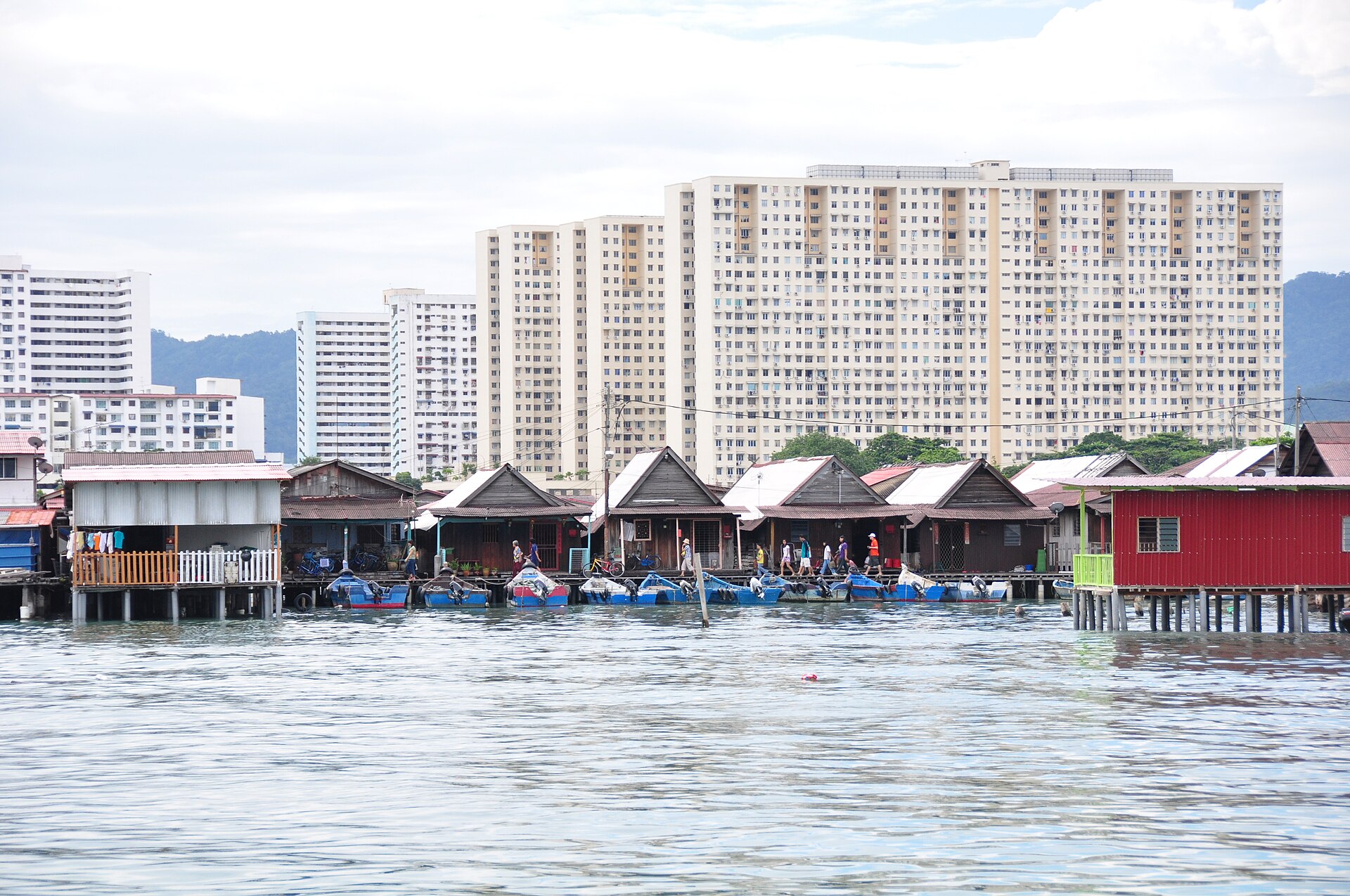
The clan jetties are a string of wooden settlements built out over the water on Weld Quay, each one raised on stilts by a different Chinese clan — Chew, Lim, Tan, Yeoh and others — and each one still home to their descendants. Walk the public boardwalk of the busiest one, Chew Jetty, or find a quieter one where the settlement is mostly just people living. Either way, this is a neighbourhood, not an attraction, and it's worth going in with that understanding first.
What the jetties actually are
In the late 19th century, Chinese immigrant families working the docks at George Town's harbour didn't have land rights in the old town proper, so several clans — groups sharing a surname and, in most cases, a home village back in Fujian — built their own settlements out over the water instead, plank by plank, on wooden piles driven into the seabed. Each jetty took its clan's name: Chew Jetty, Lim Jetty, Yeoh Jetty, Tan Jetty and several smaller ones, strung along the waterfront just west of George Town's core.
| Built | Late 19th century, by Chinese dock-worker clans without land rights onshore |
|---|---|
| Number of jetties | Around six or seven surviving today, named for the clan that built each one |
| Status | Still lived in — private homes, not a museum or heritage park |
| Entry | Free, open boardwalks |
What's easy to miss on a quick pass is that this isn't a recreation. The families who live here now are, in a lot of cases, the same clans who built the original houses — several generations deep into a settlement that started as a workaround for not being allowed to own land elsewhere in town.
Chew Jetty vs the quieter ones
Chew Jetty is the one everyone means when they say "the clan jetties" — it's the longest, the most commercialised, and the only one genuinely set up for visitors, with a shop or stall at nearly every second house selling souvenirs, snacks and drinks along a boardwalk wide enough for a steady flow of day-trippers. A small temple sits near its entrance, and the far end opens onto a view back across the harbour toward the container port.
The other jetties — Lim, Tan, Yeoh and the smaller ones further along — get a fraction of the foot traffic and read as what Chew Jetty probably looked like before tourism found it: narrower boardwalks, washing hung out to dry, someone mending fishing gear on their own porch, no shopfronts at all in places. I'd send a first-time visitor to Chew Jetty for ten minutes to understand the layout, then along to one of the quieter jetties for the actual feel of the place.
Watch out
These are homes. Don't photograph into houses, doorways or residents without asking first, and keep your voice down — you're walking through someone's front porch, not a stage set. The tourism-vs-community tension here is real: Chew Jetty's souvenir stalls exist because visitors kept coming, and that income matters to the families who run them, but it's also changed what the jetty is. Visit lightly, especially on the quieter jetties where there's no commercial buffer between you and someone's home.
What's at the entrances
Where the jetties meet Weld Quay, a handful of small temples and shopfronts mark the transition from street to boardwalk — modest structures compared to -summonable landmarks like Khoo Kongsi, but genuinely used: incense burning, offerings refreshed, a caretaker often somewhere nearby. On Chew Jetty, the shops thin out from souvenir stalls and drink stands near the entrance to plain residential doorways further along, which is as good a marker as any of where "visitor zone" ends and "home" begins.
Best time to go
| Best time | Early morning or late afternoon — cooler, and residents are more likely to be out on their porches than a tour group is filing through |
|---|---|
| Avoid | Midday, when the boardwalks are shadeless and Chew Jetty is busiest with day-trippers |
| Cost | Free to walk |
Midday sun on an unshaded wooden boardwalk over water is uncomfortable regardless of crowds, so the practical reason to go early or late lines up with the respectful one — fewer people means less pressure on a neighbourhood that has to live with the traffic every single day, not just when you're passing through.
Getting there
The jetties sit right on Weld Quay at the western edge of George Town's heritage core, an easy walk from the Street of Harmony or Armenian Street — most visitors reach them on foot as part of a wider walk through the old town rather than as a standalone trip.
| From the old town core | A short walk west to Weld Quay, roughly 10–15 minutes from the Street of Harmony |
|---|---|
| Currency | (RM), for anything you buy at the entrance stalls |
There's no ticket, no gate and no fixed hours — the boardwalks are simply part of the street grid, which is exactly why how you walk them matters more than when a sign tells you to.
Go deeper
The newsletter
I'm writing Penang street by street, the way I actually know it
The Street of Harmony, the jetties, the stall you'd only find if someone local pointed you at it — want the next guide as I write it?
</content> </invoke>