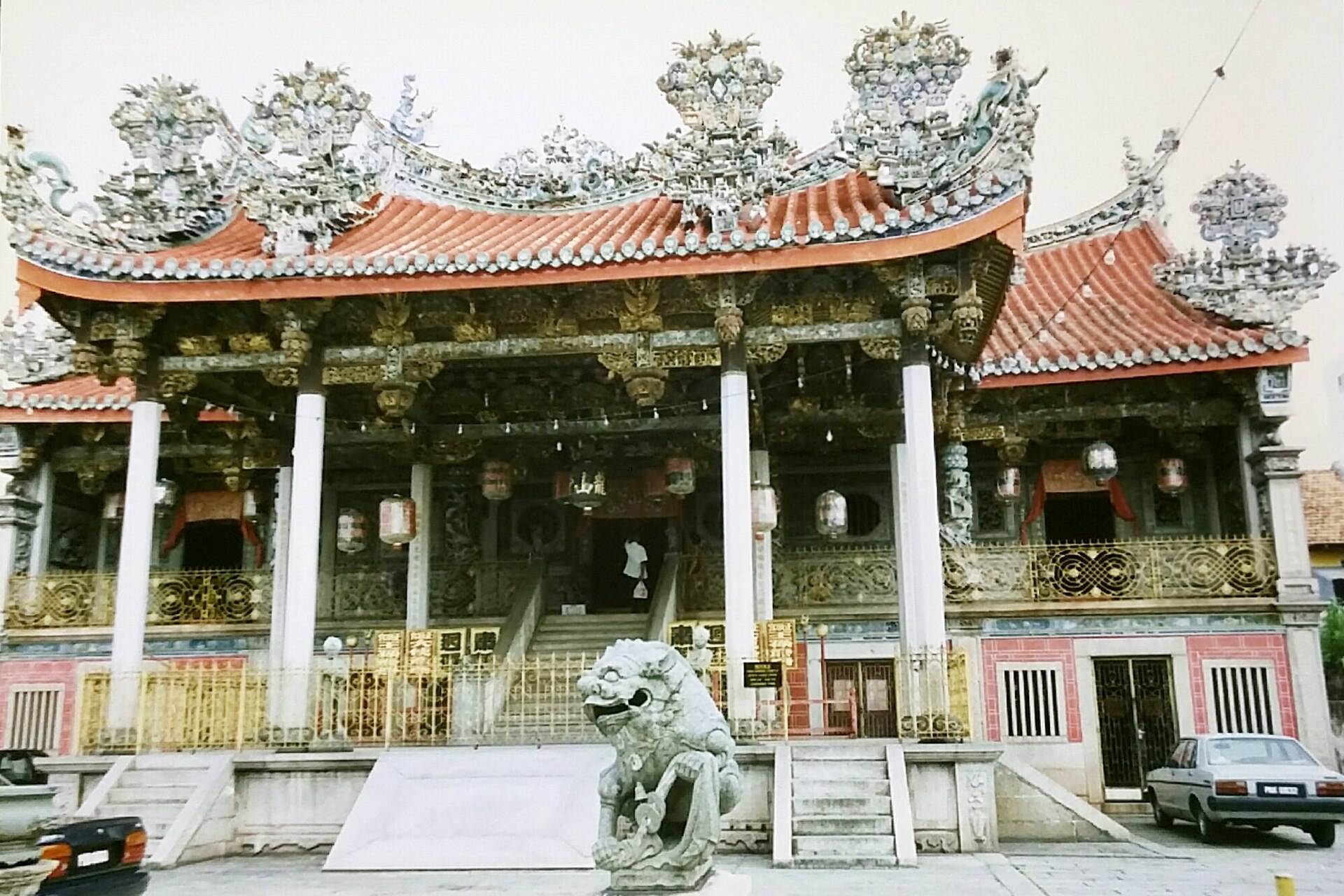
Khoo Kongsi is the grandest clan temple in George Town — a granite square tucked behind Cannon Street where one Chinese clan built a meeting hall so ornate that locals reportedly said the first version had been "too grand for mortals" and burned down within a few years of finishing it.
What a kongsi actually is
A kongsi is a clan association — an organisation built around a shared surname, formed by Chinese migrants who needed the mutual support a clan back home would have given them: somewhere to worship shared ancestors, settle disputes, house new arrivals, and put on a public face of the clan's wealth and standing. George Town has several — Khoo, Cheah, Yeoh, Lim — each centred on a clan house that's part temple, part meeting hall, part status display. Khoo Kongsi is the one that out-ornaments the rest, and the one built to be seen.
The Leong San Tong clan house
The clan house itself, Leong San Tong, is what people come for: a roofline so densely worked with carved wood, gilding, ceramic shard figures and dragon-wrapped granite columns that it apparently took years of specialist craftsmen to finish after the 1901 fire that destroyed the first, even-more-ambitious version. Inside, the main hall holds the clan's ancestral tablets under a ceiling of painted beams and lantern rows, with side halls given over to smaller shrines and clan history.
| Rebuilt | 1906, after the original 1894–1901 building burned down before completion |
|---|---|
| Style | Southern Chinese temple architecture — swallowtail roof ridges, gilded carving, granite dragon columns |
| Complex | Clan house, granite square, opera stage, museum and rows of old terraced clan houses |
| Entry fee | Around RM10–20 for the clan house and museum |
| Hours | Roughly 9am–5pm daily |
The square and the terraces
Step back from the clan house and the square around it is worth the same attention: an open granite courtyard framed by rows of older terraced clan houses, still bearing the low, practical look of housing built for clan members rather than for show, plus an opera stage used for performances during clan festivals. It's a useful contrast — Leong San Tong is the display piece, the terraces are the everyday building it grew out of. A small museum on site sets out the Khoo clan's history in Penang: where the family came from in Fujian province, how the association organised itself, and how the fire and rebuild became part of the clan's own story.
Two faces of Chinese Penang
Khoo Kongsi and the clan jetties are worth seeing as a pair, not a choice between them — they're the same migration story told at opposite ends of the wealth scale. The jetties are dock-worker families who built out over the water because they had no land rights; Khoo Kongsi is the clan that could afford granite, gilding and a purpose-built square. Walk both on the same day and George Town's Chinese heritage stops being one thing and starts reading as the layered, unequal community it actually was.
Getting there
Khoo Kongsi sits just off Cannon Square, a short walk from the Street of Harmony and easily folded into a loop through George Town's old town — there's no reason to drive it. The lanes in are narrow enough that a drop-off usually means walking the last stretch anyway.
| From the Street of Harmony | About 5–10 minutes on foot via Cannon Street |
|---|---|
| From Chew Jetty | Roughly 10–15 minutes walking |
| Currency | Priced in (RM) |
Go deeper
The newsletter
I'm writing Penang street by street, the way I actually know it
The Street of Harmony, the jetties, the clan house that out-ornaments every temple in town — want the next guide as I write it?