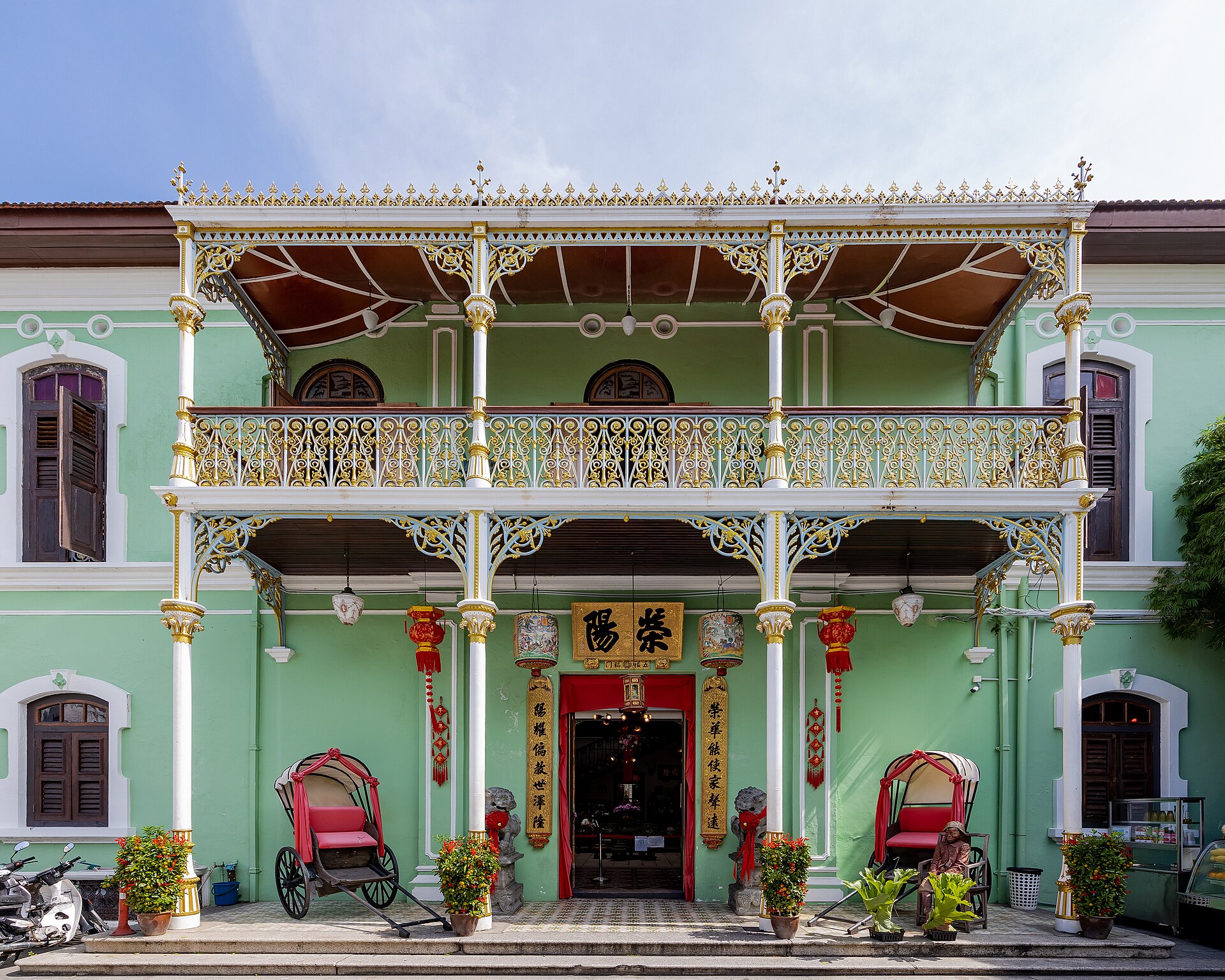
The Pinang Peranakan Mansion is a restored 19th-century townhouse on Church Street, packed floor to ceiling with the furniture, antiques and gold-leaf carving of a wealthy Straits Chinese family — and unlike its more famous neighbour the Blue Mansion, you walk through this one yourself, at your own pace, room by room.
What the mansion is
The house belonged to Chung Keng Kwee, a Hakka Chinese businessman and one of the wealthiest men in 19th-century Penang, and it's built in the eclectic style that marks out Peranakan mansions of the period — a Chinese shophouse frame dressed up with English cast-iron work, Scottish tiles and Italian marble, because a rich Straits Chinese family in colonial Penang could afford to shop the whole empire for materials. Inside, more than a thousand pieces of period furniture, porcelain, jewellery and ceremonial objects fill around a dozen rooms, most of it genuine antique rather than reproduction.
| Original owner | Chung Keng Kwee, a Hakka Chinese Kapitan and one of Penang's wealthiest 19th-century merchants |
|---|---|
| Building style | Chinese shophouse frame with English ironwork, Scottish floor tiles and gold-leaf carved timber |
| Collection size | More than a thousand period pieces on display, mostly original antiques |
| Format | Self-guided walk-through museum, room by room |
What "Peranakan" actually means
Peranakan, or Baba-Nyonya, describes the descendants of Chinese traders who settled in the Straits Settlements — Penang, Malacca and Singapore — and intermarried with local Malay communities, generations before mass Chinese migration in the 19th and 20th centuries. Over time that mix produced its own culture: a hybrid language, elaborate beadwork and textiles, a cuisine that folds coconut milk and local spice into Chinese cooking, and — visible all over this house — a decorative style that borrows just as freely, mixing Chinese motifs with European furniture and Malay patterning without much concern for which tradition anything "should" belong to. This mansion is one building's worth of that story; for the fuller picture of who the Peranakan community were and how that identity formed, see Peranakan & Nyonya heritage.
Walking the rooms
You buy a ticket and go room to room on your own, which is the main thing that sets this museum apart from the tour-only Blue Mansion down the road. The ground floor holds the reception hall and ancestral altar, heavy with gold-leaf carved screens and ceremonial furniture meant to be seen by visitors; upstairs are bedrooms laid out with the furniture, wedding regalia and beaded slippers of a well-off Straits Chinese household, plus cabinets of jewellery and porcelain collected over generations. Information cards sit in most rooms, so you can read as you go rather than needing a guide to explain what you're looking at.
| Entry fee | Around RM25–30 for adults |
|---|---|
| Opening hours | Roughly 9:30am–5pm daily |
| Time needed | About 45 minutes to an hour to see it properly |
Tip
Go in the morning if you can — the rooms are compact and get warm once tour groups from the Blue Mansion spill over after their own visit finishes.
Versus the Blue Mansion
This is the comparison most people ask, standing on Church Street with two Peranakan mansions a few minutes' walk apart, and the honest answer is that they're different experiences rather than one being strictly better. The Pinang Peranakan Mansion is denser with objects and lets you set your own pace, wandering back into a room you rushed through the first time. The Cheong Fatt Tze Mansion — the Blue Mansion — is architecture-first, a striking indigo-washed courtyard house you can only see on a scheduled guided tour, with fewer objects but a much stronger sense of the building itself. If you only have time for one, decide whether you want to look closely at things (this mansion) or at a building (the Blue Mansion); if you have the time, both together take under half a day and cover genuinely different ground.
Getting there
The mansion sits on Church Street, inside the heritage grid and an easy walk from the Street of Harmony — no need for a unless you're coming from outside the old town. Entry is priced in , same as everywhere else in Malaysia. See George Town for how this fits into a wider walk of the heritage zone.
Go deeper
The newsletter
I'm writing Penang street by street, the way I actually know it
The Street of Harmony, the mansions, the stall you'd only find if someone local pointed you at it — want the next guide as I write it?