Home › Penang › Peranakan heritage
Penang · Understand
Peranakan & Nyonya Heritage in Penang
A community born from a Chinese trader marrying a local woman, three or four centuries ago, that ended up with its own language, dress, cuisine and houses — none of them quite Chinese, quite Malay, or quite anything else.
Peranakan — also called Baba-Nyonya or Straits Chinese — describes the descendants of early Chinese traders who settled on the Malay coast, married local women, and over a few generations built a culture that borrowed from both sides without fully belonging to either: its own language, its own dress, its own cooking, and some of the most ornate townhouses George Town has. You'll meet this layer everywhere in the old town, whether or not anyone tells you what you're looking at.
Who the Peranakan actually are
The word Peranakan is Malay for "locally born," and that's the plain version of the story: Chinese traders — mostly Hokkien — settling in the Straits ports (Penang, Melaka, later Singapore) from as early as the 15th century, marrying Malay and other local women, and raising children who grew up speaking a Malay creole at home while keeping Chinese ancestor worship, surnames and trade networks. Within a few generations those children weren't quite Chinese by mainland standards and weren't Malay either — a genuinely new community, wealthy in the trading ports because that's where the original marriages happened.
| Baba | The Peranakan men — traditionally the traders, community leaders and English-educated professionals under colonial rule |
|---|---|
| Nyonya | The Peranakan women — keepers of the kitchen, the beadwork and the household |
| Language | Baba Malay — a Malay creole with heavy Hokkien loanwords, still spoken by older generations |
| Straits Chinese | The colonial-era name, common in Penang and Singapore especially |
Baba and Nyonya are simply the male and female halves of the community — a Baba is a Peranakan man, a Nyonya a Peranakan woman — and you'll see both used almost interchangeably with "Peranakan" for the culture as a whole. What's distinctly theirs isn't one thing but a whole material culture: the language, the clothes, the porcelain, the houses, and above everything else, the food.
Dress, beadwork and porcelain
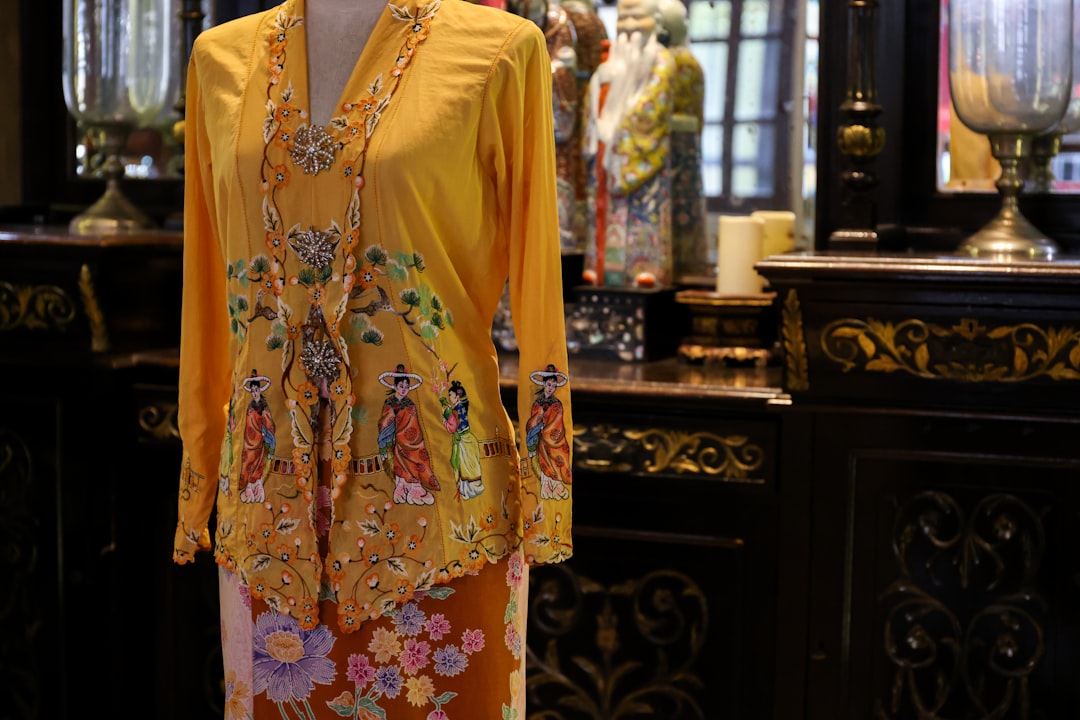
Nyonya women traditionally wore the kebaya — a fitted, embroidered blouse, often sheer voile over a camisole, paired with a batik sarong — and finished it with beaded slippers, kasut manik, hand-sewn with thousands of tiny glass beads into floral or peacock motifs, a single pair sometimes taking months to make. The porcelain tells the same mixed-heritage story: Nyonya ware, made to order in Jingdezhen kilns in China but designed to Peranakan taste — heavy on pink, green and turquoise enamels, phoenixes and peonies — is now some of the most collected antique porcelain in the region, and you'll see whole cabinets of it inside the restored mansions.
The houses match the dress: a Chinese shophouse frame with a central courtyard for light and rainwater, fitted out with carved timber screens, gilded altar panels, and then — because these were wealthy, colonial-era merchant families — English floor tiles, Scottish ironwork and French mirrors bolted straight onto the Chinese structure. It's an unmistakable look, and George Town's old town has some of the best-preserved examples left standing anywhere.
Nyonya cuisine — and why Penang's tastes different
If there's one thing that keeps the Peranakan identity alive day to day, it's the cooking. Nyonya cuisine takes Chinese ingredients and techniques and runs them through Malay flavourings — tamarind (asam), candlenut, galangal, lemongrass and belacan-based sambal — pounded into wet spice pastes the way Malay cooking does, then applied to Chinese-style braises and noodle dishes.
| Assam laksa | Thick rice noodles in a sour, tamarind-and-mackerel broth, topped with pineapple, mint and torch ginger flower — Penang's signature |
|---|---|
| Curry kapitan | A dry-ish chicken curry, candlenut and lemongrass thickened rather than coconut-heavy |
| Ayam pongteh | Chicken braised in fermented soybean paste with potatoes — the Chinese-technique, Malay-pantry dish in miniature |
| Nyonya kuih | Layered, steamed or grilled rice-flour cakes, often pandan-green or coconut-white, sold by colour and shape at any market |
Penang's version of Nyonya food leans noticeably more sour and closer to Thai flavours than Melaka's does — a reasonable amount of chilli and tamarind, torch ginger flower and turmeric leaf turning up where Melaka's kitchens would reach for coconut milk and sweetness instead. Assam laksa itself is usually filed under the broader Malaysian food picture (see Malaysian food for how laksa splits by region generally), but here in Penang it's really a Peranakan dish at heart, and it's the clearest single taste of what this cuisine does differently from mainland Chinese or straightforward Malay cooking.
Where to encounter it in Penang
The fullest single stop is Penang Peranakan Mansion — a restored 19th-century townhouse furnished down to the porcelain and the beaded slippers, which does more to explain this culture in twenty minutes than any amount of reading. For the food side, Nyonya stalls sit inside George Town's wider hawker scene rather than in a separate district of their own — I've covered where to actually find them, stall by stall, in Penang hawker food rather than repeating that list here.
Beyond the mansion, the Peranakan influence is stitched into the old town generally rather than confined to a single street: shophouse facades with that same mixed Chinese-colonial detailing turn up right across the heritage grid, and it's worth knowing what you're looking at once you've spent time with the mansion itself. See George Town for how this layer sits alongside the mosques, temples and clan houses that make up the rest of the old town.
The newsletter
I'm writing Penang's layers as I actually understand them
The Peranakan story, the clan houses, the stall down an alley you'd never find on your own — want the next guide as I write it?