Penang · Understand
Penang Hawker Food: What to Eat and How to Eat It
Penang didn't invent hawker food, but it perfected it — and the island argues about whose version is best the way other places argue about football.
Heads up: some links here are affiliate links — book through them and I may earn a small commission at no extra cost to you. It never changes what I recommend.
Ask around George Town and you'll hear the same claim in different words: Penang is where Malaysian hawker food peaks. Not the biggest city, not the capital, but the one where a plate of noodles fried by someone who's been at the same wok for thirty years is treated as seriously as fine dining is anywhere else. This page is about knowing what you're looking at when you sit down — the dishes, the culture around them, and where to go graze without chasing a "best of" list that goes stale the moment a stall changes hands.
Why Penang, specifically
Malaysia has hawker food everywhere — the country-wide picture is on the stalls and kopitiams covered on the Malaysian food page. Penang's claim is narrower and more specific: a small island that became, through a mix of trade-port history, Peninsular Malay, Hokkien Chinese and Indian-Muslim cooking overlapping in one place for two centuries, the spot where several of the country's signature dishes were either invented or perfected. Ask a Malaysian from another state where the best char kway teow or asam laksa is, and Penang comes up before their own hometown does. That's not tourism-board talk — it's the actual, ordinary consensus among Malaysians who eat this food every week.
The dishes to know before you order
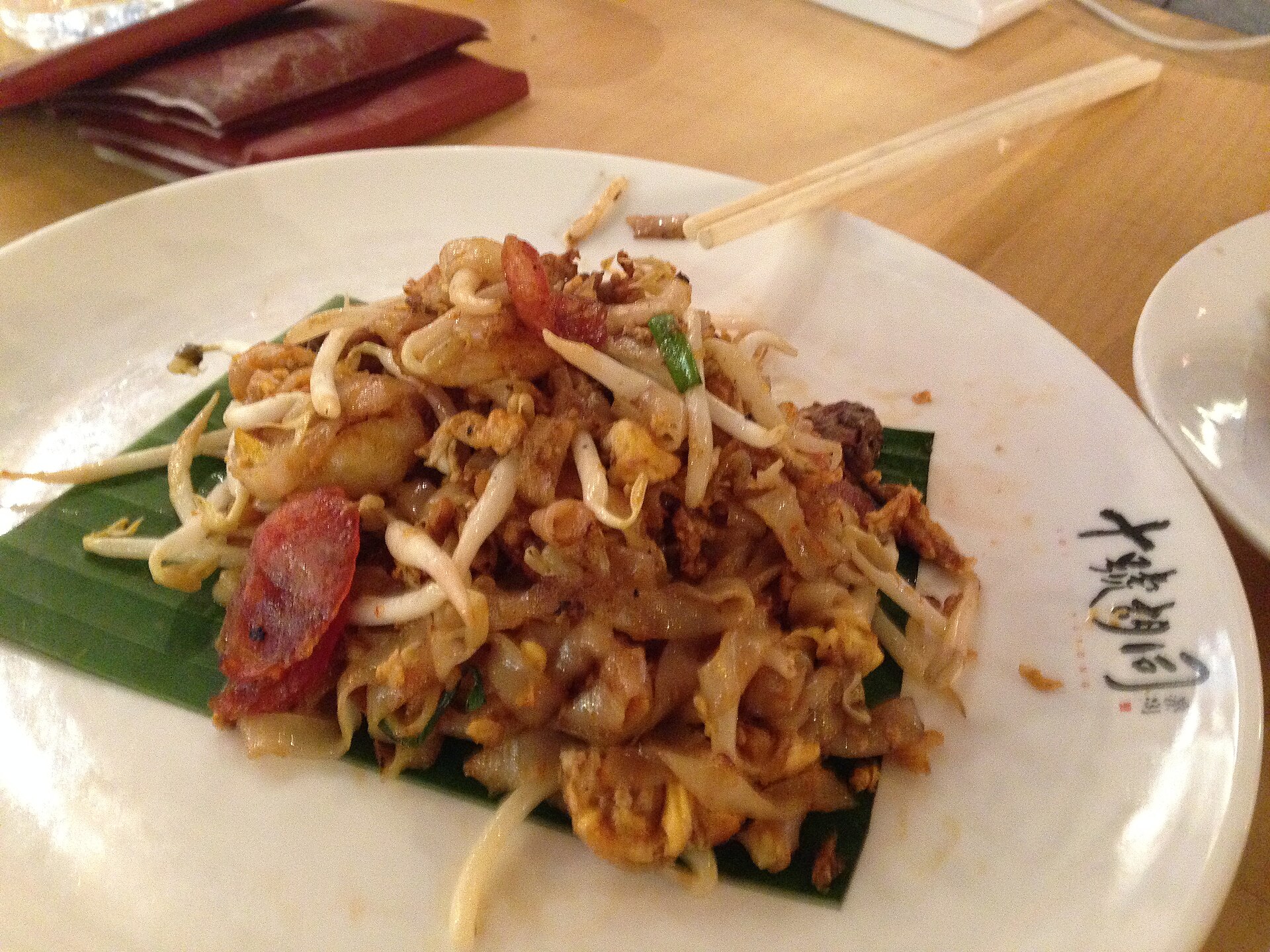
| Char kway teow | Flat rice noodles fried hard and fast over ferocious heat with prawns, egg, cockles, bean sprouts and Chinese sausage — smoky ("wok hei") in a way a home stove can't replicate |
|---|---|
| Penang asam laksa | A sour, tamarind-and-fish broth (not coconut) with thick rice noodles, torn mint, cucumber, pineapple and a dab of shrimp paste — Penang's laksa is the sour one, not the creamy one |
| Penang prawn mee (Hokkien mee) | A rich prawn-shell and pork-bone broth over yellow noodles and rice vermicelli, topped with prawns, pork and egg — confusingly, "Hokkien mee" means something completely different (dark, fried) in KL |
| Cendol | Shaved ice, coconut milk, gula melaka (palm sugar) and green rice-flour jelly strands — dessert, but eaten any time of day |
| Rojak | A fruit-and-vegetable salad tossed in a thick, dark shrimp-paste-and-tamarind dressing with crushed peanuts — sounds strange described, works completely once you taste it |
Beyond that first five: char koay kak (fried flat rice cake with egg, preserved radish and bean sprouts — a texture dish, crisped in patches), chee cheong fun (steamed rice-flour rolls, served here with a sweet dark sauce and chilli rather than the soy-based version elsewhere in Malaysia), and ais kacang (shaved ice over red beans, grass jelly, sweet corn and syrup — cendol's more chaotic cousin). None of these are obscure — you'll see most of them within a five-minute walk of any hawker centre on the island — but knowing the name and what you're supposed to taste for is the difference between ordering with confidence and pointing at random.
What makes Penang's versions distinct, across nearly all of them, comes down to the same few things: sourness handled with more restraint and precision than elsewhere in the country, a heavier reliance on seafood stock rather than pure coconut richness, and stalls that have specialised in one dish for decades rather than running a broad menu. A char kway teow stall sells char kway teow — maybe one other thing — and that focus is exactly why it's good.
How hawker culture actually works
A "hawker centre" in Penang usually means one of two things: an open-air compound with dozens of independent stalls under one roof or a cluster of awnings, or a kopitiam — an old coffee-shop building where the shop owner sells drinks and rents out cooking bays to different stall operators. You might order noodles from one stall, a drink from the coffee-shop counter, and a dessert from someone wheeling a cart between tables, and get three separate bills. That's normal, not confusing once you expect it.
Tip
The drink stall is almost always separate from the food stalls — you order your teh tarik or fresh juice from whoever runs the drinks counter, not from the noodle cook. Don't wait for the food stall to ask what you're drinking; they won't.
A few practical patterns hold across most of the island's hawker scene:
| Cash | Still the default at most stalls — some have added QR payment, but don't count on cards or count on any single stall taking them |
|---|---|
| Peak times | Breakfast (roughly 7–10am) and dinner (6–9pm) are when stalls are at full output; lunch service can taper off by early afternoon at some spots |
| Closing days | Many stalls close one fixed day a week, often Monday, on a rotation that varies stall to stall — a shuttered favourite usually isn't gone, just off that day |
| Ordering | Sit first, then order at the stall directly (or a runner will come to you) — table numbers, where marked, tell the stall where to bring the food |
| Queues | A queue at one stall next to empty ones beside it is the actual review system here — locals vote with their feet, not with a rating app |
Portions are generally small and cheap by design — the model is to eat across several stalls in one sitting, not to fill up on the first plate. Treat a hawker meal as a grazing circuit rather than a single order.
Where to graze
Rather than naming a "best stall" — which changes with retirements, rent, and family succession faster than any guide can track — it's more useful to know the areas where the island's hawker culture concentrates, so you can wander and follow the queues yourself:
Gurney Drive, on the seafront north of George Town, is the postcard hawker experience — a long row of stalls facing the strait, popular with both locals and visitors, at its best in the evening with the sea breeze cutting the heat. Chulia Street, in the heart of George Town's old town, comes alive after dark with night stalls squeezed between backpacker guesthouses and old shophouses — a good option if you're staying central and don't want to travel for dinner. New Lane, a residential side street, is a locals-first night market that fills a narrow lane with plastic tables and some of the island's most consistently recommended stalls for char kway teow and rojak. Air Itam, near the base of Kek Lok Si temple, has its own market-and-hawker cluster and is worth combining with a temple visit rather than a separate trip.
These are areas, not addresses — walk them, see what has a queue, and order there. That instinct works better on this island than any single stall recommendation that might be three years out of date by the time you read it.
How to eat well in Penang
The honest advice is less about finding the "right" stall and more about adjusting your approach: order less per stop and more stops, follow queues over quiet counters, and don't assume a place with an English menu and photos taped to the wall is where locals actually eat — it's often the opposite signal. If a stall only makes one dish, that's usually a good sign, not a limitation. And go hungry at odd hours — a spot recommended for breakfast that you visit at 3pm may already be closed for the day, not because it's bad, but because it sold out and shut the wok hours ago.
If you want the country-wide context — how Penang's food fits against KL's, what means for where you eat, mamak culture, kopitiam mornings — that's covered on the Malaysian food page. This one is deliberately narrower: what Penang does with hawker food that the rest of the country points to as the standard.
Go deeper
The newsletter
I'm writing Penang the way George Town actually eats it
The stalls, the queues, the dishes worth knowing before you order — one honest guide at a time. Want the next one?