Home › Bali › South Bali › Seminyak
South Bali · Style & sunsets
Seminyak
The grown-up, walkable end of old tourist Bali — designer boutiques, the best dining on the coast, and beach-club sunsets — with an honest reckoning of the price and the polish.
Seminyak is the upmarket end of old tourist Bali — a dense, walkable strip on the southwest coast where mainstream tourism grew up and went stylish: designer boutiques, good spas, the island's strongest restaurant row, and the famous beach clubs where the whole coast comes to drink a sunset. Is it posh? Relatively, yes — this is where the crowd that outgrew Kuta went. Is it Bali? That's the honest question this page answers. It's polished, international, expensive, and at times could be a nice beach town anywhere — but it's also the most comfortable, most convenient base on the south coast, and for the right trip that's exactly the point.
Who it's for — and who should skip it
Be honest with yourself before you book here. Seminyak suits couples, first-timers who want comfort, foodies, and anyone whose ideal day is a spa, a long lunch, some shopping, and a cocktail on the sand at sunset. It's one of the very few places in Bali you can actually walk — a rare thing on an island built for scooters — with the best concentration of good dining, shopping and spas within a few blocks of the beach. It's calmer and more grown-up than rowdy Kuta, and more polished (if less hip) than Canggu.
It is the wrong base if you're on a shoestring, chasing "real" Bali, or here to party hard. Everything is priced for the international market: a beach-club daybed, a boutique dinner and a cocktail add up fast, and the -and-rice-field texture that people fall in love with is mostly gone here, paved over by villas and restaurants. If you want scruffy charm, ceremony out your front door, or a $3 dinner, Ubud, the Bukit or east Bali deliver it; Seminyak deliberately doesn't.
Note
Where it sits. Seminyak is the next district north of Kuta and Legian, and south of Canggu — a continuous built-up coastal ribbon, so the three blur into each other on the ground. The rough dividing line north of Seminyak is often called Petitenget (around the temple) or Kerobokan/Batubelig as you head toward Canggu. Don't expect hard borders; expect one district to become the next.
Is it posh? An honest reckoning
Yes, relatively — but let's interrogate the word rather than sell it. Seminyak is "posh" in the sense that it's where mainstream Bali tourism went upscale: stylish villas behind high walls, designer and homeware boutiques, day spas on every block, and a restaurant scene (concentrated on Kayu Aya, the street everyone calls "Eat Street") that's genuinely the best on the coast. You dress a little nicer here; you pay a lot more.
Now the edges, honestly:
- It's expensive by Bali standards. Not Europe money, but multiples of what the same meal or bed costs an hour away. The polish is real and so is the bill.
- It can feel un-Balinese. Long stretches are international-generic — you could be at a nice beach town in several countries. The culture is here (see the temple below), but you have to look past the boutiques for it.
- The beach is decent, not spectacular. Grey-gold volcanic sand, wide and good for a sunset walk, but with real surf and rip currents — this is open ocean, not a calm bay. The sunsets, though, are the genuine article.
- Traffic and flooding are real. The narrow lanes clog badly, especially at the sunset rush, and in the wet season (roughly Nov–Mar) the low streets can flood hard enough to strand you for a bit.
None of that is a reason to skip it — it's a reason to book it knowingly, for what it's good at, rather than expecting an untouched fishing village.
The beach and the sunset
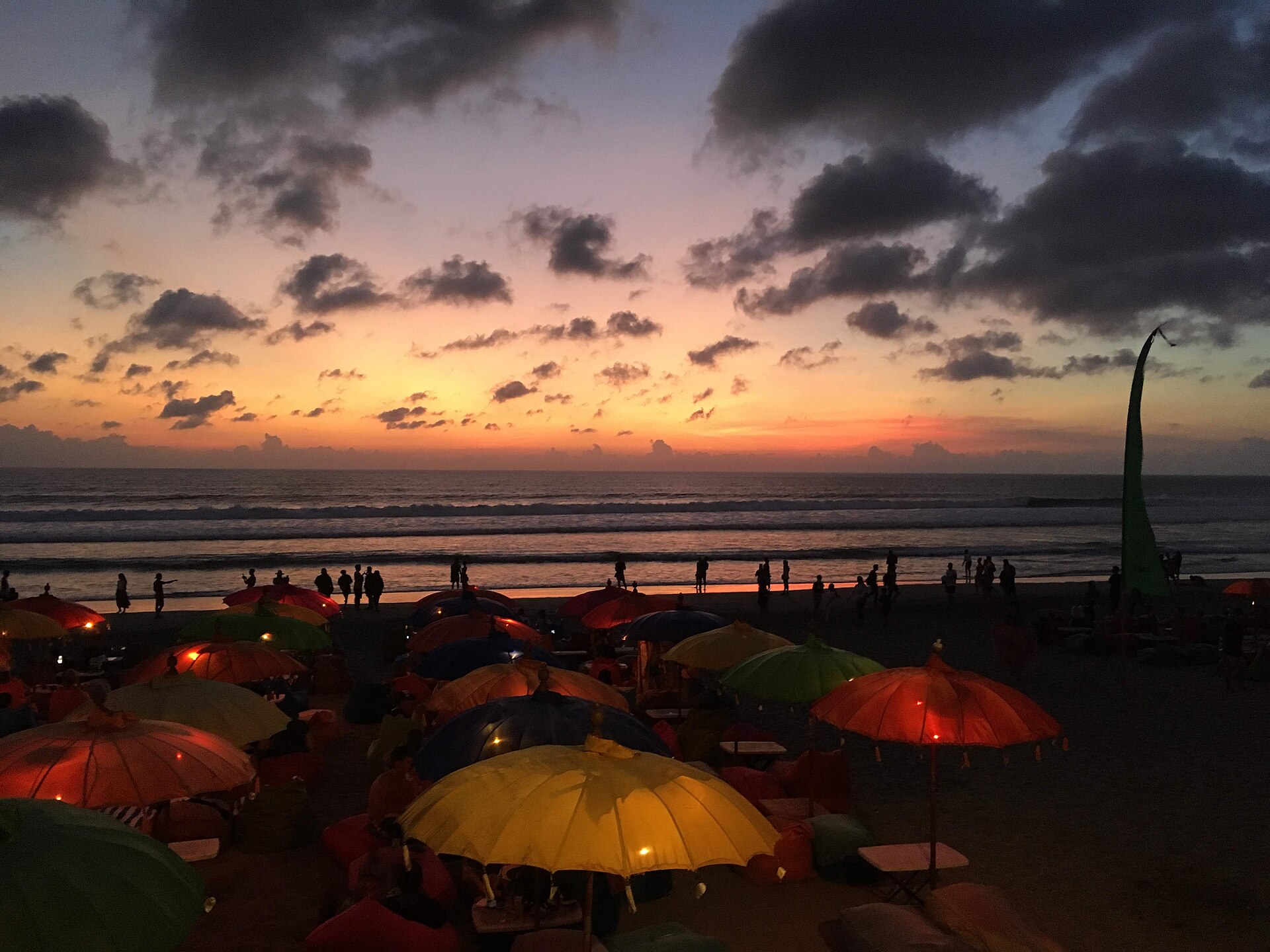
The beach itself is a long, open, grey-gold volcanic strand running from Double Six (the southern, Legian-facing end) up past Petitenget beach to the north. It's wide, walkable, and the sunsets are reliably gorgeous — the Indian Ocean faces you straight on, so the sky show is the daily event that fills the beach clubs and the bean-bag bars on the sand.
Swimming needs a caveat. This is a surf beach with genuine rip currents — fine for experienced swimmers and surfers reading the water, but not the gentle flat-water paddle that Nusa Dua or Sanur offer. There are stretches with lifeguards and flags; swim between them, and if you're here with small kids or nervous swimmers, treat the water as a paddle-and-play, not a proper swim. The waves are beginner-to-improver surf — the same sandy Kuta–Legian–Seminyak break the surf schools use — so a lesson here is easy to find.
The beach clubs and the dining
If Seminyak invented a signature, it's the beach club at sunset: daybeds and bean-bags on the sand or around a pool, a cocktail list, a DJ warming up, and the whole room turning to face the ocean as the sun goes down. This is the scene foreigners picture when they picture Seminyak, and it's the thing the district genuinely does best. Some venues are relaxed and family-friendly by day; others tip into a dressy, pricey party-adjacent evening — check the vibe of a specific place before you commit a group to it.
Behind the beach, the dining is the other pillar. Kayu Aya / "Eat Street" and the lanes off it hold the densest run of good restaurants on the south coast — everything from Balinese and Indonesian to the full international spread, plus the cafés and juice bars in between. You will eat well here. You will also pay for it, and the best tables book out in high season.
Tip
Two honest beach-club notes. First, most charge a minimum spend for a daybed rather than an entry fee — you're paying either way, so factor it into the "free sunset" maths. Second, the sunset rush is a real traffic and parking crunch; walk or get dropped off, and arrive before the sky starts turning, not as it peaks.
Pura Petitenget — the temple on the sand
For all the boutiques, Seminyak still has its sacred anchor. Pura Petitenget sits right on the beach at the northern end, one link in the chain of ( ) that guard Bali's southwest coast — the same coastal line that runs down to Tanah Lot and up through the surf coast. It's a working temple, not a museum: you'll find its open onto the sand, offerings laid out fresh, and, on ceremony days, robed processions and rituals taking place on the beach itself, sometimes a few metres from the bean-bags.
The name carries a legend. "Petitenget" is usually translated as something like "mysterious casket" or "magic box," and tradition ties the site to , the influential travelling priest of the 1530s credited with founding several of Bali's sea temples — the story going that a sacred casket was left or entrusted here, giving the place its name and its power. Treat the details as tradition rather than dated fact, but treat the temple itself with full respect.
Note
If you visit, visit properly. Wear a and sash (borrow or rent one at the temple), keep back from anyone praying and from active offerings, don't climb on the shrines for a photo, and step aside for processions — you're a guest on the sand at a place that was sacred long before the district around it existed. During a ceremony, watch quietly from a distance rather than wading in with a camera.
A little history: how the fishing coast went upmarket
Within living memory this was quiet fishing and farming coast — rice and coconut behind a beach that few tourists bothered with, in the shadow of busy Kuta to the south. Kuta was the original backpacker landing in the surf-and-party years; Seminyak was the sleepy edge of it. What changed the district was the arrival, from around the 2000s onward, of the pioneering beach clubs, boutiques and destination restaurants that pulled the money and the upmarket crowd north out of Kuta, looking for the same coast without the rowdiness. The villas, spas and Eat Street grew in behind them, and the fishing-village coast became the polished district you see now — for better and for worse. Petitenget temple, older than all of it, is the thread back to what the coast was before.
Seminyak vs Kuta vs Canggu — pick your strip
The three run into each other along the coast, but they're different trips. Here's the crisp version so you can self-select:
| Seminyak | The polished, grown-up middle: best dining and shopping, beach-club sunsets, stylish villas, walkable. Pricier and more international; couples, first-timers wanting comfort, foodies. |
|---|---|
| Kuta & Legian (south) | Cheaper, younger, rowdier and more built-up — the original tourist strip, big learn-to-surf beach, budget hotels, loud nightlife, closest to the airport. Least "Bali-feeling." |
| Canggu (north) | Younger and hipper: surf breaks, café-and-coworking culture, the digital-nomad scene, sunset at Echo Beach. More laid-back and scruffy-cool, but crowded and the traffic is brutal. |
| Quick pick | Comfort and dining → Seminyak. Budget and party near the airport → Kuta. Surf, cafés and the nomad scene → Canggu. |
If you're weighing these against Ubud, the Bukit or the islands too, I lay all the bases out side by side in where to stay in Bali.
A realistic day here
Slow morning — spa, a long café breakfast, a wander through the boutiques on and around Eat Street. Beat the heat indoors or by the villa pool in the early afternoon, then walk down to the beach as it cools, pay into a beach club or grab a bean-bag on the sand, and give the sunset the attention it deserves. Dinner is the easy part: you're a short walk from more good restaurants than you can fit into one trip. If the polish starts to feel too smooth, the wilder south is close — a short drive south gets you to Jimbaran Bay for a grilled-seafood dinner with your feet in the sand.
Practical notes
Tip
Seminyak makes a strong first base for the south — walkable, central, comfortable, and well stocked with villas and boutique hotels across a wide price range. If you want to settle in here and day-trip the rest of the south, this is an easy place to book.
Find a place to stay in SeminyakSee stays| Getting there | ~30–45 min from the airport in normal traffic, longer at peak; a fixed-price airport taxi or pre-booked driver is easiest. |
|---|---|
| Getting around | One of the few walkable Bali districts for eating and shopping; ride-hail (Grab/Gojek) and drivers fill the gaps. Expect slow going at the sunset rush. |
| Beach | Wide grey-gold sand, great for sunset; real surf and rip currents — swim between the flags, not a calm-bay swim. |
| Best time | Dry season (≈ May–Oct) for reliable sun and less street flooding; the wet season can flood the low lanes. |
| Good to know | It's the upscale-international end of the coast — budget accordingly, and step a little inland or north for cheaper, more local eating. |
The newsletter
I'm writing Bali the way I wish someone had written it for me
Which strip actually fits your trip, which beach-club sunset is worth the minimum spend, where the temple on the sand still holds ceremony — one honest, been-there guide at a time. Want the next one?