Penang · Understand
George Town Street Art
Two layers — painted murals and wrought-iron caricatures — spread across the old town since 2012, fading and getting repainted often enough that any list of locations is a snapshot, not a map.
George Town's street art is two separate things wearing one name: painted murals, mostly kicked off by Lithuanian artist Ernest Zacharevic in 2012, and a parallel set of wrought-iron caricature sculptures — witty steel-rod signs telling old local history — installed under the "Marking George Town" project. Both are scattered across the UNESCO core rather than fixed to one street, and both change: pieces fade, get damaged, get painted over, get removed. Treat any specific location as a snapshot of the date it was checked.
Where it started
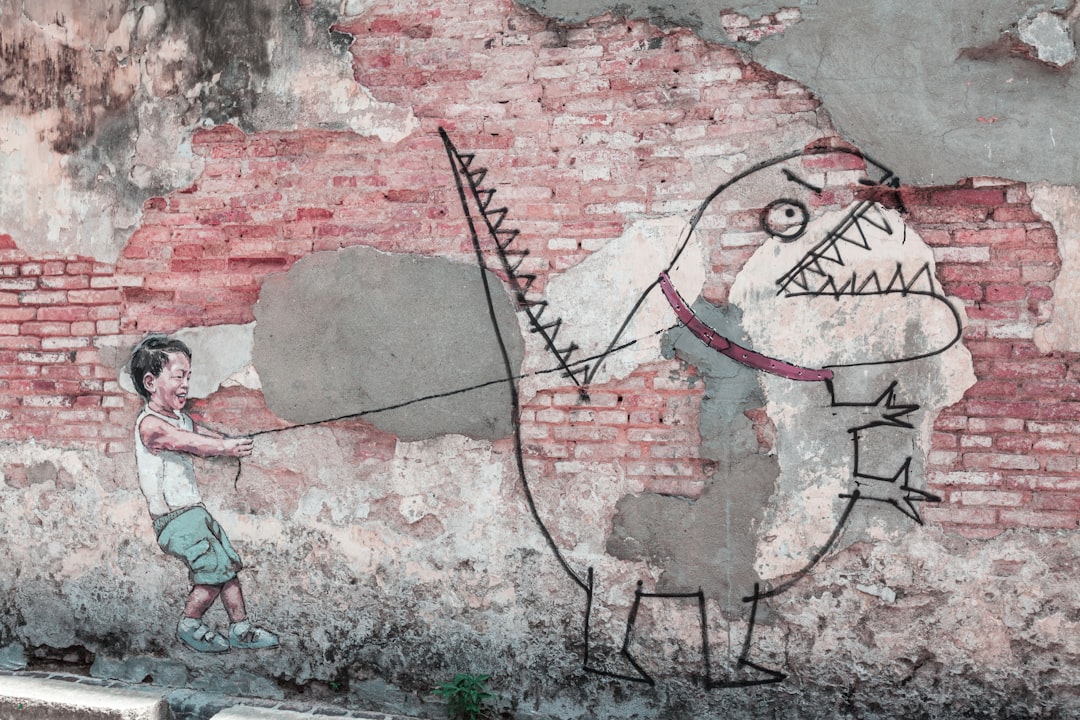
The mural wave traces to the George Town Festival of 2012, when the festival commissioned Zacharevic for a series of works under the umbrella title "Mirrors George Town" — pieces designed to reflect everyday life in the old town back at the people walking through it, rather than depict grand historical scenes. Kids on a Bicycle (also widely called Children on a Bicycle, with a real bicycle bolted to the wall on Armenian Street) became the breakout piece and is still the one most visitors go looking for first. Others from the same commission followed in its wake — Boy on a Bike and Little Boy with Pet Dinosaur among them — painted onto the blank side-walls and gable ends of shophouses across the core.
| Origin | George Town Festival 2012, Ernest Zacharevic's "Mirrors George Town" series |
|---|---|
| Best known piece | Kids on a Bicycle, Armenian Street |
| Second layer | Wrought-iron caricatures under "Marking George Town," from 2009 |
| Condition | Uneven — fading, touch-ups, repaints and removals are ongoing |
What made the murals take off beyond Penang is partly the setting: painted directly onto old shophouse walls rather than a purpose-built gallery, they read as part of the street rather than art installed on top of it, and they're free to see at any hour. That's also why they've proven hard to preserve exactly as painted — they're exposed to monsoon rain, direct tropical sun and the ordinary wear of a working street, not held behind glass.
The two layers to look for
Most first-time visitors only clock the murals, but the second layer is worth knowing about on purpose, because it's a genuinely different project with a different point.
The murals are large-scale painted works, mostly by Zacharevic and artists who followed his lead through the 2010s — some official commissions, some added independently since, official sanction varying piece to piece. They tend toward playful, human-scale scenes: children at play, everyday street moments, the odd piece of trick-of-the-eye perspective that only reads correctly from one angle.
The wrought-iron caricatures, by contrast, are small steel-rod sculptures mounted directly onto walls at head height, each paired with a short caption explaining a piece of local history or an old trade — a rickshaw puller, a boy on a swing, a nod to a Hokkien saying. They're part of the "Marking George Town" project, rolled out from 2009 as a more municipal, historically-minded companion to the mural boom that followed it. Where the murals are about atmosphere, the caricatures are closer to a history lesson delivered in cast iron rather than a plaque.
| Murals | Large painted works, mostly post-2012, playful and photograph-driven |
|---|---|
| Caricatures | Small wrought-iron sculptures with captions, from 2009, history-driven |
| Density | Both layers cluster most heavily around Armenian, Ah Quee and Chulia streets |
| Cost | Free to view — no ticket, no set hours |
How to trail it
There's no single official route, and that's mostly fine — the core mural and caricature cluster sits within an easy self-guided loop around Armenian Street, Ah Quee Street and Lebuh Cannon, with Jalan Chulia worth a detour for a few more pieces further east. Printed and digital mural maps circulate (tourist-info counters, some cafes, several apps) and are a reasonable starting point, but because pieces come and go, treat any map — including this page — as a rough guide to where to start looking rather than a guaranteed inventory.
Tip
Go early, before roughly 9–10am. The heat builds fast in the shadeless lanes, the light is softer for photos, and you'll beat the queue that forms for the bicycle mural by mid-morning.
A isn't much use for this — the trail is short walking distances between narrow, mostly one-way streets, and half the point is stumbling on a caricature you weren't looking for on the way between two murals you were.
The honest caveat: this is a snapshot, not a map
Street art is, by its nature, temporary — that's part of what distinguishes it from a heritage building under conservation order. Over the years since 2012, individual George Town murals have faded under sun and rain, been damaged or defaced, been painted over entirely, or been quietly removed when a building changed hands or was renovated. New pieces get added in the same gap years. A list of "must-see murals" compiled at any one point is therefore accurate for that point and nothing more.
| Turnover | Individual pieces fade, get touched up, get painted over or removed |
|---|---|
| What holds up longest | The most photographed pieces (the bicycle mural) tend to get restored when damaged; smaller or less-known ones don't always |
| What to do about it | Check locally on the day — tourist info, recent photos, or ask at a nearby cafe |
None of that is a reason to skip the trail — it's a reason to hold the specifics loosely. Go for the walk and the atmosphere of a shophouse street doing double duty as an open-air gallery, and treat any particular piece you've seen online as a "last confirmed" rather than a promise.
Getting there
The whole cluster sits inside George Town's compact UNESCO core, an easy walk from the Street of Harmony and a short one from the clan jetties — see George Town for how it fits against the rest of the old town, and Armenian Street for the single densest stretch and the story behind its most famous mural.
| Where to start | Armenian Street, then Cannon Street and Ah Quee Street |
|---|---|
| Best time | Early morning, before the heat and the queues build |
| Getting around | Walk it — the cluster is compact and mostly pedestrian-friendly |
| Currency | Priced in if you're buying prints or postcards nearby — the art itself is free |
Go deeper
The newsletter
I'm writing Penang street by street, the way I actually know it
The murals that have held up, the ones quietly repainted, the corner nobody photographs but should — want the next guide as I write it?