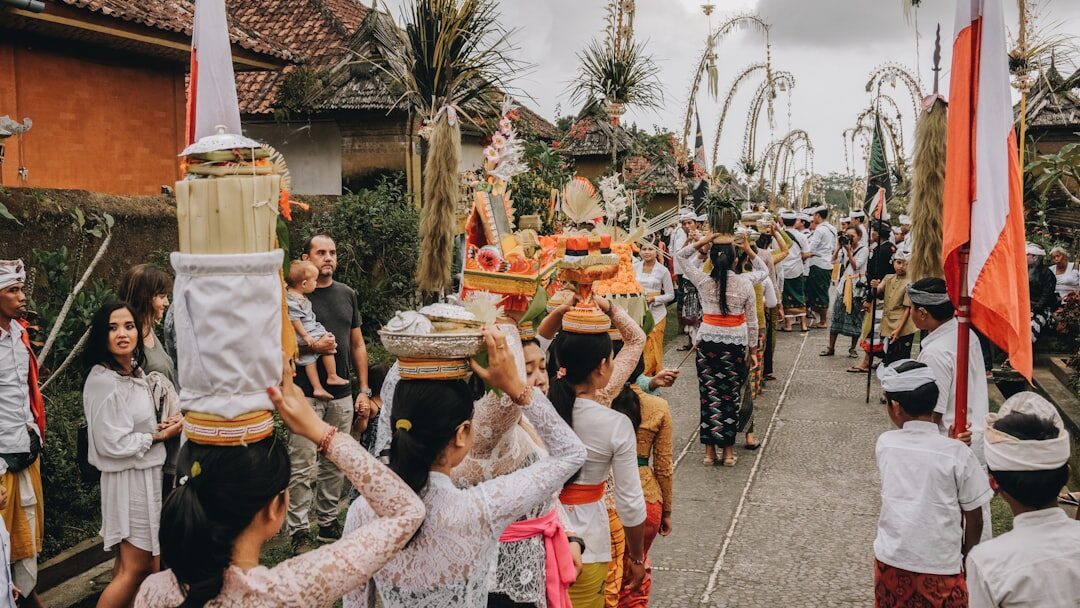
Bali is one of the last places on earth where daily life is still lived around the temple. From the moment you land you'll walk past offerings, ceremonies and quiet roadside prayer, constantly, all day. None of it is staged for you — it's simply the island keeping its balance. A little care on your part is the whole difference between being a welcome guest and being the tourist people quietly wince at.
I grew up with this. On the Bukit, where I live, the first thing my mother does each morning is lay a fresh offering on the doorstep, and the day starts from there. So none of what follows is a rulebook I'm waving at you — it's the small courtesy I'd want a friend to know before they came to stay. Get these few things right and you'll find doors open that you didn't even know were closed.
At the temple
Two things get you through the gate: a wrapped around your waist and a sash (selendang) tied over it. Both are required to enter any temple, and most of the big ones — Uluwatu, Besakih, Tirta Empul — rent or lend them at the entrance, so you're never stuck. Still, bringing your own sarong is easy, weighs nothing, and saves you queuing behind a coach party; if you're deciding what to carry, I've put it on the what to pack list.
Beyond the cloth, the manners are simple:
- Cover your shoulders and knees. A sarong handles the legs; bring something with sleeves for the top.
- Don't step in front of people who are praying. Wait, or walk behind them.
- Don't sit or stand higher than the priest or the shrines. Height is respect here — keep yourself below both.
- Some inner courtyards are for worshippers only. There'll be a sign, or a low gate. Respect it; the rest of the temple is yours to enjoy.
The menstruation rule
Traditionally, women who are menstruating are asked not to enter temples, and many temples post this plainly at the entrance. I want to be honest about it rather than tiptoe around it: this is a ritual-purity belief, not a judgement on women or a comment that anyone is unclean. The same logic keeps out men with open wounds and people in mourning — blood, birth and death all sit outside the temple's ritual cleanliness. No one checks and no one asks; it runs entirely on your own honour. If it applies to you on the day, simply admire the temple from outside.
Offerings (canang sari)
Those little palm-leaf trays of flowers, rice and a smoking stick of incense are , and once you notice them you'll see them everywhere — on shrines, on doorsteps, on dashboards, balanced on a wall, set right in the middle of the pavement. They're fresh every single day: small prayers of thanks, laid down that morning.
So the courtesy is small but it matters — don't step on them, and don't step over them. Just walk around. If you catch one with your foot by accident, genuinely don't agonise over it; it happens, it's forgiven, nobody minds a true accident. What's not okay is treading through them carelessly, and — please — never pick one up as a souvenir. If you want to understand what they actually are, I've written it up in Balinese Hinduism.
The body
Balinese ideas about the body are worth a minute, because they quietly govern a lot of small interactions:
- The head is the most sacred part of a person. Don't pat heads — not adults', and not children's, however cute the kid on the floor is.
- The feet are the least sacred. Don't point your feet or the soles of them at people, at shrines, or at offerings, and don't put your feet up on tables.
- The left hand is considered unclean. Give, receive, and eat with your right hand. When you hand someone money or take your change, right hand.
- Point with an open hand or your thumb, not a jabbing single finger — the finger reads as rude here the way it might back home, only more so.
Dress & modesty away from the beach
Beachwear belongs on the beach. The moment you're in a village, a warung, a market or anywhere near a temple, cover up — a light shirt and shorts or a sarong is plenty. Walking through town in just a bikini or with your shirt off reads as genuinely disrespectful, not carefree. Topless and nude sunbathing is not okay, on the beach or off it.
Watch out
Sacred mountains — Agung, Batur — and temple sites are not photo props. Every year a handful of tourists are deported for posing naked or disrespectfully at holy places, and the Balinese take it seriously because to us these are living sacred ground, not scenery. Climb, swim and photograph the ordinary beauty of Bali all you like; just keep the shrines and the summits treated as what they are.
Behaviour & face
Balinese culture prizes calm. Composure and politeness are read as strength; losing your temper, raising your voice, or haggling aggressively makes you look bad — and, practically, it almost never gets you the better outcome. The person across from you just goes quiet and stops helping.
So: smile, be patient, and bargain gently and with a bit of humour — a warm back-and-forth gets you a fairer price than a hard one ever will. A little of the language goes an astonishingly long way. Terima kasih is thank you; use it constantly. And the proper greeting, the one that makes faces light up, is — try it once and watch what happens.
Photography & ceremonies
You'll often be genuinely welcome to stand and watch a ceremony, even a cremation (), provided you're discreet and modestly dressed. A few quiet rules make you a good guest rather than an intrusion:
- Ask before photographing anyone up close. A smile and a gesture at your camera is enough; almost everyone says yes.
- No flash, and don't climb — a wall, a shrine, a chair — for a better shot.
- Never stand higher than the priest. If in doubt, get lower.
- A funeral is not entertainment. It's a family sending someone on. Watch with the respect you'd want at your own.
Homes & shoes
If you're invited into a Balinese home — and you might be — take your shoes off at the door, or wherever you see others have left theirs. If tea or food is offered, accept it graciously even if it's just a sip; refusing outright can sting a little. Hospitality here is heartfelt, and meeting it in kind is half of good manners.
| Temples | Sarong and sash to enter; cover shoulders and knees; don't stand above the priest or shrines. |
|---|---|
| Hands | Give, receive and eat with the right hand — never the left. |
| Heads & feet | Don't touch anyone's head; don't point your feet or soles at people, shrines or offerings. |
| Offerings | Walk around the canang sari on the ground — don't step on them, and never take one. |
| Off the beach | Cover up in villages, warungs and markets; beachwear stays on the beach. |
| Temper | Keep your cool and bargain with a smile — anger loses face and gets you nowhere. |
| Photos | Ask before close-ups; no flash, don't climb, don't treat a ceremony as a show. |
None of this is hard, and that's rather the point. Being a good guest in Bali costs you almost nothing — a length of cloth at the gate, the right hand for your change, a step around an offering, a smile instead of a raised voice. Do it, and you'll feel the island open up to you: an invitation to sit, a genuine welcome, a ceremony you're waved in to watch. Come with a little care and Bali gives it back, many times over.
The newsletter
I'm writing Bali the way I wish someone had written it for me
The offerings, the ceremonies, the small courtesies that make a place feel like yours — one honest, been-there guide at a time. Want the next one?