Home › Bali › Languages of Bali
Bali · Language
The Languages of Bali
Three languages, one island — the mother tongue, the national one, and the one on the café menu.
When a owner turns from scolding her kids to taking your order, you've just heard her switch languages mid-breath — from Balinese at home to Indonesian for the stranger, and maybe into English for you. Three languages live on this island at once, and they aren't ranked versions of the same thing. Balinese is our mother tongue, Indonesian is the national one every school child learns, and English is the language of the tourist south. Knowing which is which — and that the first two are as different as, say, Italian and Turkish — changes how you hear the whole place.
The three languages you'll actually hear
Sort them by where they live and it gets simple fast:
- (Basa Bali) — the native tongue of the Balinese people, spoken at home, in the village, at the temple, between neighbours. It's an Austronesian language, cousin to the other tongues of the archipelago, and it's what most Balinese think in. Millions speak it.
- (Bahasa Indonesia) — the national language, a standardised form of Malay, deliberately chosen after independence as a neutral common tongue so no single ethnic group's language would rule the others. It's the language of school, government, TV, road signs, and any conversation between a Balinese person and someone from Java, Sumatra or Flores. Nearly everyone here speaks it fluently.
- English — not native to anyone, but the working language of tourism across the south: Kuta, Seminyak, Canggu, Ubud, the Bukit. Menus, dive briefings, scooter rentals, hotel desks. Head into the highlands or the east and it thins out fast.
Balinese is not a dialect of Indonesian
This is the single thing most visitors get wrong, so let me be plain: Balinese and Indonesian are two different languages, not a posh and a plain version of one. They belong to the same broad Austronesian family — the way French and Hindi both trace back, distantly, to one ancestor — but a Balinese speaker and an Indonesian-only speaker cannot understand each other's mother tongue. They're mutually unintelligible. Different words, different grammar, different feel.
The reason they seem interchangeable to a visitor is that every Balinese person is bilingual, gliding between the two so smoothly you never see the seam. Indonesian is the bridge; Balinese is home.
The beautiful, difficult heart: speech levels
Here's where Balinese stops being just "another language" and becomes something that will quietly humble you. Balinese has speech levels — — whole parallel vocabularies you choose between depending on who you're talking to and about.
There's a low or common register for family, close friends, animals, small children — the everyday. And a high, refined register for elders, priests, strangers of higher standing, and anyone you're honouring. The word for "eat," for "sleep," for "you," for "house" — each has more than one form, and picking the wrong one is like turning up to a funeral in beach shorts. A Balinese speaker makes this calculation constantly, in real time, reading the caste, age and status of everyone in the conversation before a sentence even leaves their mouth.
It's genuinely hard — hard for young Balinese too, which is part of why it's under pressure. But it's also the most beautiful thing about the language: courtesy isn't a tone of voice here, it's built into the vocabulary itself. When you learn later that temple and offering ritual leans on the refined register, you understand why the language and the religion can't really be pulled apart.
Aksara Bali — the script on the temple wall
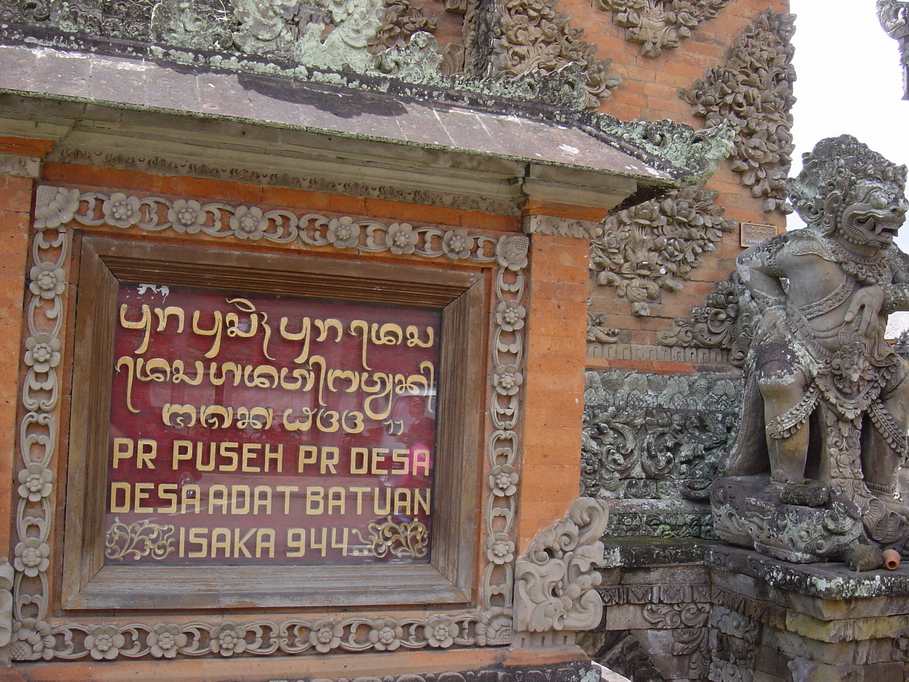
Look closely at temple signs, ceremonial banners and older inscriptions and you'll find a flowing, looping script that looks nothing like our alphabet. That's , the traditional Balinese script — a Brahmic abugida, the same broad family as the scripts of India and much of Southeast Asia, where each consonant carries a built-in vowel you modify with marks.
For centuries it was the way to write Balinese, and the deepest knowledge — ritual, medicine, myth, calendar — was inscribed on , manuscripts made of dried, treated palm leaves, the text scratched in with a blade and rubbed with soot.
Today almost all everyday Balinese is written in Latin letters — texts, signs, schoolbooks, this website. The script is still taught in schools and appears by mandate on street signs, and there are real revival efforts, but the number of people who can fluently read and write it is shrinking. You'll see Aksara Bali far more than you'll see anyone actually reading it.
A language that's alive, but under strain
Don't mistake any of this for a language dying quietly. Balinese is spoken every day by millions of people, at full volume, everywhere on the island. But it's also under real pressure. Many young Balinese now speak Indonesian more comfortably than the refined levels of their own mother tongue — Indonesian is what school rewards, what screens speak, what gets you a job beyond the island. Refined Balinese, the hardest and most honorific register, is the part slipping first.
Linguists tend to call Balinese vulnerable rather than endangered — vital, but worth worrying about. What you'll hear on the ground is constant code-switching: a single sentence that starts in Balinese, borrows an Indonesian word for something modern, and lands on an English one for "wifi" or "checkout." It's not sloppiness. It's three languages doing three jobs at once.
So which one should you learn?
Tip
Learn a little Indonesian. It's the practical one by a mile — it works not just in Bali but across the entire country, from Lombok to Sumatra, and it's genuinely one of the easier languages to start in: written in the Latin alphabet, spelled almost exactly as it sounds, no tones, no genders, no verb conjugations, no plurals to memorise. Terima kasih (thank you) and berapa? (how much?) will carry you a long way.
A few words of Balinese on top of that are pure delight — not necessary, but a gift. A greeting, a thank-you offered in the mother tongue rather than the national one lands differently; you'll watch a face open. You don't need to wade into speech levels; a couple of warm courtesies are plenty. I've put the ones actually worth carrying — in both languages, side by side — on a separate page.
Note
Want the words themselves? The companion Balinese & Indonesian phrasebook has the greetings, numbers, market and courtesy phrases laid out so you can start using them the day you land.
The newsletter
I'm writing Bali the way I wish someone had written it for me
The language you're half-hearing, the register you'll never quite master, the two words that make a market seller grin — one been-there, honest guide at a time. Want the next one?