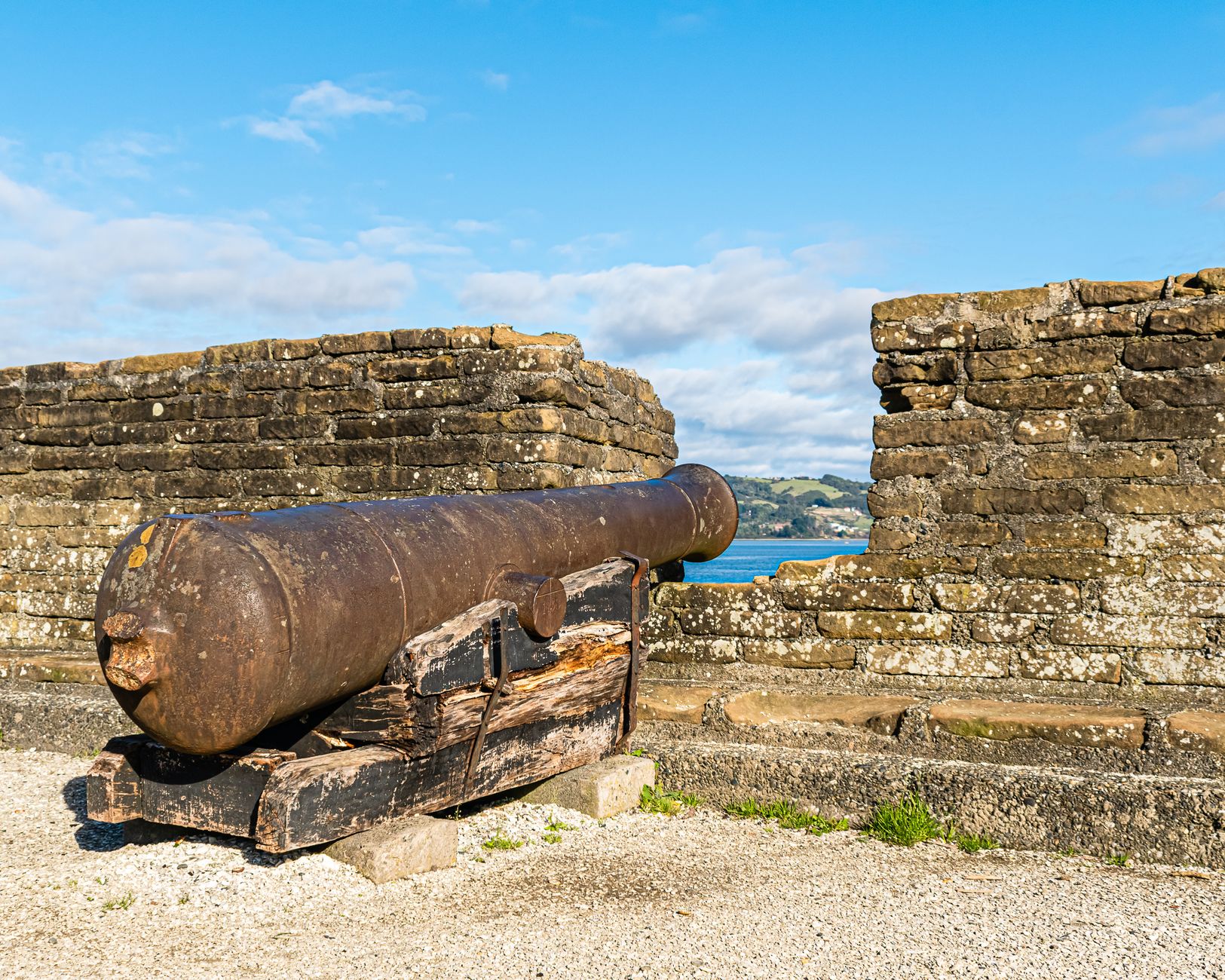
Fort Cornwallis is where British Penang starts — a star-shaped earthwork-turned-brick fort on the spot where Francis Light landed in 1786, right at the tip of George Town's waterfront. Next to it, the Esplanade (Padang Kota Lama) is the open seafront green that grew up around the fort once it stopped needing to defend anything: colonial civic buildings on one side, the Strait of Malacca on the other, and a breeze that's usually the best reason to be standing there.
What Fort Cornwallis actually is
Light's East India Company landing party built the first version of the fort in wood and palm thatch; what stands now is the brick-and-earth rebuild from the 1790s and early 1800s, laid out in the star-shaped bastion pattern that was standard European fort design at the time — points angled outward so defenders could cover every approach with crossfire, at least on paper. It never saw real combat. That's the honest headline: Penang's founding fort was built to project a claim on the harbour more than to survive a siege, and it mostly did exactly that.
Entry to the fort interior is charged; the Esplanade green outside it is free to walk. It's open daily during standard daytime hours.
Inside the walls: the original ramparts you can walk along, a scatter of Dutch and Portuguese-cast cannons (most notably the Seri Rambai, a large brass cannon with its own local folklore about fertility wishes — locals used to leave flowers on its barrel), a small lighthouse added later, a chapel, and a low-key history gallery in the old barracks building. None of it is grand. The walls are low enough to see over in most places, the courtyard is mostly grass, and you can walk the full loop in well under an hour.
Tip
Go for the setting and the history, not for the fort as a spectacle. This isn't a Kotokali or a fortress you climb for hours — it's a modest colonial structure that happens to mark the exact spot Penang's founding began. Read the plaques, walk the ramparts for the harbour view, and don't expect more than that.
The Esplanade — Padang Kota Lama
Outside the fort's landward wall, the Esplanade is a wide grass field running along the waterfront, ringed by some of George Town's grandest civic architecture: the domed City Hall and Town Hall, both early 20th-century British-built, and the white obelisk of the Cenotaph, Penang's war memorial. In the evenings this is where locals actually use the green — joggers, badminton games strung up between trees, families out for the sea breeze once the heat breaks. During the day it's mostly open lawn with a view across to the container ships queued for the strait. The green itself is free to walk, with no gate or hours to plan around, so if you're skipping the fort's entry fee, this side is where you'd still come.
The combination — a modest fort behind you, a working civic green in front, open water beside you — is what makes this corner read as George Town's colonial edge more clearly than any single building does. It's the transition point between the old trading-post waterfront and the shophouse grid that grew up behind it.
Getting there
Both sit at the northeastern tip of the old town, an easy walk from most of George Town's heritage core — roughly 10–15 minutes from the Street of Harmony, closer if you're already near the waterfront. There's no reason to take a for this one; the walk along the waterfront is part of the point, and parking near the fort is limited in any case.
| From the Street of Harmony | About 10–15 minutes on foot |
|---|---|
| Getting in | Walk-up entry to the fort; the Esplanade green has no gate |
| Currency | Fort entry, if any, is priced in (RM) |
Go deeper
The newsletter
I'm writing Penang street by street, the way I actually know it
The Street of Harmony, the jetties, the fort at the edge of it all — want the next guide as I write it?