Penang · Understand
Penang's Festival Calendar: What's Worth Timing a Trip Around
Penang's calendar runs on lunar dates that move every year — check before you book, but a handful of these are genuinely worth building a trip around.
Most of Penang's big festivals follow the lunar calendar, which means the date moves by weeks every year — the single most useful thing I can tell you is to check the actual dates for the year you're travelling before you plan around any of this. A few of them are worth timing a trip around; several more are worth knowing about mainly so you're not caught out by a closed shop or a packed ferry.
Why the dates keep moving
Chinese New Year, Chap Goh Meh, the Hungry Ghost Festival, Thaipusam and are all set by lunar or lunisolar calendars rather than the fixed Gregorian one, so each shifts by roughly ten to eleven days earlier every year, occasionally jumping a whole month when a leap month is added. The George Town Festival is the exception — it's a modern arts programme with a date the organisers pick themselves — but even that has moved between months in past years. Treat every date below as a starting point, not a booking reference.
| George Town Festival | Arts and heritage programme, usually mid-year |
|---|---|
| Chinese New Year | Late January to mid-February, lunar |
| Thaipusam | January or February, lunar Tamil calendar |
| Hungry Ghost Festival | Seventh lunar month, usually August–September |
| Deepavali | October or November, lunar Hindu calendar |
George Town Festival — the one to plan a trip around
The George Town Festival is Penang's modern arts calendar highlight: a programme of theatre, music, visual art and installations that takes over venues across the heritage zone, usually running for several weeks around the middle of the year. It's the closest thing Penang has to a festival built for visitors rather than around a religious or communal date, and it's genuinely worth checking the dates and building a trip around it if contemporary arts and a livelier-than-usual old town appeal to you.
Tip
Book accommodation early if your dates land on the festival — George Town's hotel rooms fill up fast once the programme is announced, and the best installations tend to be in venues that only open for the festival window.
Chinese New Year — Kek Lok Si and Chingay
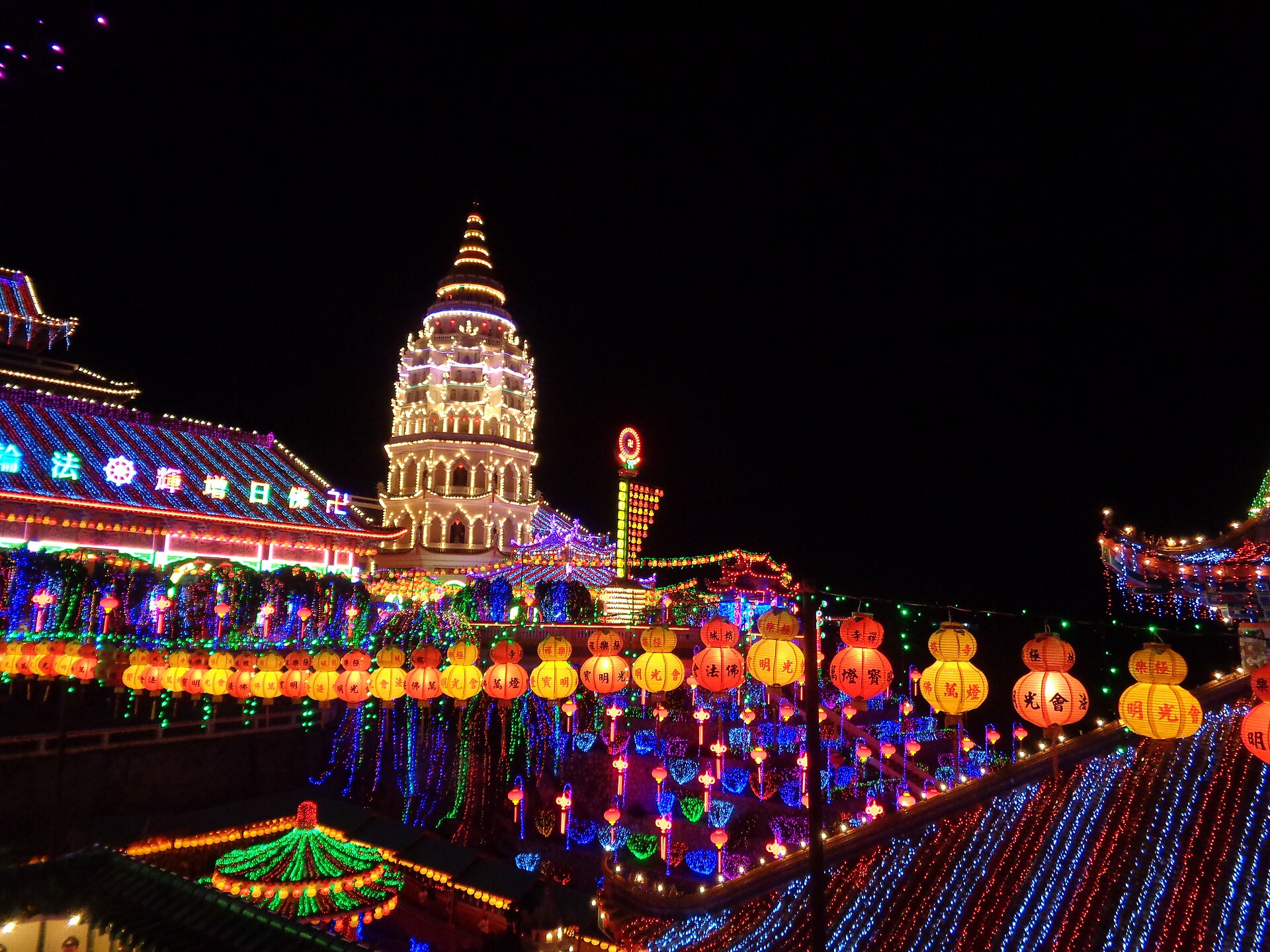
Chinese New Year is when Penang looks most like itself: Kek Lok Si Temple, up on the hill in Air Itam, strings up tens of thousands of lanterns for a light-up that runs for the weeks around the new year, visible from a fair stretch of the island after dark. In George Town itself, the Chingay parade brings lion and dragon dances, stilt-walkers and flag-bearers through the streets, and the old town's shophouses and temples get strung with red lanterns and firecracker smoke for days either side of the date itself.
This is worth timing a trip around if you want to see Penang at its most visually dense — but it's also the single busiest and most crowded stretch of the local calendar, so expect packed flights, inflated hotel rates, and some hawker stalls closed for the holiday itself rather than open and serving.
Watch out
A lot of hawker stalls and family-run kopitiam close for several days over Chinese New Year itself, since it's the one holiday most stallholders take off to be with family. Chain restaurants and hotels stay open; the small places that make George Town's food scene what it is often don't.
Chap Goh Meh — the fifteenth night
Fifteen days after Chinese New Year, Chap Goh Meh closes out the new year period — traditionally the night unmarried women threw oranges into the sea or a river for good luck in finding a partner, a custom that's faded from daily life but still gets marked with events and lantern displays around George Town and the clan jetties. It's a smaller, quieter close to the new year season rather than a reason to time a trip around on its own, but worth knowing about if you're already in town for Chinese New Year and wondering why the mood shifts a fortnight in.
Thaipusam — the local procession
Thaipusam is a Hindu festival honouring Lord Murugan, marked by devotees carrying kavadi — ornate frames, some pierced through skin with hooks and skewers as an act of devotion — in procession to a temple. Penang's observance centres on the Nattukkottai Chettiar Temple on Jalan Kebun Bunga and draws a genuine local crowd rather than a staged spectacle; it's intense to watch and not something to approach as a photo opportunity without sensitivity to what it means to the people taking part.
If you're drawn to festivals for what they reveal about a place rather than for the spectacle alone, Thaipusam is one of the more honest windows into Penang's Indian community — but go with the awareness that you're a guest at someone else's act of faith, not an audience at a show.
The Hungry Ghost Festival — getai stages and empty front-row seats
Through the seventh lunar month, Chinese communities across Penang mark the Hungry Ghost Festival, when the spirits of the dead are believed to roam freely. The most visible sign of it is getai — makeshift stages set up in car parks and open lots for nights of Hokkien and Cantonese opera, variety performances and karaoke, put on as entertainment for both the living audience and the wandering spirits. Locals leave the front row of plastic chairs empty, and it's considered bad form to sit there or to whistle after dark during the month.
This one's less about seeking out a single event and more about noticing Penang's rhythm shift for a month — burning joss paper on street corners, getai music drifting from car parks in the evenings, and a general sense that this is a month locals are observing rather than performing for visitors. Worth being aware of if you're travelling through in August or September, not something to build a trip around on its own.
Deepavali and the national calendar
Penang's Indian community marks Deepavali (the Hindu festival of lights) with oil lamps, rangoli patterns and lit-up homes, concentrated most visibly around Little India on Lebuh Pasar and Lebuh Queen, where the streets get decorated and stalls sell sweets and lamps in the run-up. It's a smaller public footprint in Penang than Chinese New Year, but Little India during the lead-up is worth a walk if your dates line up.
Penang also observes the same national holidays as the rest of Malaysia — Hari Raya at the end of Ramadan chief among them, plus Malaysia Day and the national day. I've covered how those play out islandwide, and the etiquette around Ramadan itself, on the Malaysia-wide page rather than repeating it here — see etiquette in Malaysia for the detail on fasting-month manners and what changes around Hari Raya.
Which ones to actually plan around
If I had to sort this into "build a trip around it" versus "just don't get caught out by it": the George Town Festival and Chinese New Year (for the Kek Lok Si light-up specifically) are the two I'd genuinely time dates around. Thaipusam and Deepavali are worth catching if your dates happen to align, but I wouldn't shift a trip for either unless you have a specific interest. The Hungry Ghost Festival and Chap Goh Meh are mostly things to be aware of rather than plan around — the first mainly affects which stalls are open and the local mood, the second is a quiet coda to Chinese New Year.
Note
Whatever month you're travelling, it's worth a quick check of that year's lunar calendar before you fix dates — Penang's best festival moments and its most crowded, most-closed weeks can be the exact same dates, just depending on how you'd rather spend them.
The newsletter
I'm writing Penang's calendar as the dates actually land, year by year
Festival dates shift every year — want the next update as I check them against the current year?